
You are not alone in this journey
Parenting an autistic child is one of the most rewarding yet challenging experiences you'll ever face. While the love you have for your child is limitless, the daily demands of providing care, navigating systems, advocating for needs, and managing behaviors can leave you exhausted, overwhelmed, and questioning your own capacity.
If you're feeling stressed, burned out, or emotionally depleted, you're not alone. Research consistently shows that parents of autistic children experience significantly higher levels of parenting stress compared to parents of neurotypical children or even children with other developmental disabilities. Studies published in Clinical Child and Family Psychology Review reveal that burnout affects up to 70% of families at some point in their journey.

Why is parenting an autistic child more stressful?
Understanding the sources of stress is the first step toward managing it effectively.
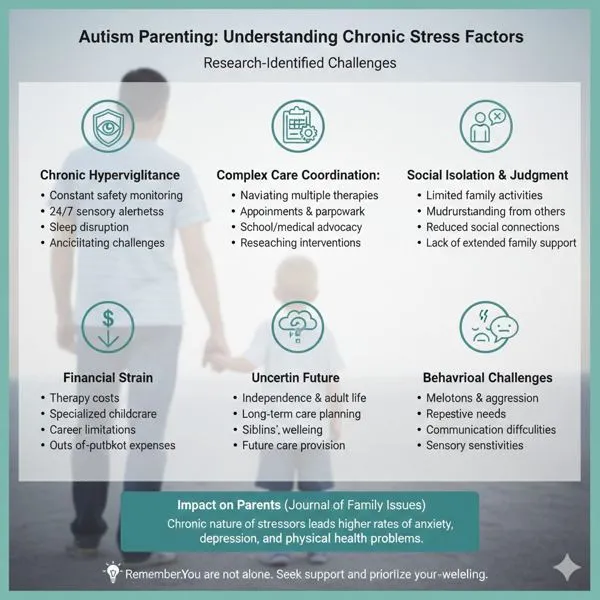
1. Chronic hypervigilance
- Constant monitoring for safety (elopement risks, self-injurious behaviors)
- 24/7 alertness to sensory triggers and meltdown precursors
- Sleep disruption due to a child's sleep difficulties
- Mental load of anticipating and preventing challenges
2. Complex care coordination
- Navigating multiple therapies (speech, occupational, behavioral)
- Managing appointments, insurance, and paperwork
- Advocating within school systems and medical settings
- Researching interventions and making treatment decisions
3. Social isolation and judgment
- Limited participation in typical family activities
- Judgment from others who misunderstand autism behaviors
- Reduced social connections due to time constraints
- Lack of understanding from extended family and friends
4. Financial strain
- Therapy costs not covered by insurance
- Need for specialized childcare or supervision
- Career limitations due to caregiving demands
- Out-of-pocket expenses for interventions and supports
5. Uncertain future
- Worries about a child's independence and adult life
- Concerns about long-term care and financial planning
- Anxiety about siblings' well-being and family dynamics
- Fear about what happens when you're no longer able to provide care
6. Behavioral challenges
- Managing meltdowns, aggression, or self-injury
- Repetitive questions and need for sameness
- Limited communication creating frustration
- Feeding difficulties and sensory sensitivities
Research in Journal of Family Issues notes that the chronic nature of these stressors, with no clear "endpoint," contributes to higher rates of anxiety, depression, and physical health problems among autism parents compared to other parent groups.
What does burnout actually look like in autism parents?
Burnout goes beyond regular tiredness, it's a state of physical, emotional, and mental exhaustion that can significantly impact your functioning and relationships.
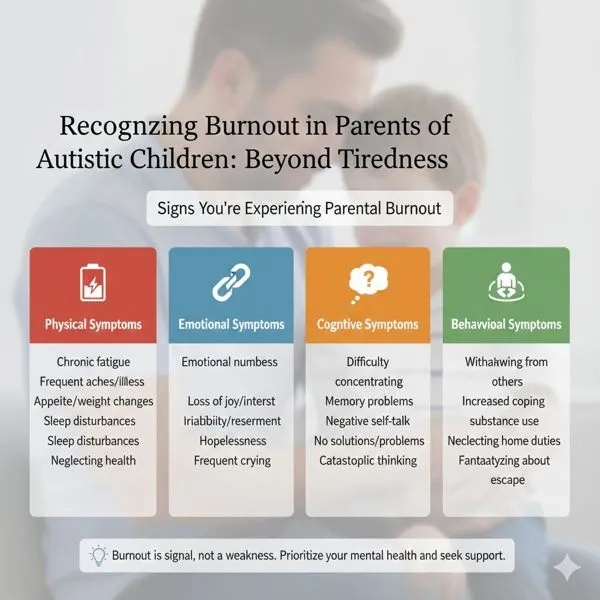
Physical symptoms
- Chronic fatigue that sleep doesn't resolve
- Frequent headaches, body aches, or illness
- Changes in appetite or weight
- Sleep disturbances (insomnia or excessive sleeping)
- Neglecting personal health needs
Emotional symptoms
- Feeling emotionally numb or detached
- Loss of joy in activities that once brought pleasure
- Irritability, anger, or resentment toward family members
- Feelings of hopelessness or depression
- Crying frequently, or inability to cry at all
Cognitive symptoms
- Difficulty concentrating or making decisions
- Memory problems
- Negative self-talk ("I'm a terrible parent")
- Inability to see solutions to problems
- Catastrophic thinking about the future
Behavioral symptoms
- Withdrawing from friends, family, or activities
- Increased use of alcohol, food, or other substances to cope
- Neglecting household responsibilities
- Reduced patience with your child
- Fantasizing about escape or running away
What actually helps parents cope with autism-related stress?
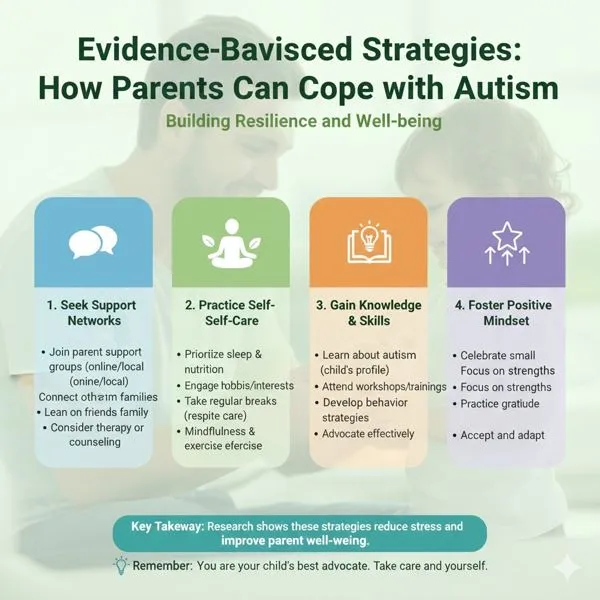
What mindfulness practices work for busy parents?
Research published in Pediatric Medicine shows mindfulness-based interventions significantly reduce autism parenting stress and improve mental health outcomes.
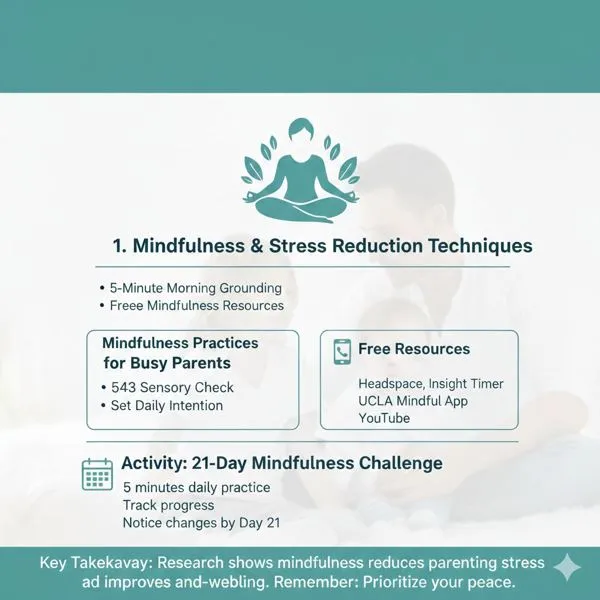
5-minute morning grounding (before your day begins)
Sit & breathe
Sit comfortably, feet on floor. Take 5 deep breaths (inhale 4, hold 4, exhale 6).
Notice 5-4-3
5 things you can see, 4 things you can hear, 3 things you can feel.
Set an intention
"I will be patient" or "I will ask for help" for the day ahead.
Micro-mindfulness throughout the day: while waiting, practice deep breathing instead of scrolling; during transitions, take 3 conscious breaths; at meals, eat one meal mindfully; before bed, a 5-minute body scan to release tension.
Free mindfulness apps
- Headspace (free trial)
- Insight Timer (free, parenting-specific tracks)
- UCLA Mindful App (free)
- YouTube: "Mindfulness for Autism Parents" channels
21-day mindfulness challenge
- Commit to 5 minutes daily
- Track it on a calendar
- 21 days is enough to build a habit
- Notice changes in stress, sleep, and regulation by day 21
How do you build your support network?
Emotional support for autism parents is crucial, no one should navigate this journey alone.
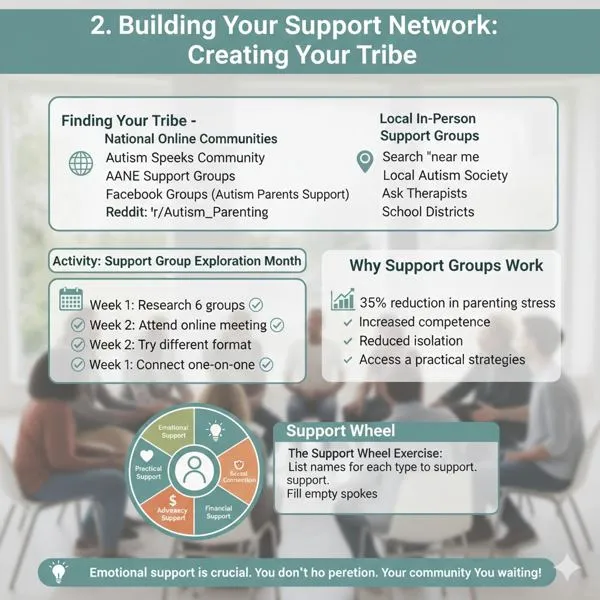
National online communities
- Autism Speaks Community: forums and virtual meetups
- AANE support groups
- Facebook: "Autism Parents Support" and similar groups
- Reddit: r/Autism_Parenting
Local in-person groups
- Search "autism parent support groups near me"
- Contact local Autism Society chapters
- Ask your child's therapists about parent groups
- Check if your school district hosts connection groups
Why support groups work: research shows roughly 35% reduction in parenting stress, increased feelings of competence, reduced isolation and loneliness, access to practical strategies, and validation of experiences.
The support wheel exercise
Draw a wheel with you at the center and 6 spokes: who can you call at 2am when overwhelmed (emotional), who can watch your child for an hour (practical), who has autism resource knowledge (information), who can help navigate schools/insurance (advocacy), what respite/therapy funding resources exist (financial), and who can you be yourself with beyond autism talk (social). List 2-3 names per spoke; where a spoke is empty, identify one step to fill it.
What does respite care actually look like?
Self-care for autism parents includes regular respite, brief breaks from caregiving responsibilities.
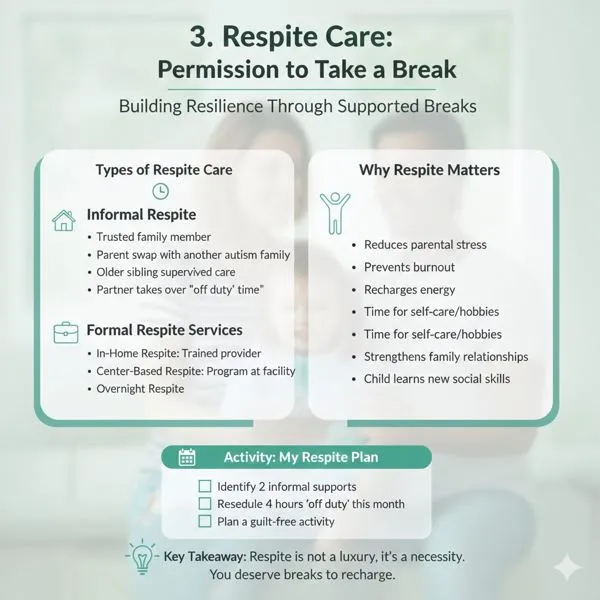
Informal respite
- Trusted family member watches child for 2-4 hours
- Parent swap with another autism family
- Older sibling provides supervised care while you're home
- Partner takes designated "off duty" time
Formal respite services
- In-home respite: trained provider comes to you
- Center-based respite programs
- Autism-friendly camp or recreation programs
- Overnight respite for extended breaks
Finding and funding respite: ARCH National Respite Network, Autism Speaks respite guide, local developmental disability services, Medicaid waiver programs, nonprofit grants, and flexible spending accounts can all help offset the cost.
What does essential self-care look like for autism parents?
Self-care isn't a luxury, it's maintenance. Just as you maintain your car to keep it running, you must maintain yourself to keep functioning.
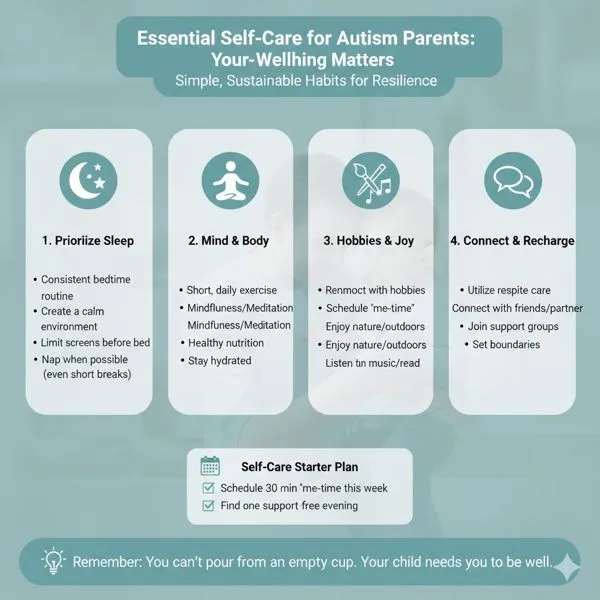
What are the four pillars of parental self-care?
1. Physical self-care
Sleep & nutrition
- Prioritize 7-8 hours, even if interrupted
- Create a bedtime routine for yourself too
- Naps are valid when nighttime sleep is disrupted
- Keep easy healthy snacks accessible; don't skip meals
Exercise & medical care
- Even 10 minutes daily makes a difference
- Walk while your child is at therapy
- Schedule your annual physical and dental visits
- Take prescribed medications consistently
2. Emotional self-care
Types of therapy that help autism parents: individual therapy for grief and stress, Cognitive Behavioral Therapy for anxiety and thought patterns, Acceptance and Commitment Therapy for psychological flexibility, parent coaching, and couples therapy (roughly 80% of autism parents report relationship strain).
Finding affordable therapy: check in-network insurance providers, sliding-scale therapists on directories like Psychology Today, university training clinics, online therapy platforms, and Employee Assistance Programs, which often provide free sessions.
Emotional release practices: journaling for 10 minutes daily, allowing yourself to cry without judgment, talking things through with a trusted friend or therapist, and creative expression through art, music, or dance.
3. Mental self-care
Replace stress-inducing thoughts with balanced alternatives:
Learning, growth, and mental breaks: read for pleasure, learn a new unrelated skill, listen to podcasts, try a 5-minute meditation, a puzzle, music, or simply notice nature or art.
4. Social and spiritual self-care
Reconnect with who you were before your child's diagnosis: what hobbies did you enjoy, what aspects of yourself have you set aside, what dreams got postponed?
Spiritual practices, whatever that means to you: a religious or spiritual community, time in nature, meditation or prayer, gratitude practice, or meaning-making through writing or art.
What daily strategies actually support autism parents?
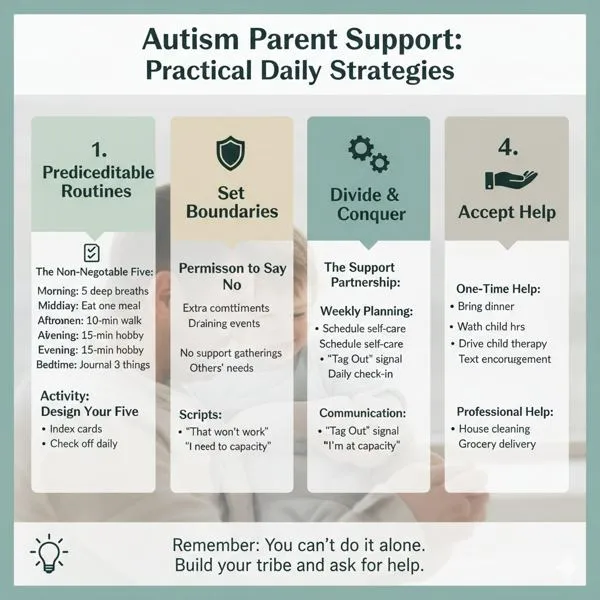
1. Create predictable self-care routines
Just as your child thrives on routine, so do you. Identify 5 daily self-care practices that are non-negotiable, even on the hardest days, for example: 5 deep breaths before getting out of bed, eating one actual meal sitting down, a 10-minute walk or stretch, 15 minutes of something enjoyable, and journaling 3 things that went okay at bedtime.
2. Set boundaries and learn to say no
Give yourself permission to say no to: extra volunteer commitments, social events that drain rather than energize, family gatherings without adequate support, and explaining or justifying your parenting choices.
Simple scripts: "That won't work for our family right now." "I appreciate the invitation, but I need to pass." "I'm at capacity and can't take on anything else." "We're focusing on what's essential right now."
3. Divide and conquer with co-parents
If you have a partner, strategic division of responsibilities prevents burnout. Hold a 15-minute weekly planning meeting (Sunday evening) to review the week's appointments, assign who's "on duty" for challenging times, and schedule each person's self-care time.
Built-in breaks: assign specific "off duty" evenings to each partner, give each a 3-hour weekend block of personal time, and if one uses the other's time, they "owe" a block back. Add a daily 10-minute check-in, a "tag out" signal for when overwhelmed, and a monthly date night, even a virtual one.
4. Accept help and build your help-request skills
Many autism parents struggle to ask for help. Create a specific "help menu" so when someone asks "how can I help?" you have ready answers.
One-time help
- "Bring us dinner Thursday night"
- "Watch my child for 2 hours Saturday so I can nap"
- "Help me organize therapy paperwork"
Ongoing help
- "Drive my child to therapy Tuesdays"
- "Text me daily encouragement"
- "Include us in low-key social activities"
Professional help worth investing in: house cleaning service, lawn care, grocery delivery, meal kit subscriptions, and professional organizing for paperwork.
How do you build long-term resilience?
Resilience isn't bouncing back unchanged, it's adapting and growing through challenges.
1. Cultivate acceptance
Acceptance doesn't mean giving up, it means acknowledging reality without constant resistance. Notice resistance ("I wish this weren't happening"), acknowledge reality ("this IS happening"), then choose a response ("what can I control right now?").
2. Focus on what you can control
The circle of control exercise: inner circle (full control) is your responses, self-care, asking for help, and boundaries. Middle circle (influence) is therapy choices, school communication, and family education. Outer circle (no control) is others' judgments, cure timelines, and others' behaviors. Focus energy on the inner circle, strategize about the middle, release the outer.
3. Practice gratitude without toxic positivity
You can simultaneously feel overwhelmed and grateful for good therapy, grieve lost dreams and celebrate small victories, struggle with behaviors and love your child deeply.
When should you seek professional help?
It's time to reach out to a mental health professional if you're experiencing:
- Persistent hopelessness lasting more than 2 weeks
- Thoughts of harming yourself or your child
- Inability to complete daily tasks
- Substance use to cope
- Complete emotional numbness
- Significant relationship breakdown
- Physical symptoms affecting your health
Professional support options
- Individual or family therapists: process grief, stress, and relationship strain
- Couples counselors: for partnership strain under caregiving pressure
- Parent coaches: practical strategies and emotional support
- Support group facilitators: peer-based, often free or low-cost
Not sure where to start? Talk it through with another parent first.
Book a free 30-min consultationWhat resources actually help with parent mental health?
Online communities and support
- Autism Speaks Community (autismspeaks.org/community): online forums and virtual meetups
- AANE (aane.org): support groups and resources
- Autism Society Parent to Parent (autism-society.org)
- Postpartum Support International (postpartum.net): not just for postpartum parents
- 7 Cups (7cups.com): free emotional support chat
Books for autism parent wellness
- Differently Wired by Deborah Reber
- Peaceful Parent, Happy Kids by Dr. Laura Markham
- The Self-Compassion Workbook by Kristin Neff
- Raising Human Beings by Ross Greene
Apps for mental health and organization
Stress management
- Calm (premium): meditation and sleep stories
- Headspace (premium): mindfulness for parents
- Breathe2Relax (free): breathing exercises
- Sanvello (free/premium): mood tracking and CBT tools
Reducing mental load
- Cozi (free): shared family calendar and lists
- Notion (free): customizable planning system
- Google Keep (free): quick notes and reminders
How do you build a 30-day wellness plan?

Week 1: track stress daily (1-10), note triggers, identify top 3 stressors, join one support group. Week 2: establish your Non-Negotiable Five, schedule one respite period, begin 5-minute daily mindfulness, reach out to one supportive person. Week 3: add 10 minutes of exercise 3x, start a gratitude + challenge journal, delegate or eliminate one responsibility, practice saying "no" once. Week 4: review and adjust, celebrate what's working, problem-solve barriers, and plan next month's focus.
Key takeaways
- You are doing better than you think, reading this shows you care and are seeking solutions
- Self-care isn't selfish, a depleted parent cannot effectively care for anyone
- Progress isn't linear, some days just breathing counts as success
- You don't have to do this alone, support exists, and reaching for it is strength
Questions parents ask about mental health and support
What are the signs of burnout in parents of autistic children?
Signs include chronic fatigue sleep doesn't fix, feeling emotionally numb or detached, irritability toward family members, difficulty concentrating or making decisions, withdrawing from friends and activities, and reduced patience with your child. Research shows burnout affects up to 70% of autism parents at some point.
Is it okay to feel guilty and still use respite care?
Yes, guilt is common but shouldn't stop you from using respite. Taking a break isn't abandoning your child, it's ensuring you can be the best parent possible, and your child also benefits from experiencing other caring adults.
How can I find affordable therapy as an autism parent?
Options include checking in-network insurance providers, sliding-scale therapists on directories like Psychology Today, university training clinics with supervised students, online therapy platforms, and Employee Assistance Programs, which often provide free sessions.
How do I stop feeling guilty about setting boundaries with family and friends?
Remember that saying no protects your limited energy so you can show up for what matters most. Simple, brief scripts help, and no lengthy justification is needed.
How can co-parents divide responsibilities without one person burning out?
Hold a short weekly planning meeting to review the week's appointments, assign who is on duty during difficult times, and schedule built-in off-duty blocks for each partner. A simple tag-out signal when overwhelmed also helps hand off care without judgment.
When should an autism parent seek professional mental health help?
Reach out to a mental health professional if you experience persistent hopelessness lasting more than two weeks, thoughts of harming yourself or your child, inability to complete daily tasks, using substances to cope, complete emotional numbness, or significant relationship breakdown.
Related Reading: Diagnosis & Genetics
Final thoughts: you are enough
Parenting an autistic child doesn't have to mean sacrificing your own mental health. Managing parenting stress, preventing burnout, accessing emotional support, and using daily coping strategies are not optional, they're essential.
You are doing better than you think. Self-care isn't selfish. Progress isn't linear. You don't have to do this alone. And your worth isn't measured by your child's progress, you are valuable simply because you exist.
Start small. Choose one strategy from this guide to implement this week. Just one. Then next week, add another. Small, consistent steps create lasting change.