
Jump to Section 👉
- You Are Not Alone in This Journey
- Why Is Parenting an Autistic Child More Stressful?
- Signs of Burnout in Parents of Autistic Children
- How Parents Can Cope with Autism?
- Mindfulness Practices for Busy Parents
- Essential Self Care for Autism Parents
- The Four Pillars of Parental Self-Care
- Autism Parent Support Tips: Practical Daily Strategies
- Building Resilience: Long-Term Strategies for Thriving
- Resources for Parent Mental Health & Support
- 30-Day Parent Wellness Challenge
Introduction: You Are Not Alone in This Journey
Parenting an autistic child is one of the most rewarding yet challenging experiences you’ll ever face. While the love you have for your child is limitless, the daily demands of providing care, navigating systems, advocating for needs, and managing behaviors can leave you exhausted, overwhelmed, and questioning your own capacity.
If you’re feeling stressed, burned out, or emotionally depleted—you’re not alone. Research consistently shows that parents of autistic children experience significantly higher levels of autism parenting stress compared to parents of neurotypical children or even children with other developmental disabilities. Studies published in Clinical Child and Family Psychology Review reveal that burnout in parents of autistic children affects up to 70% of families at some point in their journey.
But here’s the crucial truth: taking care of yourself is not selfish—it’s essential. Your well-being directly impacts your child’s well-being. This comprehensive guide provides evidence-based strategies for emotional support for autism parents, practical tips on how parents can cope with autism, essential self care for autism parents, and actionable autism parent support tips to help you not just survive, but thrive.

Understanding Autism Parenting Stress: The Research Reality
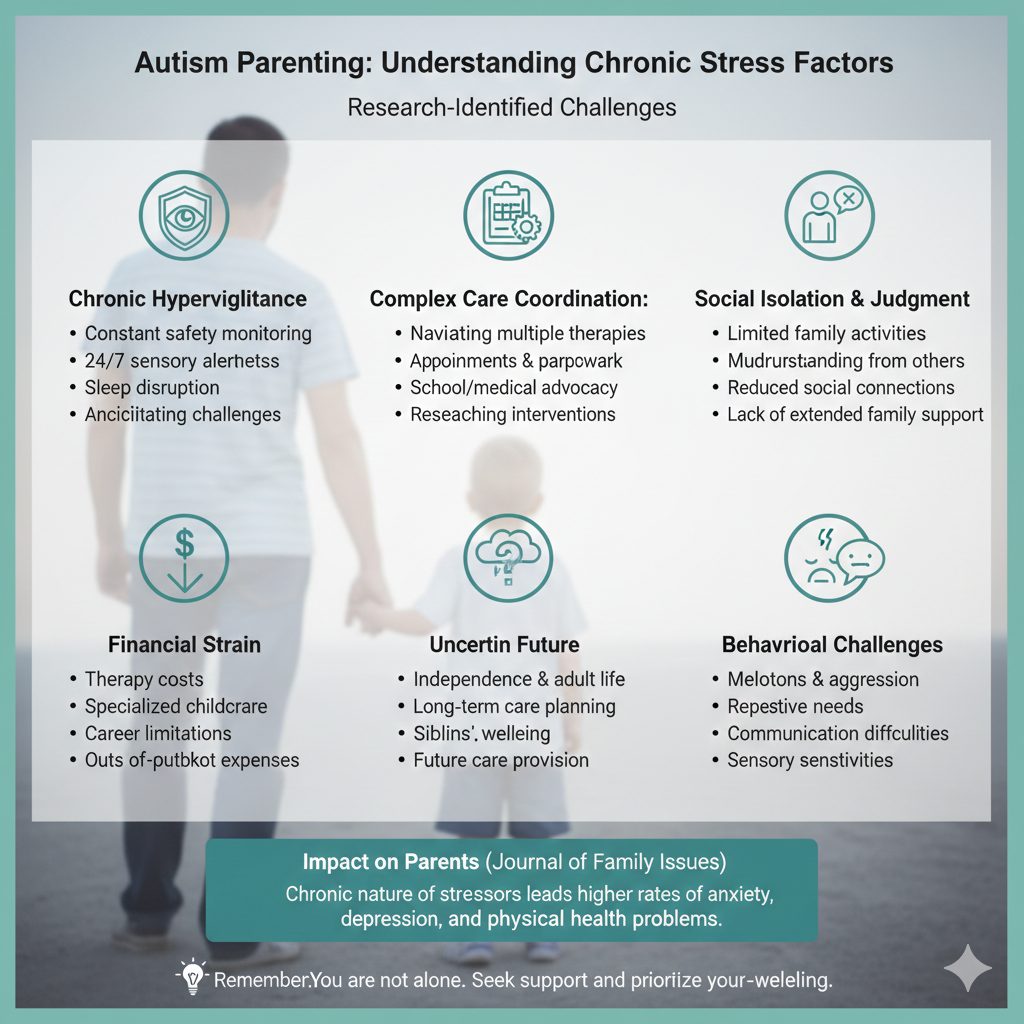
Why Is Parenting an Autistic Child More Stressful?
Understanding the sources of stress is the first step toward managing it effectively.
Research-Identified Stress Factors:
1. Chronic Hypervigilance
- Constant monitoring for safety (elopement risks, self-injurious behaviors)
- 24/7 alertness to sensory triggers and meltdown precursors
- Sleep disruption due to child’s sleep difficulties
- Mental load of anticipating and preventing challenges
2. Complex Care Coordination
- Navigating multiple therapies (speech, occupational, behavioral)
- Managing appointments, insurance, and paperwork
- Advocating within school systems and medical settings
- Researching interventions and making treatment decisions
3. Social Isolation and Judgment
- Limited participation in typical family activities
- Judgment from others who misunderstand autism behaviors
- Reduced social connections due to time constraints
- Lack of understanding from extended family and friends
4. Financial Strain
- Therapy costs not covered by insurance
- Need for specialized childcare or supervision
- Career limitations due to caregiving demands
- Out-of-pocket expenses for interventions and supports
5. Uncertain Future
- Worries about child’s independence and adult life
- Concerns about long-term care and financial planning
- Anxiety about siblings’ well-being and family dynamics
- Fear about what happens when you’re no longer able to provide care
6. Behavioral Challenges
- Managing meltdowns, aggression, or self-injury
- Repetitive questions and need for sameness
- Limited communication creating frustration
- Feeding difficulties and sensory sensitivities
According to research in Journal of Family Issues, the chronic nature of these stressors—with no clear “endpoint”—contributes to higher rates of anxiety, depression, and physical health problems among autism parents compared to other parent groups.
Recognizing Burnout in Parents of Autistic Children
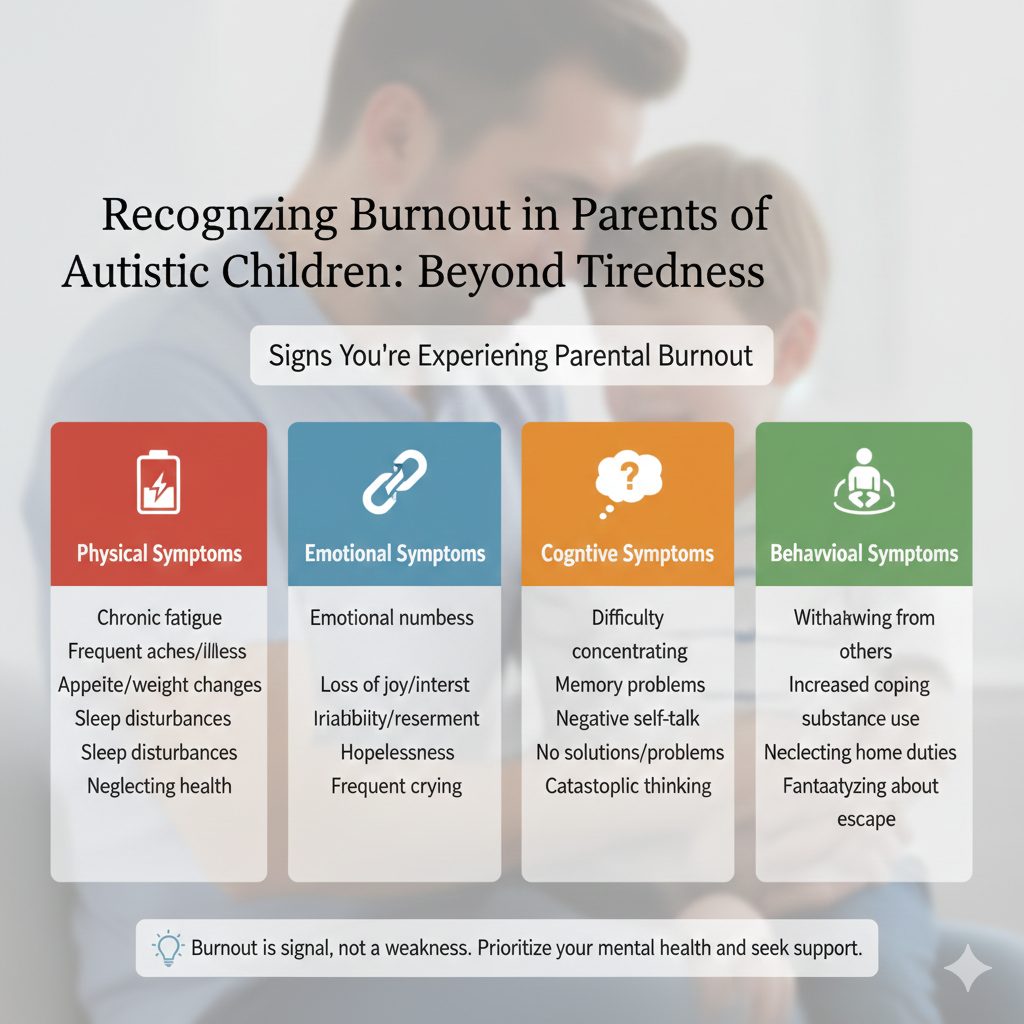
Burnout goes beyond regular tiredness—it’s a state of physical, emotional, and mental exhaustion that can significantly impact your functioning and relationships.
Signs You’re Experiencing Parental Burnout:
Physical Symptoms:
- Chronic fatigue that sleep doesn’t resolve
- Frequent headaches, body aches, or illness
- Changes in appetite or weight
- Sleep disturbances (insomnia or excessive sleeping)
- Neglecting personal health needs
Emotional Symptoms:
- Feeling emotionally numb or detached
- Loss of joy in activities that once brought pleasure
- Irritability, anger, or resentment toward family members
- Feelings of hopelessness or depression
- Crying frequently or inability to cry at all
Cognitive Symptoms:
- Difficulty concentrating or making decisions
- Memory problems
- Negative self-talk (“I’m a terrible parent”)
- Inability to see solutions to problems
- Catastrophic thinking about the future
Behavioral Symptoms:
- Withdrawing from friends, family, or activities
- Increased use of alcohol, food, or other substances to cope
- Neglecting household responsibilities
- Reduced patience with your child
- Fantasizing about escape or running away
If you’re experiencing several of these symptoms, it’s time to prioritize your mental health. Burnout isn’t a sign of weakness—it’s a signal that you need support.
Evidence-Based Strategies: How Parents Can Cope with Autism
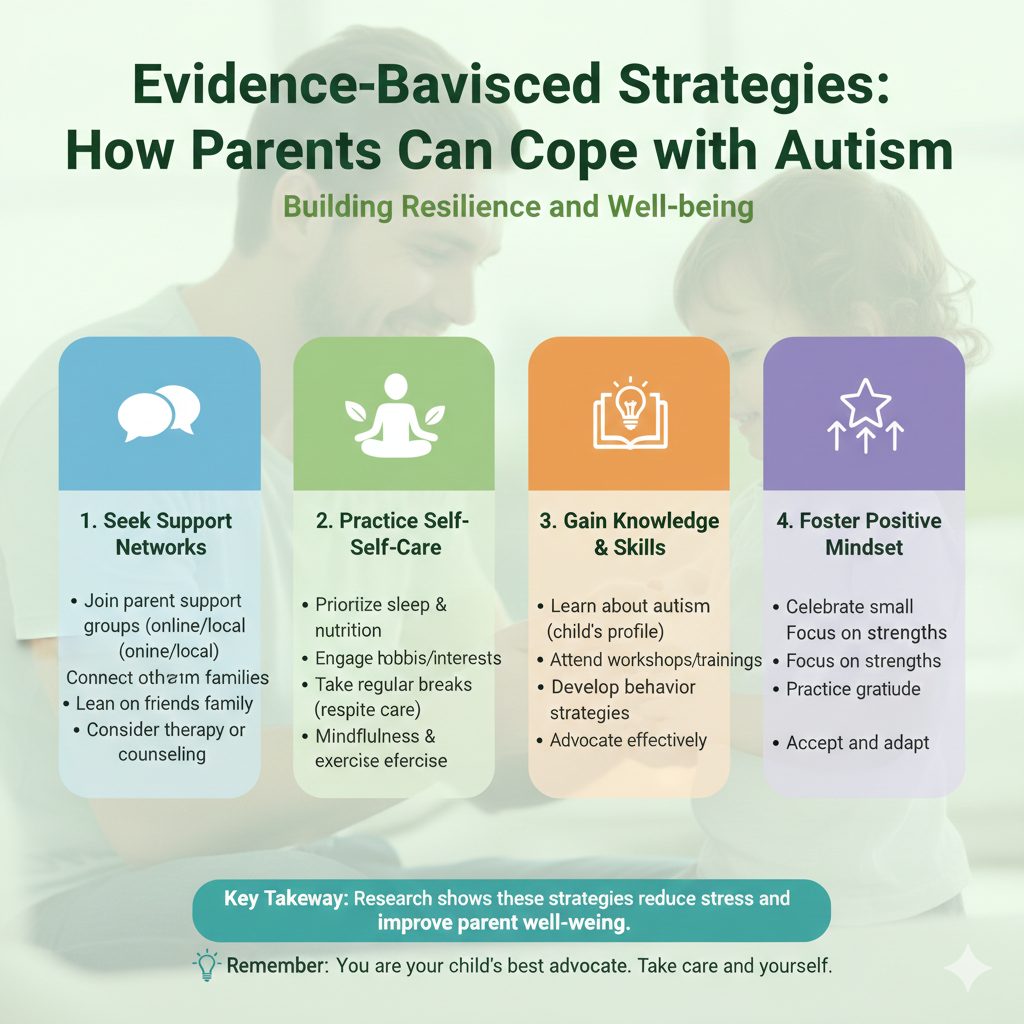
1. Mindfulness and Stress Reduction Techniques
Research published in Pediatric Medicine shows that mindfulness-based interventions significantly reduce autism parenting stress and improve mental health outcomes.
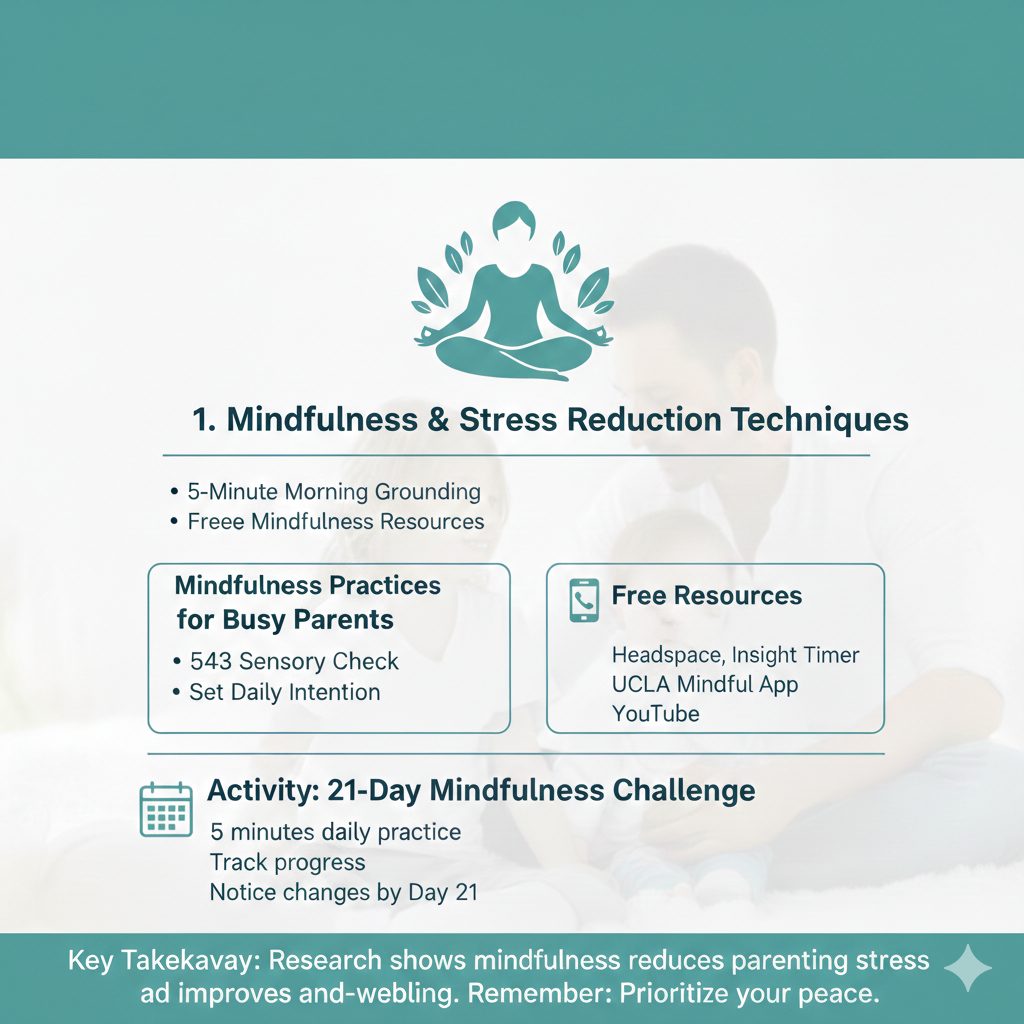
Mindfulness Practices for Busy Parents:
5-Minute Morning Grounding (Before Your Day Begins):
- Sit comfortably with feet on floor
- Take 5 deep breaths (inhale for 4, hold for 4, exhale for 6)
- Notice 5 things you can see
- Notice 4 things you can hear
- Notice 3 things you can feel (texture, temperature)
- Set one intention for the day: “I will be patient” or “I will ask for help”
Micro-Mindfulness Throughout the Day:
- While waiting: Instead of scrolling phone, practice deep breathing
- During transitions: Take 3 conscious breaths before moving to next task
- At meals: Eat one meal mindfully, noticing flavors and textures
- Before bed: 5-minute body scan to release tension
Free Mindfulness Resources for Autism Parents:
- Headspace (free trial): Guided meditations designed for parents
- Insight Timer (free): Thousands of guided meditations, including parenting-specific ones
- UCLA Mindful App (free): Research-based mindfulness exercises
- YouTube: “Mindfulness for Autism Parents” channels with 5-10 minute sessions
Activity: 21-Day Mindfulness Challenge
Commit to just 5 minutes daily of mindfulness practice. Track on a calendar. Research shows 21 days creates a habit. Notice changes in your stress response, sleep quality, and emotional regulation by day 21.
2. Building Your Support Network
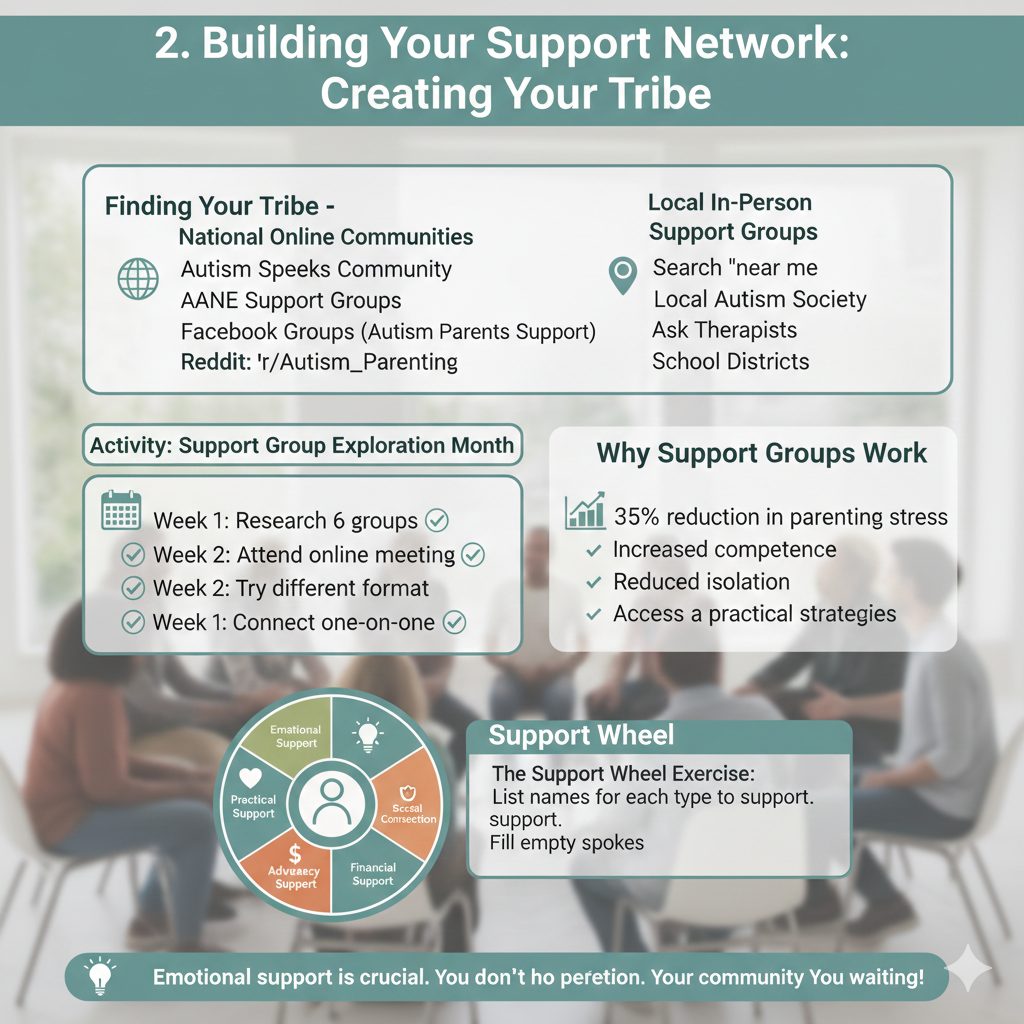
Emotional support for autism parents is crucial—no one should navigate this journey alone.
Creating Your Support Circle:
Finding Your Tribe – Autism Parent Support Groups:
National Online Communities:
- Autism Speaks Community (autismspeaks.org/community): Online forums and virtual meetups
- AANE Support Groups (aane.org): Groups specifically for parents of autistic children
- Facebook Groups: “Autism Parents Support” (100K+ members), “Autism Inclusivity”
- Reddit: r/Autism_Parenting (supportive community with daily discussions)
Local In-Person Support Groups:
- Search “autism parent support groups near me”
- Contact local autism organizations (Autism Society chapters)
- Ask your child’s therapists about parent support groups
- School districts often host parent connection groups
Activity: Support Group Exploration Month
- Week 1: Research 3 online and 3 local groups
- Week 2: Attend your first online group meeting (lower pressure)
- Week 3: Try a different format (coffee meetup, structured group, etc.)
- Week 4: Connect one-on-one with one parent you relate to
Why Support Groups Work:
Research shows that parents who participate in support groups experience:
- 35% reduction in parenting stress
- Increased feelings of competence and empowerment
- Reduced isolation and loneliness
- Access to practical strategies from experienced parents
- Validation of their experiences and emotions
Building Your Personal Support Network:
The Support Wheel Exercise:
Draw a wheel with you at the center and 6 spokes representing different types of support:
- Emotional Support: Who can you call at 2 AM when you’re overwhelmed?
- Practical Support: Who can watch your child for an hour?
- Information Support: Who has knowledge about autism resources/strategies?
- Advocacy Support: Who can help navigate schools/insurance?
- Financial Support: Resources for respite care, therapy costs
- Social Connection: Who can you be yourself with, beyond autism talk?
For each spoke, list 2-3 names. If spokes are empty, identify steps to fill them (join support group, reconnect with old friend, reach out to family member).
3. Respite Care: Permission to Take a Break
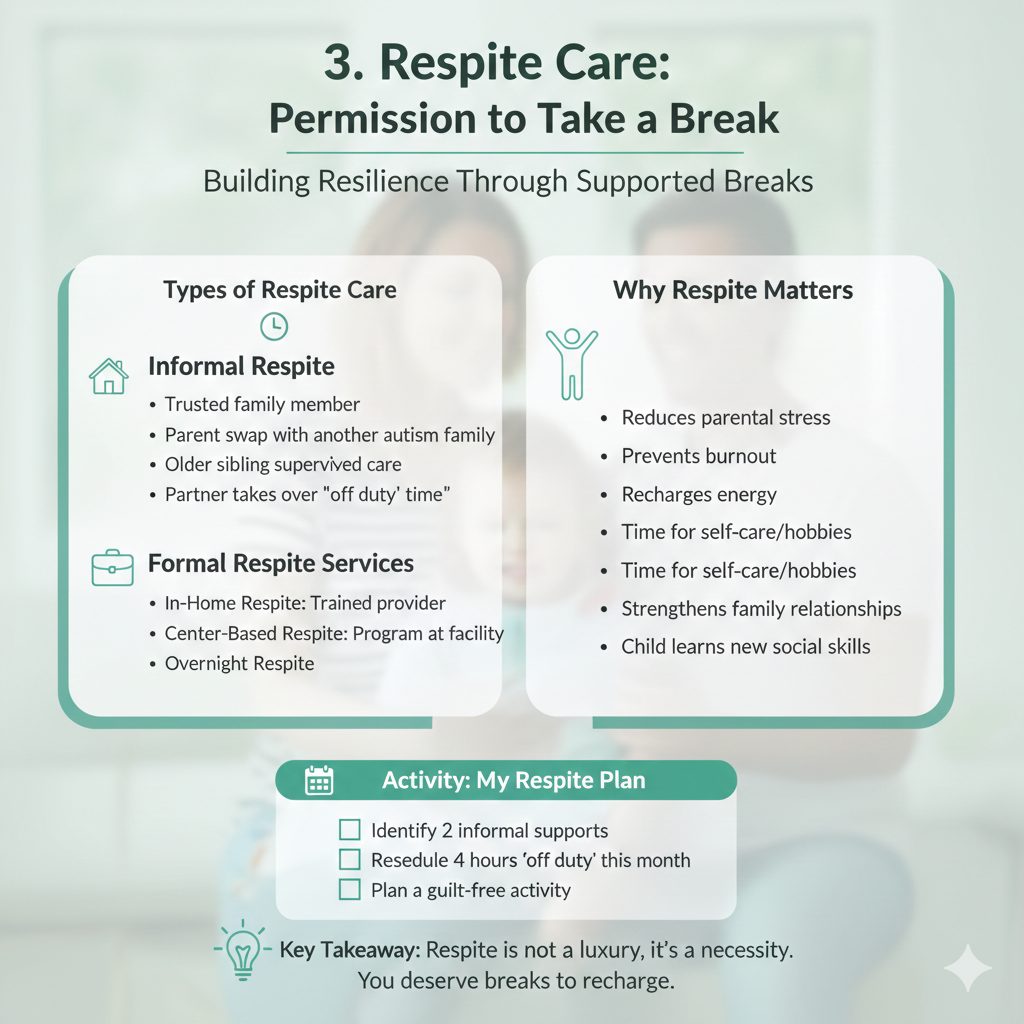
Self care for autism parents includes regular respite—brief breaks from caregiving responsibilities.
Types of Respite Care:
Informal Respite:
- Trusted family member watches child for 2-4 hours
- Parent swap with another autism family
- Older sibling provides supervised care while you’re home
- Partner takes over for designated “off duty” time
Formal Respite Services:
- In-Home Respite: Trained provider comes to your home
- Center-Based Respite: Child attends program at facility
- Camp or Recreation Programs: Autism-friendly activities providing parent break
- Overnight Respite: Extended care allowing parents full day/night off
Finding Respite Care:
Resources to Explore:
- ARCH National Respite Network (archrespite.org): State-by-state respite locator
- Autism Speaks Resource Guide (autismspeaks.org/respite-care): Comprehensive respite information
- Local Developmental Disability Services: Often provide respite funding
- Medicaid Waiver Programs: Many cover respite services
- Area Agency on Aging: Sometimes offers family caregiver respite programs
Financial Assistance for Respite:
- State Medicaid waivers
- Family support subsidies
- Nonprofit grants (Autism Care Today, ACT Today!)
- Flexible Spending Accounts (FSA) for dependent care
Overcoming Respite Guilt:
Many parents feel guilty using respite. Reframe this thinking:
- ❌ “I’m abandoning my child”
- ✅ “I’m ensuring I’m the best parent I can be”
- ❌ “No one can care for them like I can”
- ✅ “My child benefits from experiencing other caring adults”
- ❌ “Taking a break is selfish”
- ✅ “Self-care prevents burnout and models healthy boundaries”
Activity: Schedule Your First Respite
This week, commit to scheduling just 2 hours of respite. Use this time for something restorative (not errands!):
- Massage or spa treatment
- Coffee with a friend
- Walk in nature alone
- Reading a book uninterrupted
- Exercise class
- Simply sleeping
Essential Self Care for Autism Parents
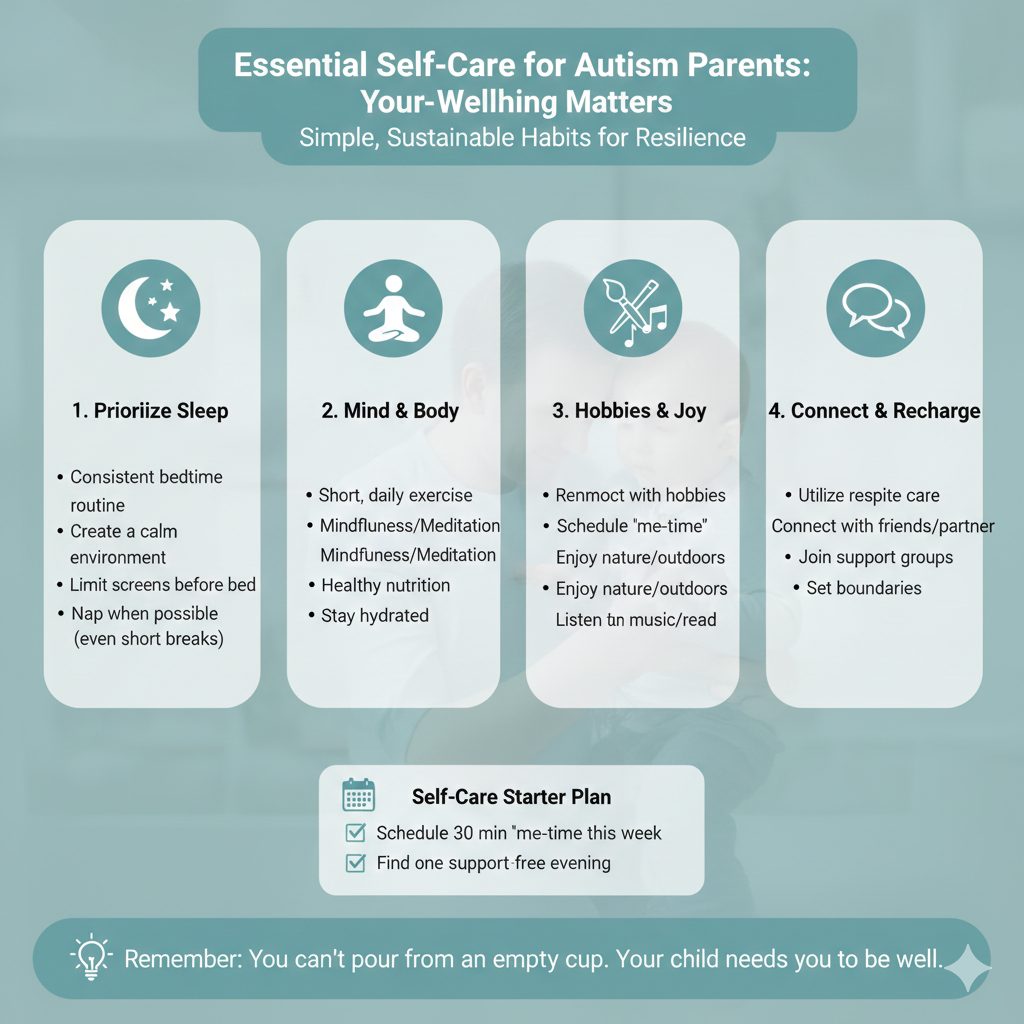
Self-care isn’t luxury—it’s maintenance. Just as you maintain your car to keep it running, you must maintain yourself to keep functioning.
The Four Pillars of Parental Self-Care
1. Physical Self-Care
Sleep:
- Prioritize 7-8 hours even if quality is interrupted
- Create bedtime routine (yes, even for adults!)
- Consider sleep shifts with partner if child has sleep issues
- Naps are valid when nighttime sleep is disrupted
Nutrition:
- Keep easy, healthy snacks accessible (nuts, fruit, protein bars)
- Meal prep on less stressful days
- Don’t skip meals even when busy
- Stay hydrated (keep water bottle with you)
Exercise:
- Even 10 minutes daily makes a difference
- Walk while child is at therapy
- YouTube home workouts during screen time
- Exercise as sensory regulation for YOU
Medical Care:
- Schedule annual physical exam
- Don’t skip dental appointments
- Address health concerns promptly
- Take prescribed medications consistently
Activity: Physical Self-Care Starter Kit
This week, implement ONE item from each category:
- Sleep: Set phone alarm for bedtime (30 min before target sleep time)
- Nutrition: Prep 5 healthy grab-and-go snacks Sunday evening
- Exercise: Commit to 10-minute walk 3x this week
- Medical: Schedule one overdue appointment
2. Emotional Self-Care
Therapy and Counseling:
Types of Therapy Beneficial for Autism Parents:
- Individual Therapy: Process grief, stress, relationship challenges
- Cognitive Behavioral Therapy (CBT): Manage anxiety and negative thought patterns
- Acceptance and Commitment Therapy (ACT): Build psychological flexibility
- Parent Coaching: Practical strategies and emotional support
- Couples Therapy: Strengthen partnership under stress (80% of autism parents report relationship strain)
Finding Affordable Therapy:
- Insurance coverage (check in-network providers)
- Sliding scale therapists (Psychology Today directory)
- University training clinics (lower cost, supervised students)
- Online therapy platforms (BetterHelp, Talkspace)
- Employee Assistance Programs (EAP): Often provide free sessions
- Support groups (free alternative to individual therapy)
Emotional Release Practices:
- Journaling: 10 minutes daily brain dump
- Crying: Allow yourself to cry without judgment
- Talking: Process emotions with trusted friend or therapist
- Creative Expression: Art, music, dance as emotional outlet
3. Mental Self-Care
Cognitive Reframing:
Replace stress-inducing thoughts with balanced alternatives:
Common Cognitive Distortions in Autism Parents:
| Distorted Thought | Reframed Thought |
|---|---|
| “I should be able to handle this better” | “I’m doing the best I can with extremely challenging circumstances” |
| “Other parents don’t struggle like this” | “Every parent has struggles; mine are just more visible” |
| “I’m failing my child” | “I’m showing up every day and that’s what matters” |
| “This will never get easier” | “Challenges change over time; this phase will pass” |
| “I should be doing more therapies” | “I’m doing what’s sustainable for our family” |
Learning and Growth:
- Read for pleasure (not just autism books!)
- Learn new skill unrelated to autism
- Engage intellectually with podcasts or documentaries
- Take online course in area of interest
Mental Breaks:
- 5-minute meditation
- Puzzle or game
- Listening to music
- Looking at nature or art
4. Social and Spiritual Self-Care
Maintaining Your Identity Beyond “Autism Parent”:
Reconnect with Pre-Parent Self:
- What hobbies did you enjoy before your child’s diagnosis?
- What aspects of yourself have you set aside?
- What dreams or goals got postponed?
Activity: Identity Reclamation Project
Make two lists:
- Who I Was: Interests, hobbies, personality traits, goals
- Who I Am Now: Current realities, new skills, evolved perspectives
Identify 3 items from “Who I Was” to reintegrate into “Who I Am Now” in adapted form.
Example:
- Was: Marathon runner → Now: 20-minute neighborhood walks 3x/week
- Was: Book club member → Now: Audiobooks during therapy wait times
- Was: Amateur photographer → Now: Phone photography project with child
Spiritual Practices (Whatever That Means to You):
- Religious or spiritual community connection
- Time in nature
- Meditation or prayer
- Gratitude practice
- Meaning-making through writing or art
Autism Parent Support Tips: Practical Daily Strategies
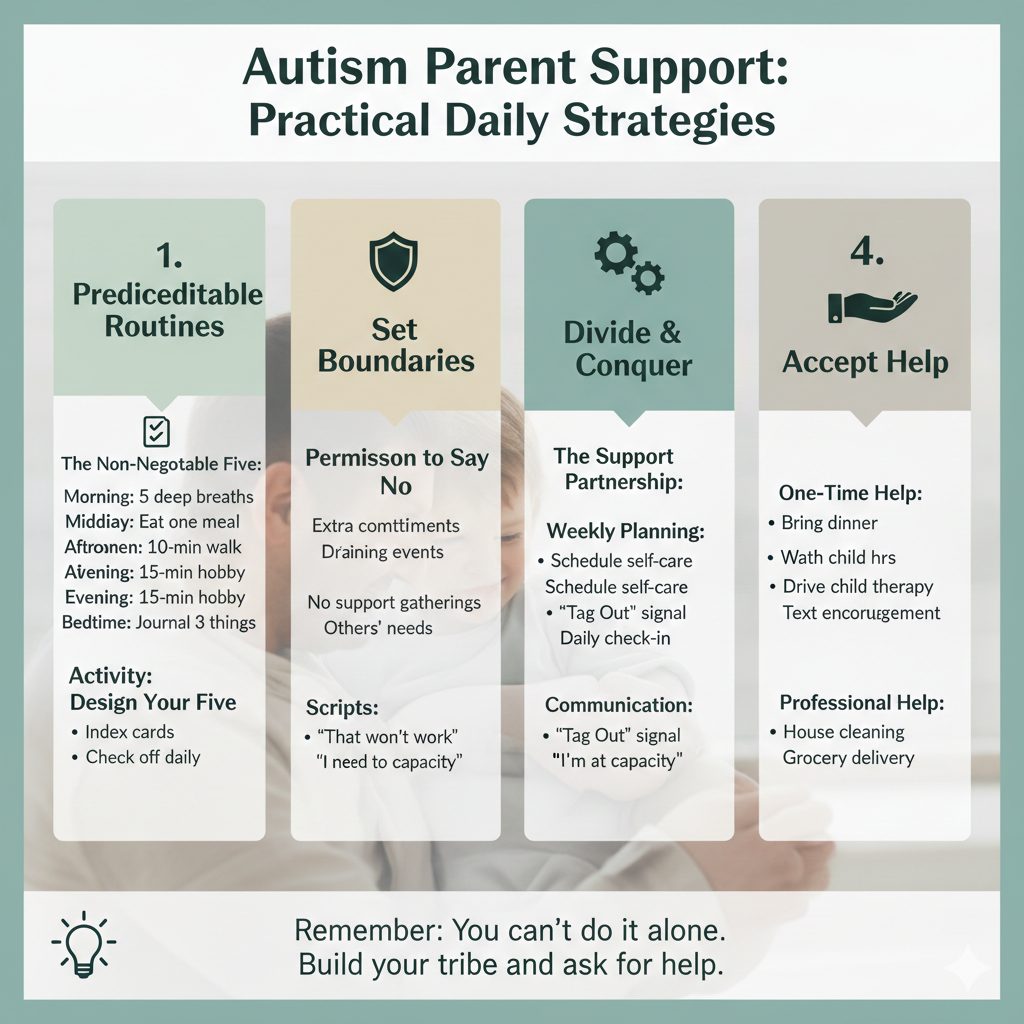
1. Create Predictable Self-Care Routines
Just as your child thrives on routine, so do you.
The Non-Negotiable Five:
Identify 5 daily self-care practices that are NON-NEGOTIABLE, even on hardest days:
Example set:
- Morning: 5 deep breaths before getting out of bed
- Midday: Eat one actual meal sitting down
- Afternoon: 10-minute walk or stretch
- Evening: 15 minutes of something enjoyable (read, hobby, bath)
- Bedtime: Journal 3 things that went okay (not perfect, just okay)
Activity: Design Your Non-Negotiable Five
Write your 5 practices on index cards. Place where you’ll see them daily (bathroom mirror, refrigerator). Check off each day for one week.
2. Set Boundaries and Learn to Say No
Autism parent support tips include protecting your limited energy.
Permission to Say No:
- Extra volunteer commitments
- Social events that drain rather than energize
- Family gatherings without adequate support
- Activities that primarily serve others’ needs
- Explaining or justifying your parenting choices
Scripts for Saying No:
- “That won’t work for our family right now.”
- “I appreciate the invitation, but I need to pass.”
- “I’m at capacity and can’t take on anything else.”
- “We’re focusing on what’s essential right now.”
- “That doesn’t fit with our current priorities.”
3. Divide and Conquer with Co-Parents
If you have a partner, strategic division of responsibilities prevents burnout.
The Support Partnership Agreement:
Weekly Planning Meeting (15 minutes Sunday evening):
- Review upcoming week’s appointments
- Assign who’s “on duty” for challenging times
- Schedule each person’s self-care time
- Identify where outside help is needed
Built-In Breaks:
- Partner A: Monday/Wednesday evenings “off duty” (6-8pm)
- Partner B: Tuesday/Thursday evenings “off duty”
- Weekends: Each gets 3-hour block of personal time
- Trade: If one person uses the other’s off time, they “owe” an extra block
Communication Agreements:
- Daily 10-minute check-in (how are YOU doing?)
- “Tag out” signal when overwhelmed (hand off without judgment)
- Monthly date night (even virtual/at-home counts)
- Acknowledge each other’s efforts weekly
4. Accept Help and Build Your Help Request Skills
Many autism parents struggle to ask for help. Practice makes this easier.
The Help Menu:
Create a specific list of tasks others can help with. When someone asks “How can I help?” you have ready answers:
One-Time Help:
- “Bring us dinner Thursday night”
- “Watch my child for 2 hours Saturday so I can nap”
- “Help me organize therapy paperwork”
Ongoing Help:
- “Drive my child to therapy Tuesdays”
- “Text me daily encouragement”
- “Include us in low-key social activities”
Professional Help Worth Investing In:
- House cleaning service (monthly or quarterly)
- Lawn care or yard maintenance
- Grocery delivery
- Meal kit subscriptions
- Professional organizing for paperwork
Building Resilience: Long-Term Strategies for Thriving
Resilience isn’t bouncing back unchanged—it’s adapting and growing through challenges.
Resilience-Building Practices
1. Cultivate Acceptance
Acceptance doesn’t mean giving up—it means acknowledging reality without constant resistance.
Acceptance and Commitment Therapy (ACT) Principles:
- Accept thoughts and feelings without trying to change them
- Choose valued directions (what matters to you?)
- Take committed action aligned with values
Acceptance Practice:
Notice resistance: “I wish this weren’t happening”
Acknowledge reality: “This IS happening”
Choose response: “What can I control right now?”
2. Focus on What You Can Control
Circle of Control Exercise:
Draw three circles:
- Inner circle (Full Control): Your responses, self-care, asking for help, boundaries
- Middle circle (Influence): Therapy choices, school communication, family education
- Outer circle (No Control): Others’ judgments, cure timeline, others’ behaviors
Focus energy on inner circle. Strategize about middle circle. Release outer circle.
3. Practice Gratitude Without Toxic Positivity
You can simultaneously:
- Feel overwhelmed AND grateful for good therapy
- Grieve lost dreams AND celebrate small victories
- Struggle with behaviors AND love your child deeply
Realistic Gratitude Practice:
Daily note 3 things: 1 challenge (validating difficulty) + 2 small positives (noticing light)
Example:
- Challenge: “Rough morning meltdown exhausted me”
- Positive: “Got child to school anyway—we’re resilient”
- Positive: “Friend texted check-in; felt supported”
When to Seek Professional Help
It’s time to reach out to a mental health professional if you’re experiencing:
- Persistent hopelessness lasting more than 2 weeks
- Thoughts of harming yourself or your child
- Inability to complete daily tasks
- Substance use to cope
- Complete emotional numbness
- Significant relationship breakdown
- Physical symptoms affecting health
There is no shame in needing professional support. Reaching out is strength, not weakness.
Resources for Parent Mental Health & Support
Online Communities and Support
Autism-Specific Parent Support:
- Autism Speaks Community (autismspeaks.org/community)
- AANE (aane.org): Support groups and resources
- Autism Society Parent to Parent (autism-society.org)
- The Autism Cafe Facebook Group: Peer support community
General Parenting Mental Health:
- Postpartum Support International (postpartum.net): Not just postpartum!
- NAMI Family Support Groups (nami.org)
- 7 Cups (7cups.com): Free emotional support chat
Books for Autism Parent Wellness
- “Differently Wired” by Deborah Reber
- “Peaceful Parent, Happy Kids” by Dr. Laura Markham
- “The Self-Compassion Workbook” by Kristin Neff
- “Raising Human Beings” by Ross Greene
- “Joy Fix for Weary Parents” by Lindsey Horner
Apps for Mental Health
Stress Management:
- Calm (premium subscription): Meditation and sleep stories
- Headspace (premium subscription): Mindfulness for parents
- Breathe2Relax (free): Breathing exercises
- Sanvello (free/premium): Mood tracking and CBT tools
Organization to Reduce Mental Load:
- Cozi (free): Shared family calendar and lists
- Notion (free): Customizable planning system
- Google Keep (free): Quick notes and reminders
Creating Your Personal Wellness Plan

30-Day Parent Wellness Challenge
Week 1: Awareness
- Track stress levels daily (1-10 scale)
- Note triggers and patterns
- Identify top 3 stressors
- Join one support group (online or in-person)
Week 2: Foundation
- Establish Non-Negotiable Five practices
- Schedule one respite period
- Begin 5-minute daily mindfulness
- Reach out to one supportive person
Week 3: Building
- Add 10 minutes exercise 3x
- Start gratitude + challenge journal
- Delegate or eliminate one responsibility
- Practice saying “no” once
Week 4: Sustaining
- Review and adjust practices
- Celebrate what’s working
- Problem-solve barriers
- Plan next month’s self-care focus
Conclusion: You Are Enough
Parenting an autistic child doesn’t have to mean sacrificing your own mental health. Managing autism parenting stress, preventing burnout in parents of autistic children, accessing emotional support for autism parents, learning how parents can cope with autism, implementing self care for autism parents, and using autism parent support tipsare not optional—they’re essential.
Remember these truths:
✨ You are doing better than you think. The fact that you’re reading this shows you care and are seeking solutions.
✨ Self-care isn’t selfish. A depleted parent cannot effectively care for anyone.
✨ Progress isn’t linear. Some days you’ll implement all strategies; other days just breathing counts as success.
✨ You don’t have to do this alone. Support exists; reaching for it is strength.
✨ Your worth isn’t measured by your child’s progress. You are valuable simply because you exist.
Start small. Choose ONE strategy from this guide to implement this week. Just one. Then next week, add another. Small, consistent steps create lasting change.
Your Action Plan This Week
Choose one from each category:
☐ Emotional: Join one autism parent support group or schedule therapy consultation
☐ Physical: Implement one Non-Negotiable Five practice daily
☐ Social: Reach out to one person for connection
☐ Practical: Schedule 2 hours of respite
You’ve got this. And on days when you don’t feel like you’ve got this—that’s okay too. We’re here, and we understand.
Connect with Our Community
Visit futureforautism for:
- Free downloadable: “Self-Care for Autism Parents Toolkit”
- Monthly virtual parent support meetups
- Personal wellness planning templates
- Connection with other parents on the same journey
Related Articles:
- Communication & Behavior Support in Autism
- School & Learning Support in Autism
- Building Your Autism Support Team
Download Your Free Resources:
- Self-Care Tracking Calendar
- Respite Resource Directory
- Support Group Finder Guide
- Emergency Self-Care Plan Template