
Providing effective learning support at home can transform your child's educational experience and unlock their full potential. Whether you're supplementing traditional schooling, exploring homeschooling, or supporting your child through learning difficulties, evidence-based strategies make the difference.
Approximately 70% of autistic children face learning challenges that require specialized support approaches. With the right strategies, structured environment, and consistent implementation, every autistic child can thrive academically and develop essential life skills.

Why does your child's learning profile matter more than a generic curriculum?
Autistic children often have distinctive learning profiles, exceptional strengths alongside specific challenges. Understanding this profile is the foundation of effective home learning support, and it's the reason a one-size curriculum so often falls flat.
What does your child's autism learning profile actually look like?
What are your child's common learning strengths?
- Visual learning excellence: many autistic children are strong visual processors who learn best through pictures, diagrams, and written information
- Detail-oriented processing: exceptional ability to notice patterns, details, and systematic approaches
- Deep interest learning: intense focus on special interests can be leveraged for educational motivation
- Concrete thinking skills: strong ability with factual information, rules, and logical sequences
- Memory for specific information: often remarkable recall for details in areas of interest
What learning challenges should you plan to support?
- Executive function difficulties: challenges with planning, organization, time management, and task initiation
- Flexible thinking: difficulty adapting to changes, transitions, or unexpected situations
- Abstract concepts: struggles with inferential thinking and reading comprehension beyond literal meaning
- Sensory processing: environmental factors (noise, lighting, textures) significantly impact learning capacity
- Social communication: group work, verbal instructions, and social classroom demands may be challenging
Research published in Focus on Autism and Other Developmental Disabilities shows that educational interventions addressing these unique profiles significantly improve academic outcomes for autistic learners.
What does the optimal home learning environment look like?
The foundation of successful home learning support starts with the physical and sensory environment.
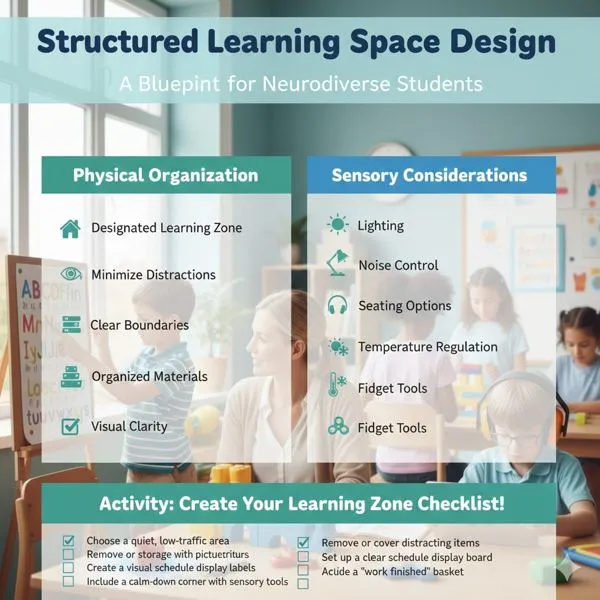
- Designated learning zone, separate from play spaces
- Workspace facing a wall, not windows; neutral colors
- Clear boundaries with rugs, tape, or furniture placement
- Labeled bins and shelves so everything has a place
- Clutter-free surfaces: only current-task materials visible
- Natural lighting; avoid overstimulating fluorescent lights
- Noise-canceling headphones or soft background music
- Wobble cushions, therapy balls, or standing-desk options
- Comfortable temperature, with blankets or fans available
- Discrete fidget tools kept accessible
What evidence-based strategies work best for home learning?
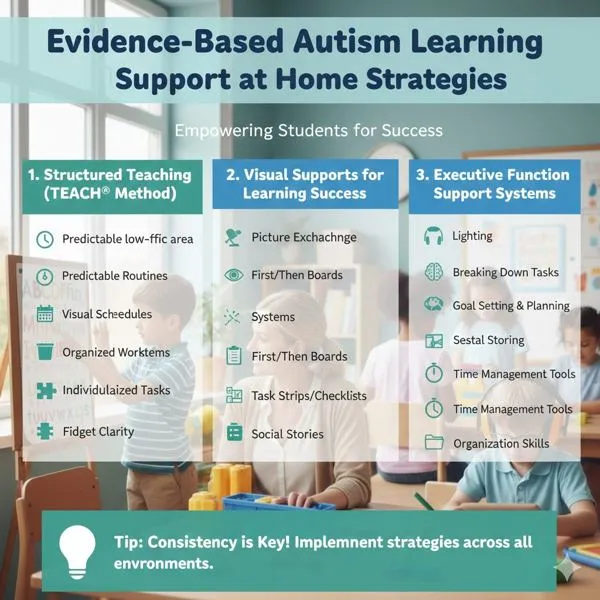
1. Structured teaching (the TEACCH method)
TEACCH (Treatment and Education of Autistic and Related Communication-Handicapped Children) is one of the most effective home learning methods, emphasizing visual structure and predictability.
Work systems answer four questions visually: what work, how much work, when am I finished, and what happens next. A simple three-basket system works well:
Red basket (left)
Tasks to be completed go here.
Work space (center)
Where the child completes each task.
Green basket (right)
Finished work goes here. Child knows they're done when the red basket is empty.
2. Visual supports for learning success
Visual supports provide concrete information that supports comprehension and independence: daily learning schedules, task analysis charts broken into picture steps, visual math manipulatives, and choice boards for activities, breaks, and rewards.
3. Executive function support systems
External support systems are crucial since executive function difficulties (planning, organization, task completion) are common in autism.
Planning & tracking
- Large wall calendars, color-coded by subject
- Assignment notebooks with visual checkboxes
- "To Do / Doing / Done" visual tracking boards
Time & task management
- Visual timers showing time remaining
- Time-estimation practice with a timer
- Large assignments broken into task cards, one at a time
What actually helps when homeschooling an autistic child?
Whether full-time homeschooling or supplementing traditional school, structure, curriculum adaptation, and built-in social opportunities make the biggest difference.
Establishing predictable routines
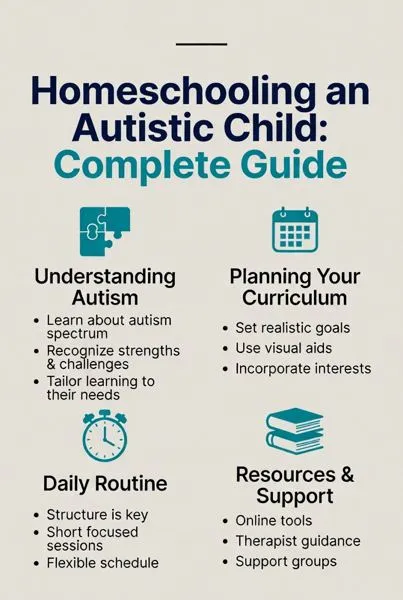
Routine is the cornerstone of successful homeschooling. Keep a consistent daily schedule, but build in "backup activities" for difficult days, choice time, and space for intense special-interest exploration, since that IS learning. Schedule breaks before frustration builds, not after.
Curriculum adaptation strategies
- Multi-sensory approaches: physical manipulatives for math, movement with letters for reading, hands-on experiments for science, dictation or typing for writing
- Incorporate special interests: a dinosaur enthusiast can do math problems about dinosaurs and read about paleontology; a trains lover can learn geography through train routes
- Clear success criteria: show examples of completed work, use rubrics with visual indicators, and checklists so "finished" is unambiguous
Social skills integration in homeschooling
Homeschooling can offer excellent, lower-overwhelm social learning: co-op classes, special interest clubs (robotics, chess, art), library and museum programs, structured volunteer work, and moderated online groups with shared interests. At home, role-play common scenarios, use social stories before new situations, and practice with siblings in low-pressure settings.
How do you prepare an autistic child for school?
Whether transitioning to preschool, kindergarten, or a new school, these activities build the essential foundation skills. A free, printable School Routine Visual Schedule can also help — a 26-step visual poster covering the whole day, from waking up to coming home.
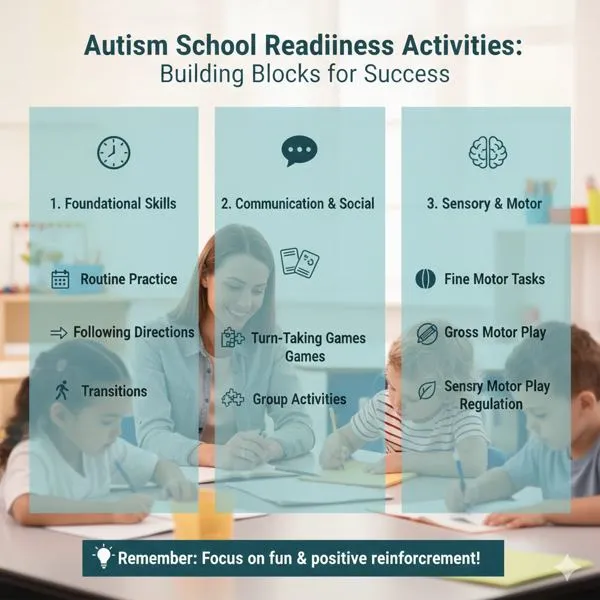
What pre-academic skills should you build first?
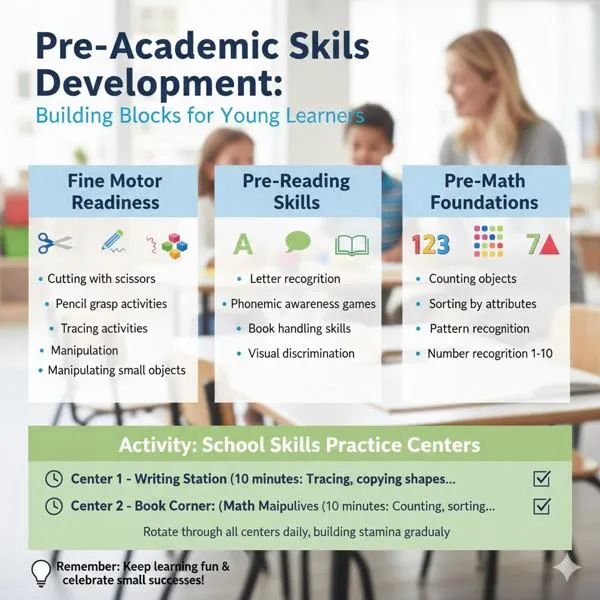
Fine motor readiness
- Cutting: start with play dough, then paper
- Pencil grasp: tweezers, tongs, clothespins for strength
- Tracing progressing to writing
- Manipulating small objects: beads, buttons, Legos
Pre-reading & pre-math
- Letter recognition via sandpaper letters, letter building
- Phonemic awareness games: rhyming, first sounds
- Counting with one-to-one correspondence
- Sorting by color, size, shape; pattern recognition
School skills practice centers (10 minutes each, rotate daily): writing station, book corner, math manipulatives, independence skills (zipping, buttoning, opening containers).
How do you prepare for classroom behavior expectations?
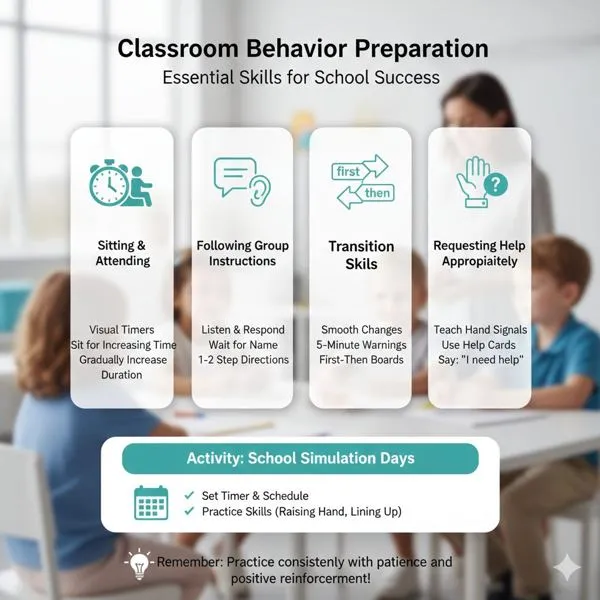
- Sitting and attending: start with 5 minutes, use visual timers, build to age-appropriate periods
- Following group instructions: practice listening with others present, wait for name to be called, follow 1-2 step directions
- Transition skills: practice moving between activities, use warnings ("5 more minutes"), and first-then boards
- Requesting help: teach hand-raising, practice "I need help with ___," use help cards if verbal requests are hard
What targeted interventions help with specific learning difficulties?
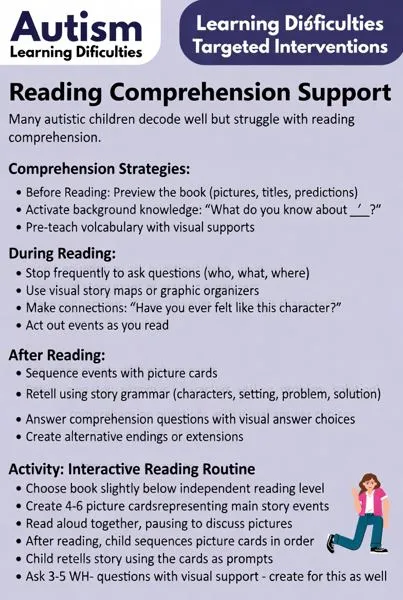
Reading comprehension support
Many autistic children decode well but struggle with comprehension. Before reading: preview the book and activate background knowledge. During reading: stop frequently to ask who/what/where questions and use visual story maps. After reading: sequence events with picture cards and retell using story grammar.
Math concept development
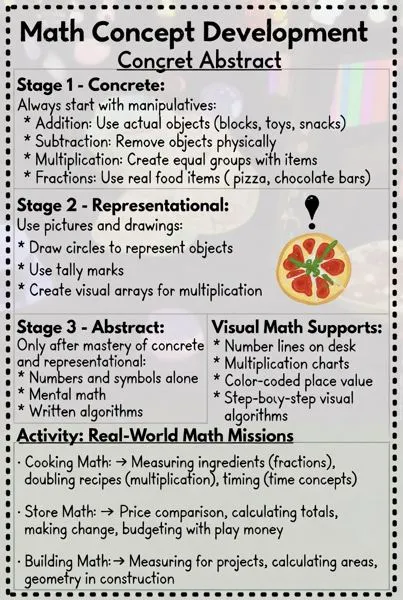
Follow a concrete-to-abstract progression:
Start with manipulatives (blocks, snacks, real food for fractions), move to pictures and tally marks, and only introduce numbers and symbols alone once both earlier stages are solid.
Real-world math missions: cooking math (measuring, doubling recipes), store math (price comparison, making change), building math (measuring, geometry in construction).
Written expression support
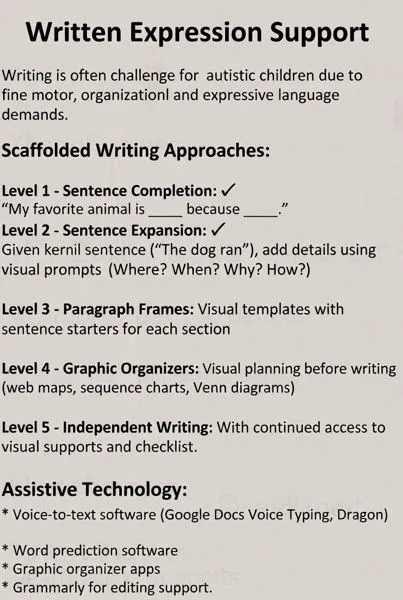
Writing is often challenging due to fine motor, organizational, and expressive language demands. Scaffold it in levels: sentence completion → sentence expansion with visual prompts → paragraph frames → graphic organizers → independent writing with continued visual support. Assistive technology (voice-to-text, word prediction, Grammarly) can help throughout.
What are the best learning activities for an autistic child?
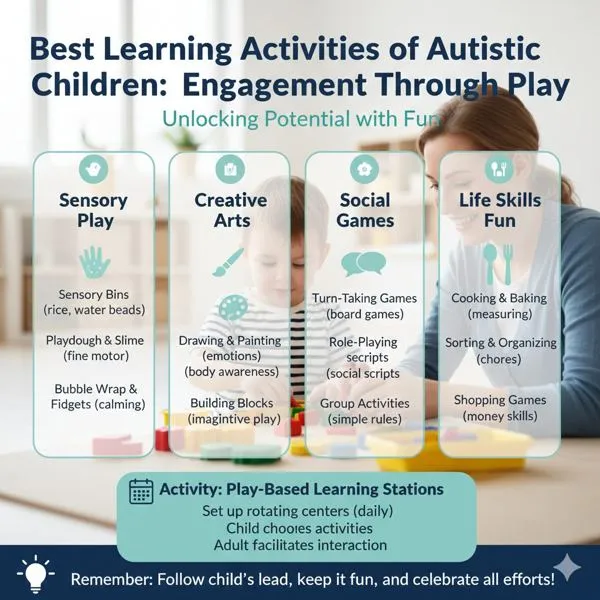
Sensory learning activities
- Hide magnetic letters in rice; find and name them
- Bury numbered eggs in sand; order them when found
- Write sight words in shaving cream or sandpaper
- Gross-motor letters: form letters with bodies
Technology-based learning
- Reading Eggs, Starfall, Epic! for literacy
- Prodigy Math, Splash Learn for math
- Choiceworks for visual schedules and wait timers
- Khan Academy, Scratch for broader skills
Special interest integration: a child who loves trains can learn geography (mapping routes), physics (motion, speed), math (schedule and distance problems), and art (drawing locomotives), turning one passion into a cross-subject curriculum.
How do you build focus and attention?
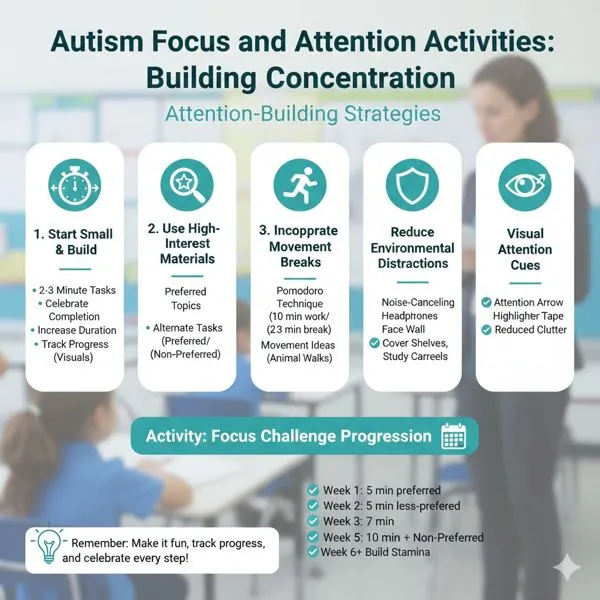
- Start small, build gradually: begin with 2-3 minute tasks, celebrate completion, track progress visually
- Use high-interest materials: attention spans are longer for preferred topics; alternate preferred and non-preferred tasks
- Movement breaks: 10 minutes work, 2-3 minutes movement break, repeat
- Reduce distractions: noise-canceling headphones, face the wall, cover toys/shelves during work
- Visual attention cues: an arrow pointing where to look, highlighter tape, reduced worksheet clutter
Attention games: matching games, Simon Says with increasingly complex directions, I Spy for visual scanning, Freeze Dance for auditory attention and impulse control, and pattern-block or bead-threading sequencing games.
How do you build a homework routine that actually reduces stress?
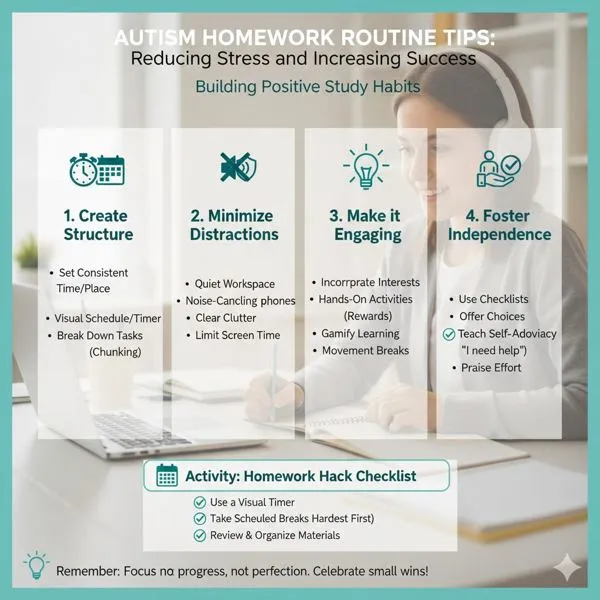
- Consistent time and place: same time daily, same dedicated space, reduces decision fatigue and resistance
- Visual homework schedule: picture sequence from getting the folder through earning a break
- Break down assignments: task cards for each assignment, moved to a "done" pile one at a time
- Use timers strategically: estimate time, add a buffer, take the break when the timer goes off regardless of completion
- Offer choices: "math or reading first?", "desk or table?", limited choices that give control without overwhelm
What do you do when your child refuses homework?
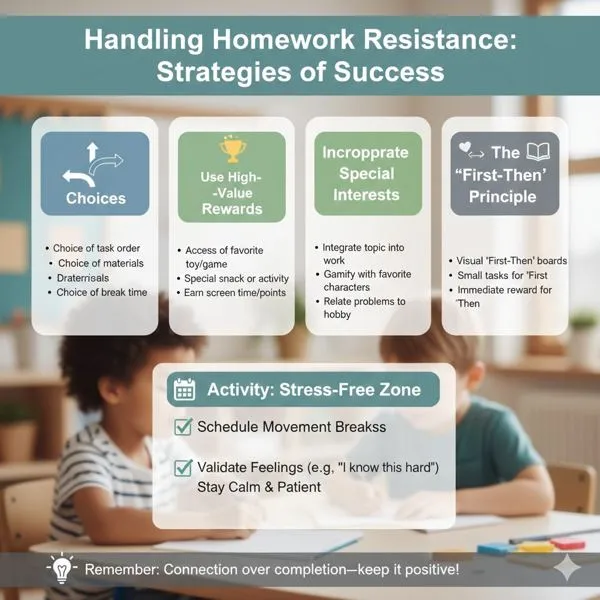
First/Then board
"First 10 minutes homework, then 5 minutes [preferred activity]."
Start tiny
"Let's do just ONE problem." Starting is often the hardest part.
Work alongside
Parent or sibling does their own work nearby, modeling focus.
Add movement
5 jumping jacks between problems, or a wall whiteboard instead of a desk.
Talk to the teacher
Ask about reduced quantity, extended time, or an alternative format.
Professional support options
- Educational Therapists: specialized in learning differences
- Occupational Therapists: support sensory and fine motor needs affecting learning
- Special Education Advocates: help navigate IEP/504 or RPWD Act accommodations
- Autism-trained tutors: for one-on-one academic support
Not sure where your child's plan should start? Talk it through with another parent first.
Book a free 30-min consultationWhat free resources actually help with home learning?
Autism-specific educational resources
- Autism Little Learners (autismlittlelearners.com): free visual schedules, task cards, activity ideas
- AFIRM Modules (afirm.fpg.unc.edu): free training in evidence-based practices
- Autism Internet Modules (autisminternetmodules.org): free training modules and assessment tools
- STAR Autism Support (starautismsupport.com): structured teaching resources and visual supports
Curriculum, apps, and technology
Curriculum
- Time4Learning: online, self-paced, visual supports
- Autism Teaching Strategies: communication-focused
- Education.com: printable worksheets by grade/subject
Organization & learning apps
- Cozi Family Organizer (free): shared calendars
- Trello (free): visual task boards
- Khan Academy, Duolingo, Scratch (free)
How do you build your family's learning success plan?
- Assess current functioning: what subjects are strengths, where are the challenges, what environment and time of day work best?
- Set SMART goals: instead of "improve in math," try "complete 10 single-digit addition problems with 80% accuracy within 10 minutes, 4 out of 5 days, by end of month."
- Choose 3-5 core strategies: visual daily schedule, structured learning space, a work system, one executive-function support, and a consistent routine.
- Track progress: date, activity, duration of focus, accuracy/completion, support needed, notes. Review weekly.
- Celebrate all progress: completed a task independently, tried something new, stayed focused for a personal best, asked for help appropriately.
Key takeaways
- Autistic children aren't broken learners who need fixing, they're different learners who need different approaches
- Visual structure (TEACCH-style work systems and schedules) reduces anxiety and builds independence more than verbal instruction alone
- Special interests are a curriculum, not a distraction from one
- Reading comprehension, math, and writing each benefit from their own scaffolded, concrete-to-abstract progression
Questions parents ask about school and learning support
What is the TEACCH method and how does it help autistic learners?
TEACCH is a structured teaching approach built on four components: physical structure, visual schedules, work systems, and visual structure of tasks. It emphasizes predictability so children know what to do, how much, and what happens next.
Can autistic children be successfully homeschooled?
Yes. Homeschooling can work very well when built around a consistent daily routine, multi-sensory teaching methods, and special interests, and it allows social skills to be practiced in structured, lower-pressure settings like co-op classes.
My child refuses to do homework, what actually works?
Try a First-Then board, start with just one problem to build momentum, work alongside your child so they see you focusing too, and add short movement breaks between tasks rather than expecting one long sitting.
Why does my child decode words well but still struggle to understand what they read?
This is common in autism: many children are strong at word recognition but find comprehension harder. Previewing the book, stopping to ask simple questions during reading, and sequencing story events with picture cards afterward can help.
How can I teach math concepts if my child struggles with abstract numbers?
Follow the concrete-to-abstract progression: start with real objects for the concept, move to pictures and drawings once that is mastered, and only introduce numbers and symbols alone after both earlier stages are solid.
How can I use my child's special interest to support learning?
Intense interests are a powerful learning tool. A child who loves trains, for example, can practice math through schedule and distance problems, geography by mapping train routes, and writing by researching railway history.
Related Reading: Rights, School & Disability
Final thoughts: empowering your child's educational journey
Effective learning support at home is about meeting your child where they are, providing structure, and celebrating their unique learning style. Whether it's homeschooling, school readiness activities, solutions for learning difficulties, or a homework routine that finally works, consistency and understanding are your most powerful tools.
Your child isn't a broken learner who needs fixing. They're a different learner who needs different approaches. With visual supports, structured environments, sensory consideration, and their special interests as a starting point, they can not only succeed academically but thrive.
Start this week: create one visual support, establish a consistent learning time, organize a dedicated space, choose one executive-function support to implement, and celebrate small wins daily.