
Finding effective communication strategies can transform daily interactions and unlock your child's potential. Whether your child is nonverbal, minimally verbal, or struggles with social communication, understanding evidence-based support is essential.
Communication difficulties affect approximately 25-50% of children diagnosed with autism spectrum disorder, with many experiencing challenges in both verbal and nonverbal communication. With the right tools, strategies, and consistent support, every autistic child can develop meaningful ways to express themselves and connect with the world around them.
Why does communication development matter so much in autism?
Communication is more than speaking: it's expressing needs, sharing emotions, building relationships, and navigating the world. For autistic children, communication challenges can lead to:
- Frustration and behavioral difficulties when needs aren't understood
- Social isolation and difficulty forming friendships
- Limited academic progress without alternative communication methods
- Safety concerns when children cannot express pain or danger
Research consistently shows that early intervention and appropriate communication support can significantly improve outcomes. Behavioral interventions like Applied Behavior Analysis (ABA) and specialized communication therapies show strong evidence for encouraging desired behaviors and supporting language development.
What does communication difficulty actually look like day to day?
Before implementing strategies, it helps to understand your child's unique communication needs. This helps parents tailor techniques that match their child's abilities, rather than applying a one-size-fits-all approach.
What is your child's communication profile?
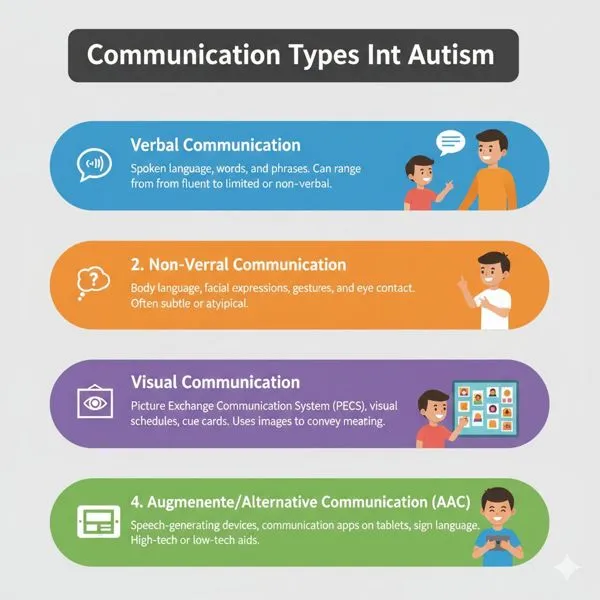
1. Nonverbal communicators
- May use gestures, pointing, or leading to communicate
- Benefit from communication support tools such as AAC
- Often understand more than they can express
2. Minimally verbal children
- Have some spoken words but limited functional speech
- May use single words or short phrases inconsistently
- Can benefit from multimodal communication strategies
3. Verbal with pragmatic challenges
- Can speak but struggle with social use of language
- May have difficulty with conversations, taking turns, or understanding context
- Need support with social communication skills
What are the most effective evidence-based communication tips?
Visual supports, PECS, AAC, simple language modeling, and environmental modifications are the five pillars of evidence-based communication support. Each is covered below.
What visual communication strategies actually help?
Visual supports are one of the most effective tools for autistic communication. Research shows visual tools provide concrete, consistent information that reduces anxiety and improves understanding.
Practical implementation
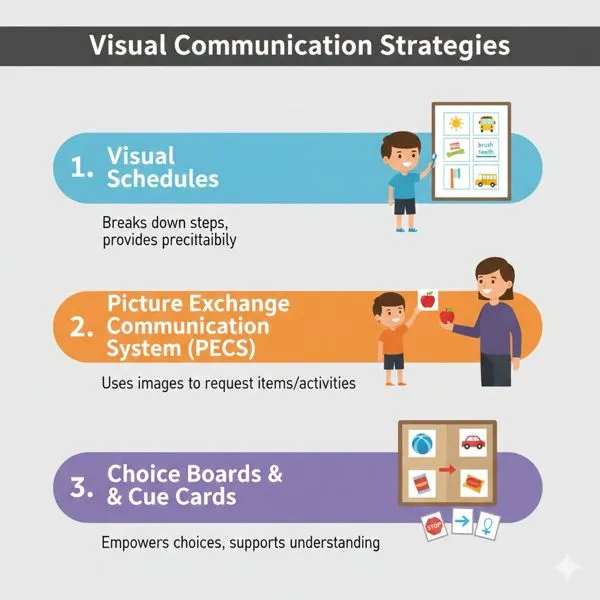
- Visual schedules: Use picture cards showing daily routines (morning routine, school, meals, bedtime). This reduces uncertainty and behavioral challenges.
- Communication boards: Create boards with pictures of common needs (food, drink, bathroom, break, help). Place them in accessible locations throughout your home.
- First-Then boards: Show "First [non-preferred activity], Then [preferred activity]" to improve cooperation and understanding of sequences.
- Social stories: Use illustrated stories that describe social situations and appropriate responses, particularly effective for preparing children for new experiences.
Take photos
Take photos of your child performing daily activities.
Print and laminate
Print and laminate 4-6 pictures.
Arrange in order
Arrange them in order with Velcro on a board.
Practice "all done"
Practice removing completed activities as each one finishes.
Increase gradually
Gradually increase activities as your child masters the concept.
What is PECS and how does it work?
PECS (Picture Exchange Communication System) is an evidence-based strategy that teaches functional communication through picture exchange. It has six phases and is particularly effective for children who are nonverbal or minimally verbal.
- Phase 1: Child exchanges a picture for a desired item
- Phase 2: Increases distance and persistence
- Phase 3: Discriminates between different pictures
- Phase 4: Builds sentence structure ("I want [item]")
- Phase 5: Responds to questions ("What do you want?")
- Phase 6: Comments and expands language
Getting started with PECS
- Identify highly motivating items (favorite snacks, toys)
- Begin with one clear picture per item
- Physically guide your child to pick up the picture and place it in your hand
- Immediately give the item with verbal reinforcement
- Practice multiple times daily in natural contexts
What is AAC, and does it delay speech?
AAC (Augmentative and Alternative Communication) encompasses all communication methods beyond speech, from low-tech picture boards to high-tech speech-generating devices. AAC does not prevent speech development, research shows it actually supports and enhances verbal communication.
Low-tech solutions
- Communication books with picture symbols
- Pointing boards
- Sign language for young children
- Written words for literate children
High-tech AAC apps (2026)
- Proloquo2Go: comprehensive symbol-based AAC
- TouchChat: customizable vocabulary sets
- LAMP Words for Life: motor planning-based
- GoTalk NOW LITE: free starter app
- CoughDrop: cloud-synced, cross-device
How should you simplify your language and model communication?
One of the most effective techniques is adjusting your communication style to match your child's comprehension level.
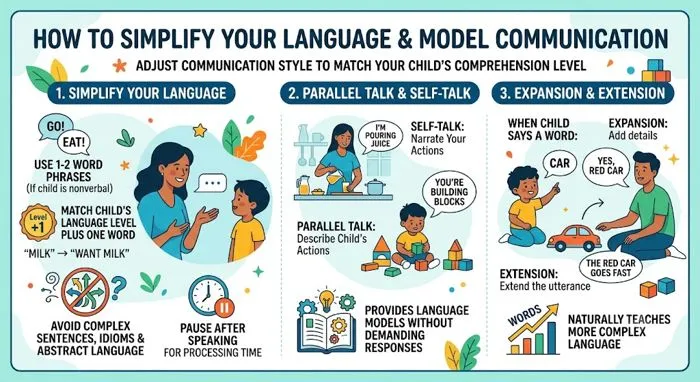
Simplify your language
- Use 1-2 word phrases if your child is nonverbal
- Match your child's language level plus one word ("milk" → "want milk")
- Avoid complex sentences, idioms, and abstract language
- Pause after speaking to allow processing time (3-5 seconds)
Parallel talk and self-talk
- Narrate your actions: "I'm pouring juice"
- Describe what your child is doing: "You're building blocks"
- This provides language models without demanding responses
Expansion and extension
- When your child says "car," expand: "Yes, red car"
- Extend their utterance: "The red car goes fast"
- This naturally teaches more complex language
How can you modify your environment to create communication opportunities?
- Controlled access: Keep preferred items visible but out of reach, requiring requests
- Silly situations: Put shoes on hands, food in wrong containers, creating a need to comment
- Pause and wait: During routines, pause expectantly for your child to initiate
- Offer choices: "Do you want crackers or pretzels?" (hold up both)
How does challenging behavior connect to communication?
Communication difficulties often manifest as challenging behaviors. Understanding the function of behavior is key to effective behavior support.
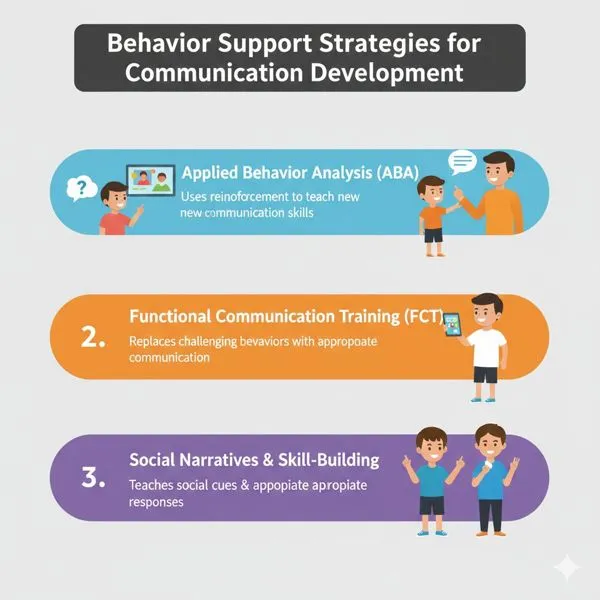
Positive Behavior Support (PBS) framework
Prevention strategies: maintain predictable routines with visual supports, provide advance warnings before transitions ("5 more minutes"), ensure sensory needs are met, and teach communication alternatives before problems arise.
Replacement behaviors: when challenging behavior occurs, teach an appropriate replacement, such as: hitting to escape → teach a "break" sign; crying for attention → teach tapping shoulder or a "help" card; grabbing items → teach "my turn" or "want" communication.
Response strategies: stay calm and neutral, prompt the replacement behavior, reinforce immediately when the appropriate communication is used, and be consistent across all caregivers.
How do sensory differences affect communication?
Many autistic children have sensory processing differences that impact their ability to focus and communicate.
For sensory-seeking children
- Provide movement breaks before communication activities
- Use fidgets during listening tasks
- Incorporate heavy work before requesting seated activities
- Try therapy balls or wobble cushions during practice
For sensory-avoiding children
- Reduce background noise (noise-canceling headphones)
- Use calm, quiet spaces for communication practice
- Avoid overwhelming visual clutter near communication boards
- Respect personal space preferences during interactions
Sensory diet activities that support communication: jumping on a trampoline 15 minutes before meals/communication time, weighted lap pads during visual schedule review, chewing gum or crunchy snacks before speech practice, deep pressure hugs or compression vests for regulation.
What speech therapy techniques can you use at home?
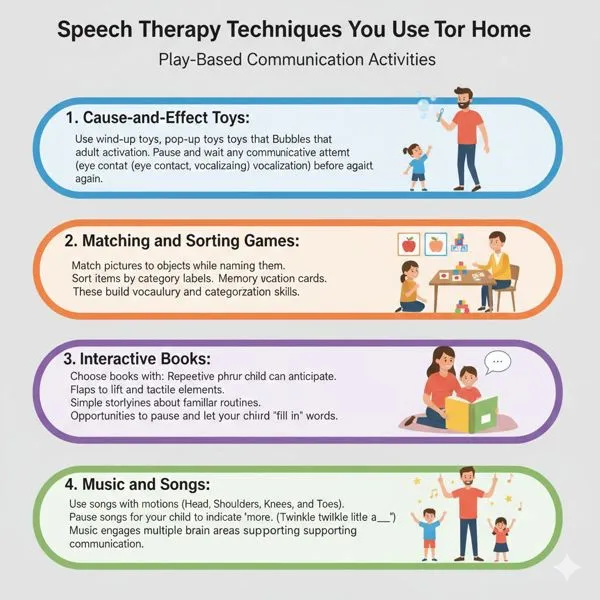
Play-based communication activities
- Cause-and-effect toys: wind-up toys, pop-up toys, or bubbles that require adult activation. Pause and wait for any communicative attempt before activating again.
- Matching and sorting games: match pictures to objects while naming them, sort items by category with verbal labels, memory games with communication cards.
- Interactive books: choose books with repetitive phrases, flaps to lift, simple storylines about familiar routines, and pauses that let your child "fill in" words.
- Music and songs: use songs with motions (Head, Shoulders, Knees, and Toes), pause songs for your child to indicate "more," fill-in-the-blank with familiar songs.
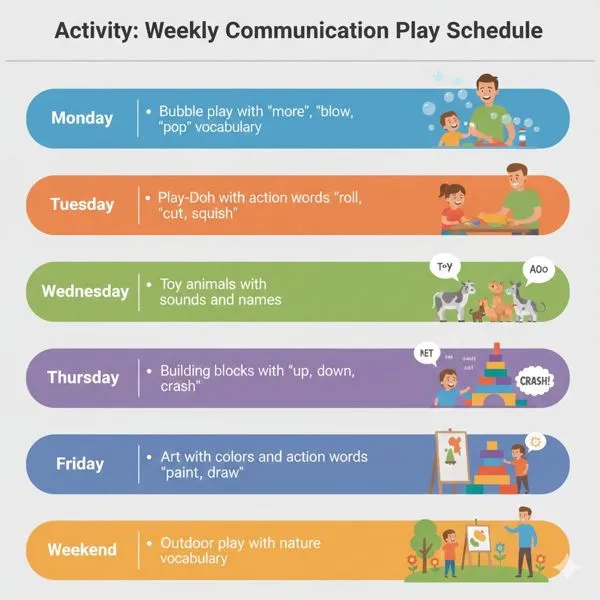
A weekly communication play schedule
Bubble play: "more," "blow," "pop"
Play-Doh: "roll," "cut," "squish"
Toy animals with sounds and names
Blocks: "up," "down," "crash"
Art with colors and action words
Cooking together: "mix," "pour," "stir"
Outdoor play with nature vocabulary
Joint attention, sharing focus with another person, is foundational for communication development.
Strategies to build joint attention
- Follow your child's lead and comment on their interests
- Point to interesting objects and name them
- Use animated facial expressions to gain attention
- Play together with cause-and-effect toys
- Alternate turns with toys, emphasizing "my turn/your turn"
Turn-taking games
- Rolling a ball back and forth
- Stacking blocks alternately
- Simple board games with clear visual turns
- Musical instruments: you play, then child plays
Which apps and professionals can support communication?
Communication apps
- Autism 360: free visual supports and schedules
- Choiceworks: visual schedules, wait timers, feeling wheels
- Proloquo4Text: text-based for literate users
- Social Express: interactive social scenarios
Visual support apps
- First Then Visual Schedule: free basic scheduling
- Pictello: create visual stories with photos and audio
- AutisMate: comprehensive visual support system
Professional support options
- Speech-Language Pathologists (SLPs): specialized in autism communication
- Board Certified Behavior Analysts (BCBAs): for behavioral communication approaches
- Occupational Therapists (OTs): address sensory issues affecting communication
- Developmental Pediatricians: coordinate comprehensive care
Not sure where to start? Talk it through with another parent first.
Book a free 30-min consultationHow do you create a family communication plan?
- Assess current communication: what methods does your child currently use, what are their most pressing needs, what's working and what isn't?
- Set specific goals: rather than "improve communication," try "child will request 5 preferred items using pictures within 3 months."
- Choose 2-3 strategies: don't overwhelm yourself. Select strategies that fit your family, e.g. visual schedule + choice boards, or PECS training + environmental modifications.
- Ensure consistency: train all caregivers on chosen strategies, use the same tools at home, school, and therapy, document progress weekly.
- Celebrate progress: every communication attempt matters, from eye contact to a first new word or gesture.
Common challenges and solutions
"My child isn't interested in communicating"
Start with highly motivating items. Find what your child loves and create opportunities where they need to communicate to access it.
"We tried AAC and it didn't work"
AAC requires consistent modeling by adults. Spend 2 weeks modeling extensively before expecting your child to use it. Research shows it takes time.
"My child gets frustrated when I don't understand"
Acknowledge their effort first: "You're trying to tell me something!" Then offer visual choices: "Show me, is it this or this?"
"Different people use different strategies"
Hold a family meeting to agree on core communication methods. Create a simple visual guide that all caregivers can follow.
What are your next steps?
This week
- Choose ONE visual support strategy to implement
- Identify 3 highly motivating items for communication practice
- Create 5 daily communication opportunities
- Download a free AAC or visual support app
This month
- Establish a consistent visual schedule
- Begin PECS or AAC if appropriate for your child
- Connect with a speech-language pathologist specializing in autism
- Join a parent support group for shared learning
This year
- Expand communication methods as your child progresses
- Integrate strategies across home, school, and community
- Celebrate every milestone, no matter how small
Additional resources for parents and caregivers
Free online resources
- Autism Little Learners (autismlittlelearners.com): free visual supports starter set, social stories library
- Autism Speaks Resource Library (autismspeaks.org): visual supports toolkit, communication development guides
- AFIRM Modules (afirm.fpg.unc.edu): free online training modules, evidence-based practice guides including PECS
- Vanderbilt Kennedy Center TRIAD (vkc.vumc.org/triad): free videos, tip sheets, and communication resources
Key takeaways
- Every autistic child can develop meaningful communication, whether through speech, pictures, signs, or technology
- AAC supports speech development, it never delays it
- Challenging behavior is often a communication attempt: teach the replacement, don't just discipline the behavior
- Consistency across all caregivers matters more than any single strategy
Questions parents ask about communication and behavior
What is PECS and how does it help nonverbal autistic children?
PECS is an evidence-based approach that teaches functional communication through picture exchange. It has six phases, starting with exchanging a single picture for a desired item and progressing to building full sentences and responding to questions.
Does using AAC or picture cards delay speech development?
No. Research shows AAC does not prevent or delay speech, it actually supports and often accelerates verbal communication by giving children a reliable way to express themselves while spoken language develops.
My child isn't interested in communicating, what should I do?
Start with highly motivating items. Find what your child loves and create natural opportunities where they need to communicate to access it, such as keeping a favorite snack visible but out of reach.
We tried AAC and it didn't work, should we give up?
Not at all. AAC requires consistent modeling by adults before a child starts using it independently. Spend at least 2 weeks modeling the device or picture system extensively during daily activities.
How should I respond when my child's challenging behavior seems to be about communication?
Stay calm and neutral, then prompt an appropriate replacement behavior, such as teaching a break sign for a child who hits to escape a task. Reinforce the replacement communication immediately and consistently.
When should we involve a speech-language pathologist?
A speech-language pathologist specializing in autism can help if your child has limited or no functional speech, struggles with social use of language, or if home strategies aren't leading to progress after consistent use.
Related Reading: Communication & Behavior
Final thoughts: empowering your child's voice
Every autistic child has something to say. With the right strategies, patience, consistency, and evidence-based support, you can help your child find their voice, whether through speech, pictures, signs, technology, or a combination of approaches.
Communication development isn't about "fixing" your child; it's about building bridges of understanding, reducing frustration, and creating connections that enrich both your lives.
Start today. Your child's communication journey begins with a single step, and you're already taking it by reading this guide.
How do you build joint attention and turn-taking?