
Putting on Socks and Shoes — Visual Task Analysis
Putting on socks and shoes is really nine small motor steps stacked together — finding the right foot, orienting the sock, pulling it over the heel, then repeating the whole sequence with the shoe. When any one step is unclear, the whole routine can fall apart. This free visual task analysis breaks it into 9 clear picture steps, in both boy and girl versions, so your child can follow along one step at a time instead of needing it explained from scratch every morning.
At a Glance
- What it is: A free, 9-step printable visual task analysis for putting on socks and shoes.
- Who it's for: Autistic children learning to dress independently, especially the sock-and-shoe sequence.
- What you get: A full-resolution PDF chart, available in both boy and girl versions, emailed instantly.
- How to use it: Post it at your child's dressing spot and point to each step as they go.
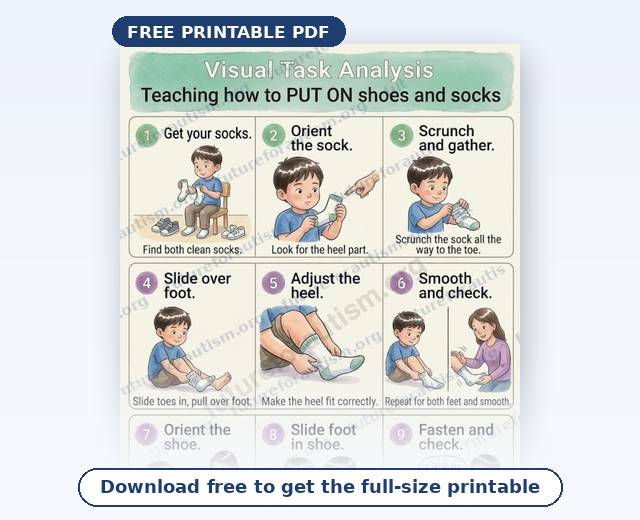
Boy version
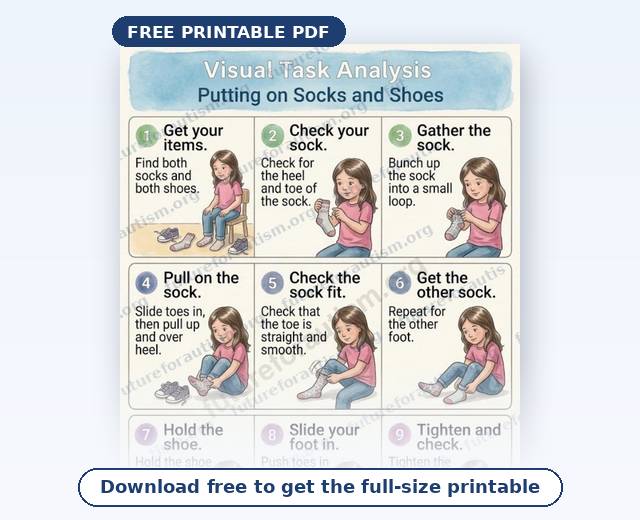
Girl version
Preview of the printable chart — comes in both versions, download the full-resolution, watermark-free PDFs below.
What's in this guide
- Why a visual schedule helps
- What you'll get in the free PDF
- How to use it
- What If My Child Gets Frustrated Partway Through?
- Frequently asked questions
Why a Visual Schedule Helps
Dressing routines ask a child to sequence several small motor actions in the right order without skipping any — and sock-and-shoe routines are often where that breaks down first, since a twisted sock or a shoe on the wrong foot undoes the whole thing. Breaking the routine into separate, numbered picture steps gives your child something to check their own progress against, so they can see exactly where they are in the sequence instead of relying on you to narrate every step out loud each morning.
What You'll Get in the Free PDF
A single-page, 9-step visual task analysis:
- Get your socks and shoes ready
- Check the sock for heel and toe
- Scrunch and gather the sock
- Slide the sock over your foot
- Pull up and adjust the heel
- Repeat for the other foot
- Find the matching shoe for each foot
- Slide your foot into the shoe
- Tighten and check — you did it!
Get the Free Putting on Socks and Shoes Visual Task Analysis PDF
Enter your details below and we'll email the printable PDF to you instantly.
How to Use It
Print the chart and keep it at your child's usual dressing spot — a bedroom floor, a hallway bench — at their eye level. Point to each numbered step as they complete it for the first few tries, then step back and let the chart do the prompting on its own. The "check your sock" and "check the fit" steps are usually where kids need the most practice, so don't rush past those even if the rest of the sequence goes smoothly.
What If My Child Gets Frustrated Partway Through?
That's common, especially with the heel-and-toe steps, which take more fine motor control than the rest of the sequence. Let your child finish just the steps they can manage independently and quietly help with the rest rather than stopping the routine altogether — over repeated mornings, hand over one more step at a time. A reward at the end (built into both chart versions) can help carry your child through the harder middle steps.
Frequently Asked Questions
Why are there two different versions of this chart?
The two versions use different artwork and slightly different step wording — pick whichever your child responds to better, or let them choose.
What age is this chart for?
It's built for a child who is starting to learn independent dressing but still needs the sequence broken down — there's no fixed age, go at your child's current skill level.
Can I use just part of the chart?
Yes — if your child only needs help with the shoe steps (7–9) or the sock steps (1–6), you can print and use just that section.