
How to Teach an Autistic Child to Wash Hands
A dozen or so small motions, done the same way every time, at a sink your child may or may not enjoy standing at. Handwashing looks simple from the outside and rarely feels simple to teach, which is exactly why a structured approach makes such a visible difference.
Teaching an autistic child to wash hands works best through task analysis and chaining, breaking the skill into discrete steps and teaching them in a specific, consistent sequence. This approach is recognized as an established, evidence-based practice for self-help skills, and works well combined with a visual timer for wash duration and gradually faded physical prompts.
Why Task Analysis and Chaining Work
The National Clearinghouse on Autism Evidence and Practice identifies task analysis and chaining, alongside prompting strategies like least-to-most prompting, as established, evidence-based practices for teaching self-help skills, including handwashing. Breaking the skill into small, consistent, teachable pieces removes the ambiguity that otherwise makes an ordinary daily task feel unpredictable.
A Sample Step Sequence
- Turn on the water
- Wet both hands
- Apply soap
- Rub hands together for a set duration
- Rinse soap off completely
- Turn off the water
- Dry hands
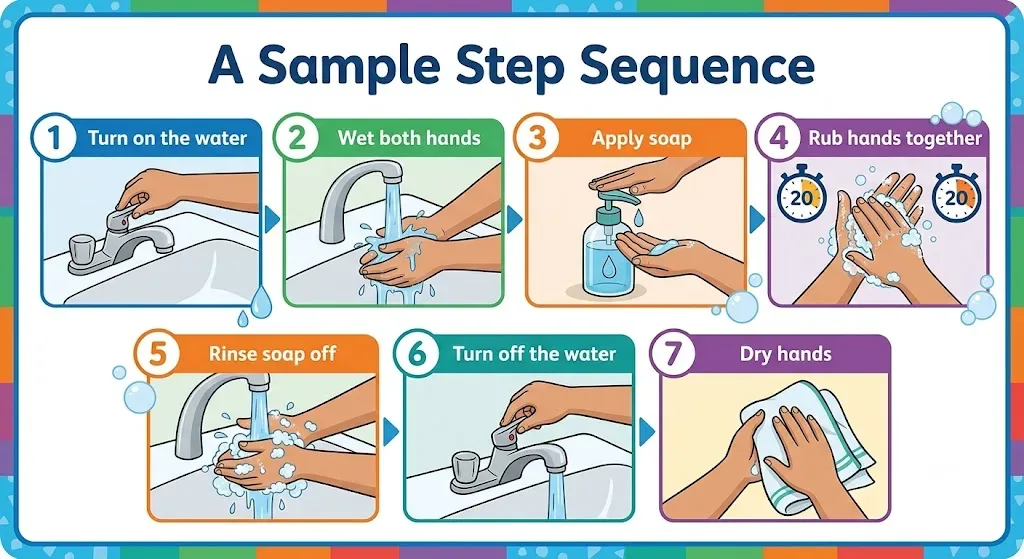
A visual version of the same 7-step sequence
Adjust the number of steps based on your child's current skill, splitting a step further only if it consistently causes trouble on its own.
Forward vs Backward Chaining
Forward chaining
Teach the first step until mastered, then add the next, building the sequence from the beginning.
Backward chaining
Teach the last step first, so your child experiences finishing the task successfully from very early on.
Making Wash Time Work
Visual timer for duration
A short, visible countdown gives a concrete signal for how long to keep washing.
A known-length song
Singing a short, familiar song while washing gives a natural, easy-to-remember timing cue.
Adjust soap and water
Different soap textures, scents, and water temperature can resolve sensory-based resistance.
Least-to-most prompting
Start with the smallest prompt needed, increasing only if your child does not respond.
Frequently Asked Questions
What teaching method works best for handwashing?
Task analysis combined with chaining, breaking the skill into discrete steps and teaching them in a specific sequence, is identified as an established, evidence-based practice for self-help skills including handwashing by the National Clearinghouse on Autism Evidence and Practice.
What is the difference between forward and backward chaining?
Forward chaining teaches the first step of a routine until mastered before adding the next, building from the beginning. Backward chaining teaches the last step first, so the child experiences completing the task from very early on, which can build a stronger sense of accomplishment.
How many steps does handwashing typically include?
A typical task analysis breaks handwashing into around 6 to 10 steps, wetting hands, applying soap, rubbing hands together for a set duration, rinsing, and drying, adjusted based on your child's current skill level.
How do I make sure my child washes for long enough?
A visual timer, a short song of a known length, or counting aloud together all give a concrete, predictable signal for how long to keep washing, rather than relying on an abstract sense of time.
What if my child dislikes the feeling of soap or water temperature?
Experiment with different soap textures and scents, and adjust water temperature to what your child tolerates best. Sensory sensitivity around this specific task is common and often solvable with small material changes rather than more repetition.
Should I use least-to-most or most-to-least prompting?
Least-to-most prompting, starting with the smallest possible prompt and increasing only if needed, is commonly used and lets a child demonstrate independence whenever possible, rather than assuming help is needed from the start.
How do I know if my child is ready to try handwashing with less support?
Consistent success across several sessions with a given level of prompting is a reasonable signal to try fading that support slightly, rather than a fixed number of days or a specific age.
Does this approach generalize to other settings like school?
Practising the exact steps and cues used at home in other settings, or asking school staff to use the same sequence, supports generalization. A skill taught only at one sink in one bathroom does not always transfer automatically to another without this extra step.
Not sure which daily living skill to focus on next?
Our free tool helps you build a support profile in a few minutes, a useful starting point before choosing a priority.
Free Sensory Profile & Support Tool for Parents →Sources: DSM-5, WHO ICD-11, Steinbrenner et al. (2020), National Clearinghouse on Autism Evidence and Practice, Action for Autism India.