
How to Teach an Autistic Child to Brush Teeth
Twice a day, every day, for the rest of a lifetime. Toothbrushing is one of those skills that seems small until it is the thing you are fighting about every morning and every night. It responds well to structure, and the structure that works is well documented.
Teaching an autistic child to brush teeth works best by breaking the task into small, consistent steps, called a task analysis, and teaching them with physical guidance, visual supports, and parent involvement at home. A 2024 study found that this combined approach produced significant improvement in independent brushing across eight autistic children, with progress typically becoming visible around the third month of consistent practice.
Why Toothbrushing Is Genuinely Hard
A 2024 study published in the journal Children, involving eight autistic children trained during an ABA summer program, found that sensory hypersensitivity and lower baseline skill levels were both linked to slower progress in learning to brush teeth independently. The task combines fine motor coordination, sequencing, and tolerating an intense sensory experience all at once, which is a genuinely demanding combination, not a matter of a child simply refusing to cooperate.
Breaking It Into Steps
A task analysis simply means writing out every discrete step of the routine, then teaching them in order, in the same sequence, every time.
- Pick up the toothbrush
- Wet the toothbrush
- Open the toothpaste
- Apply toothpaste to the brush
- Brush the outer surfaces of the top teeth
- Brush the outer surfaces of the bottom teeth
- Brush the inner and chewing surfaces
- Spit
- Rinse the mouth
- Rinse the toothbrush
- Put the toothbrush away
Start with fewer, larger steps if your child is new to structured teaching, and only split a step further if it consistently causes difficulty on its own.
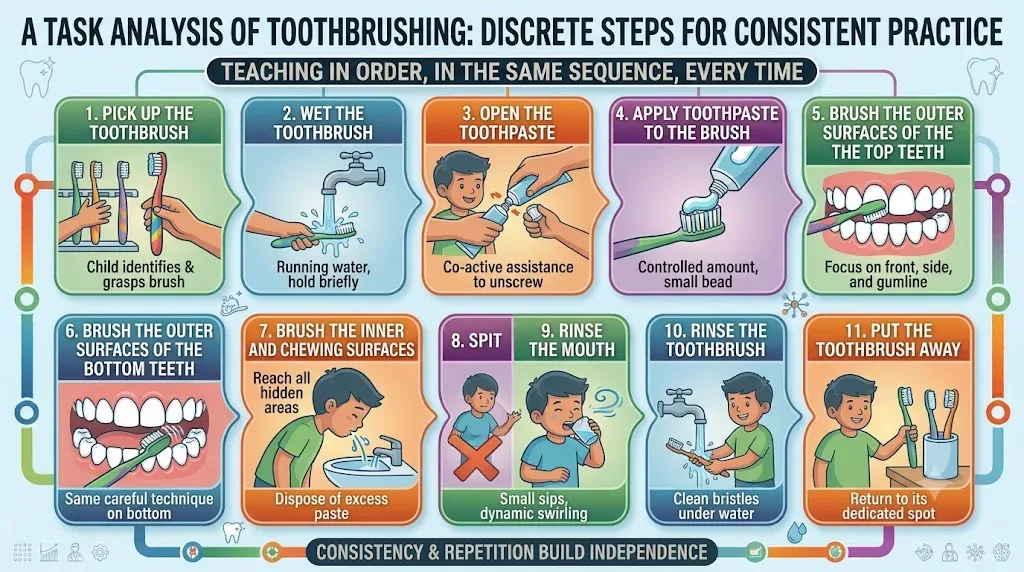
The full 11-step task analysis at a glance
Want a more detailed, print-ready version of this sequence? Our free Toothbrushing Visual Schedule breaks it into 7 numbered picture steps you can stick up by the bathroom mirror.
Building Tolerance First
If your child resists having a toothbrush in their mouth at all, teaching the full brushing motion too early usually backfires. Build tolerance in stages first.
Touching the lips
A dry toothbrush briefly against closed lips, building comfort before anything goes further.
Brief tooth contact
A few seconds of contact with front teeth only, gradually extended.
Adding water, then paste
Introduce water first, then a small amount of toothpaste, once basic contact is tolerated.
Teaching Tools That Help
Picture sequence
A card near the mirror showing each step in order, reducing reliance on verbal instructions alone.
Video modeling
A short video of the routine, watched before or during brushing, supports learning alongside physical guidance.
Physical guidance, faded gradually
Hand-over-hand support at first, reduced step by step as independence builds.
Parent consistency
The same steps, cues, and sequence used by every family member involved in the routine.
Frequently Asked Questions
Why is toothbrushing especially hard for some autistic children?
Toothbrushing requires coordinating many separate motor steps while tolerating a sensory experience many autistic children find uncomfortable, taste, texture, and sensation in and around the mouth. A 2024 study published in the journal Children found that sensory hypersensitivity was one of the factors most strongly linked to slower progress in toothbrushing training.
How many steps should toothbrushing be broken into?
Most task analyses break toothbrushing into somewhere between 8 and 17 discrete steps depending on the level of detail needed. Start with fewer, larger steps for a child new to structured teaching, and break steps down further only if a specific one consistently causes difficulty.
Should parents be involved in teaching, or is this better left to professionals?
Parent involvement is strongly supported by the research. A study involving eight autistic children found that a training package including parents alongside behavioral staff produced significant improvement in independent brushing, with the parent's daily consistency identified as an important factor in maintaining progress.
What if my child won't tolerate the toothbrush in their mouth at all?
Start well before the brushing step itself, with tolerance of a toothbrush touching the lips, then teeth briefly, building up gradually. Trying to teach the full brushing motion before basic tolerance is established usually leads to more resistance, not less.
Does video modeling actually help with toothbrushing?
Yes, multiple studies support video modeling as an effective tool for teaching toothbrushing to autistic children, often used alongside task analysis and visual supports rather than as a standalone method.
How long does it typically take to see progress?
The 2024 study found meaningful improvement began around the third month of consistent practice, with some children reaching full independence and others showing partial but significant gains. Progress varies considerably based on individual factors like sensory sensitivity.
What if my child understands the steps but still resists?
Resistance despite understanding often points to a sensory or motivational issue rather than a skill gap. Trying a different toothbrush texture, a preferred flavor of toothpaste, or pairing the activity with a strongly motivating reward afterward can address this more effectively than repeating the same teaching steps.
Can toothbrushing be taught using a picture schedule alone?
A picture schedule helps significantly with sequencing but usually works best combined with physical guidance and reinforcement, rather than as the only teaching tool, especially for children newer to the skill.
Not sure how to structure your child's hygiene routine?
Our free tool helps you build a support profile in a few minutes, a useful starting point before choosing an approach.
Free Sensory Profile & Support Tool for Parents →Sources: DSM-5, WHO ICD-11, Esposito, Piersanti, Fadda, Boitani, Mazza & Marrocco (2024), Children, 12(1), 5, Action for Autism India.