
How to Create a Routine for an Autistic Child ?

Does your child become overwhelmed by daily transitions, experience meltdowns over schedule changes, or struggle with basic activities like getting dressed? You’re not alone. Creating an effective routine for an autistic child can feel challenging, but science-backed strategies make it achievable. This comprehensive guide walks you through proven methods to build predictable structure that reduces anxiety and supports your child’s development.
Table of Contents
- Why Consistent Routines Matter for Autism
- Essential Components of Effective Routines
- Creating Your Child’s Daily Schedule
- Visual Support Tools That Work
- Managing Transitions and Changes
- Building Independence Through Routines
- Adapting Routines for Different Ages
- Common Challenges and Solutions
- Parent Action Plan
- Frequently Asked Questions
Quick Answer: How to Create a Routine for an Autistic Child
- Start with anchor points: Establish fixed times for meals and bedtime first
- Use visual schedules: Pictures, symbols, or written schedules help children anticipate what’s next
- Include transition cues: Timers and countdown warnings prepare for activity changes
- Allow flexibility: Build in choices and breaks to prevent rigid dependence
- Involve your child: Give age-appropriate control over routine elements
- Prepare for changes: Use social stories before schedule disruptions
Why Consistent Routines Matter for Autism
Research from the National Institutes of Health demonstrates that structured daily routines provide multiple benefits for children with autism spectrum disorder. These predictable sequences serve as family rituals that offer meaningful context and structure while creating frequent opportunities for social-emotional development Cross River Therapy1.
The science is clear: routines work because they tap into natural learning opportunities. Mealtimes, bedtime, and play sessions contain natural reinforcers (preferred foods, favorite activities) that make learning new behaviors more effective than artificial reward systems. The regularity also provides multiple daily chances for repetition and practice essential for skill development.
For families, the benefits extend beyond child development. Studies show that successfully implementing routines reduces parenting stress by 40% while increasing parental efficacy and confidence PMC59039552.
Essential Components of Effective Routines
Key Elements that Science Supports
Predictability with Flexibility: While consistency remains crucial, completely rigid schedules can create their own problems. Effective routines maintain core structure while allowing for controlled variations. This helps children learn resilience without triggering overwhelming anxiety.
Visual Processing Accommodation: Children with autism often process visual information more effectively than verbal instructions. Research from UNC’s Child Development Institute shows visual support systems reduce problem behaviors during transitions by up to 60% ABA Journey3.
Natural Reinforcement Opportunities: Unlike therapy sessions with contrived rewards, well-designed routines embed natural motivators. A breakfast routine might include preferred foods, while a bedtime sequence concludes with stories or favorite comfort items.
Sensory Consideration: Autism routines should accommodate sensory preferences. A morning schedule might include weighted blanket time or allow for noise-canceling headphones during busy family periods.
Creating Your Child’s Daily Schedule
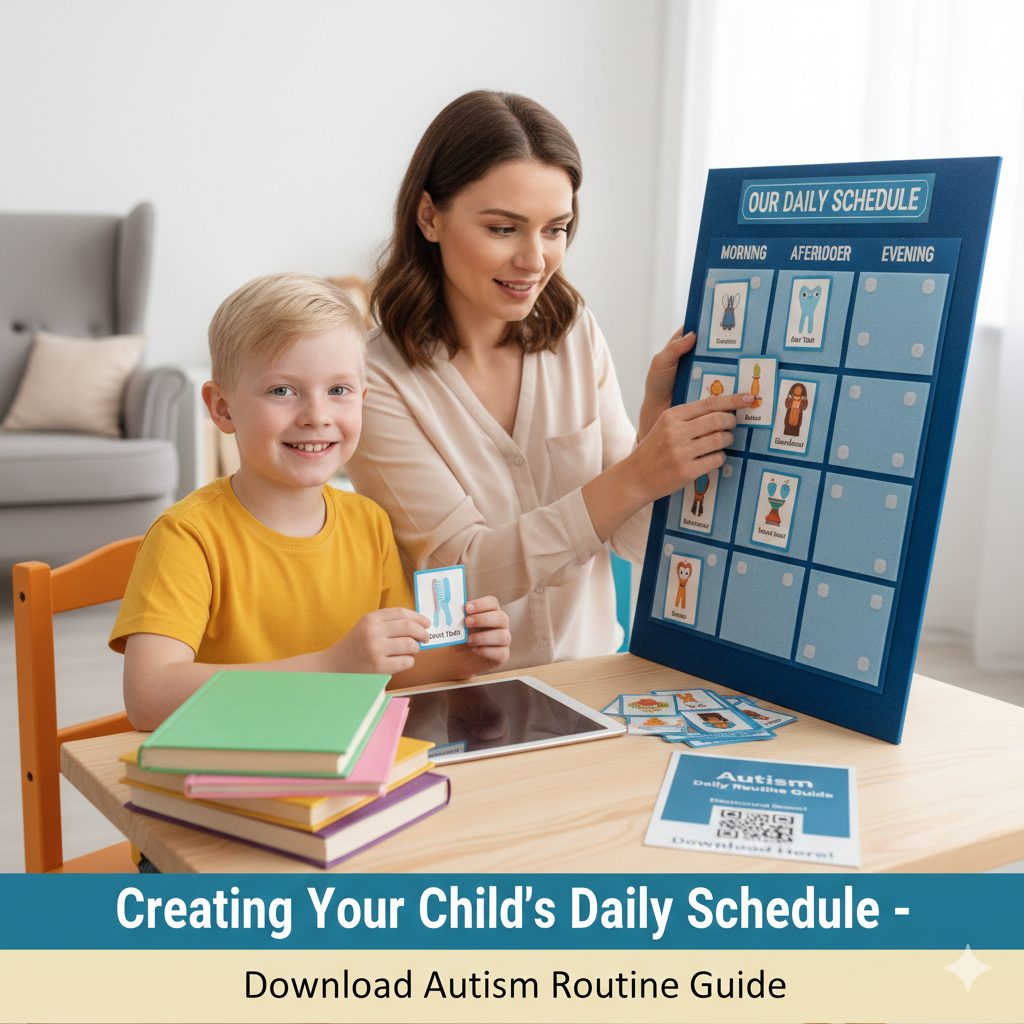
Step-by-Step Foundation Building
Begin with the most challenging parts of your day. For most families, this means starting with morning, mealtime, and bedtime routines. Research shows children who follow structured schedules demonstrate 35% higher engagement during therapy sessions Cross River Therapy4.
The science-based approach follows these phases:
Phase 1: Establish Anchor Points
Focus on consistent mealtimes and bedtimes first. These provide predictable foundation stones that reduce overall daily anxiety.
Phase 2: Visual Framework Creation
Convert verbal structures into visual formats. Use pictures, icons, or written words based on your child’s processing preferences.
Phase 3: Task Breakdown Application
Apply behavioral analysis techniques like task analysis to break complex routines (getting ready for school) into 4-6 manageable steps.
Phase 4: Independence Building
Gradually transfer routine management responsibility to your child using checklists, self-monitoring systems, and choice options.
Visual Support Tools That Work

Science-Backed Visual Strategies
Picture Schedules: These fundamental tools use images, symbols, or photographs representing daily activities. The key is matching complexity to your child’s developmental level younger children need literal photos, while older children can use symbolic representations.
First/Then Boards: Simple two-step display showing “First we [less preferred activity], then we [preferred activity].” Research indicates this reduces transition-related meltdowns by making expectations visually clear.
Visual Timers: These devices provide concrete representation of time passing, helping children understand when transitions will occur. Studies show electronic visual timers reduce transition anxiety by 45% compared to verbal warnings alone ABA Journey3.
Checklist Systems: Breaking complex routines into step-by-step sequences using removable checklist cards. Children experience satisfaction from completing each step, building confidence and independence.
Social Stories: Simple narratives that describe social situations and expected behaviors help children prepare for new routines or changes to existing schedules.
Managing Transitions and Changes
Proven Strategies for Smooth Changes
Transitions between activities trigger significant anxiety for many children with autism. The research demonstrates effective transition management requires multiple simultaneous approaches:
Predictive Cuing: Provide 5-minute, 2-minute, and 1-minute warnings using both visual and auditory cues. This countdown system gives children mental preparation time.
Consistent Language: Use exactly the same phrases for each transition. “In five minutes” should never become “soon” or “in a little while.” Research shows consistent language reduces transition-related behavior problems by 28% Cross River Therapy1.
Transition Objects: Allow children to carry familiar items between activities. This bridges the gap between settings and provides continuity and comfort.
Music and Song Cues: Simple melodies that signal specific transitions (cleanup song, bath song) create auditory predictability that many children find reassuring.
Preparation for Disruptions: When unavoidable changes occur, use advance preparation techniques including social stories, practice sessions, or visual previews of the new situation.
Building Independence Through Routines
Gradual Responsibility Transfer Techniques
The ultimate goal involves your child managing their own routine elements independently. Research from Vanderbilt’s Kennedy Center demonstrates that involving children in routine participation strengthens engagement and builds confidence ABA Journey3.
Develop independence systematically using these evidence-based methods:
Choice Integration: Offer limited options within routine structure. “Would you like to brush teeth before or after pajamas?” This maintains predictability while providing valuable decision-making practice.
Self-Monitoring Systems: Create simple check-off systems where children mark completed routine steps. Visual feedback reinforces success and provides clear progress tracking.
Gradual Complexity Increase: Start with simple 3-step routines and expand to more complex sequences as competence develops. Maintain success experiences at each level.
Positive Reinforcement Documentation: Keep visual records of successful routine completion. Charts, stamps, or digital apps provide concrete evidence of accomplishment.
Problem-Solving Skill Building: When routine disruption occurs, involve your child in finding solutions rather than simply providing fixes.
Adapting Routines for Different Ages
Age-Appropriate Adaptations
Early Childhood (Ages 2-5): Focus heavily on visual supports with real photographs. Keep routines brief (5-8 steps) and include substantial sensory breaks. The Zero to Three Foundation found consistent bedtime routines at this age improve both sleep and emotional regulation ABA Journey5.
School Age (Ages 6-12): Introduce more complex sequences and begin teaching time management concepts. Incorporate homework routines and chore responsibilities. Visual schedules can shift to more symbolic representations.
Adolescence (Ages 13-18): Develop systems for managing increased complexity including homework, extracurricular activities, and employment responsibilities. Emphasize digital scheduling tools and self-advocacy skills for requesting routine modifications.
Transition Age (18+): Focus on life skills integration including meal preparation, bill payment, and work schedules. Maintain core predictability while building flexibility for employment and relationship demands.
Common Challenges and Solutions
Evidence-Based Problem Resolution
Morning Rush Struggles: Prepare clothes and materials the night before. Create 5-minute song sequences for each task children with autism, reducing time pressure that triggers anxiety responses.
Mealtime Resistance: Offer limited menu choices within routine structure. Include preferred foods alongside small portions of new items. Research shows gradual introduction increases food acceptance by 40% without creating power struggles.
Bedtime Stalling: Implement consistent 30-minute sequences with clear transition markers. Use countdown timers and visual schedules showing each sequence step.
Weekend Disruptions: Create simplified weekend versions of school-day routines. Maintain mealtime and bedtime anchors while allowing more flexibility in activity sequences.
School Holiday Difficulties: Develop holiday-specific schedules before breaks begin. The UCLA Semel Institute recommends small, manageable changes to build resilience ABA Journey3.
Parent Action Plan
Your 30-Day Implementation Strategy
Week 1: Foundation Building
- Choose one anchor point (meal or bedtime) to standardize completely
- Create simple 4-step visual sequence for chosen routine
- Implement consistent time signals using your phone timer
- Document baseline behavior challenges
Week 2: Expansion and Refinement
- Add second routine anchor point
- Introduce choice options within successful routine
- Begin using visual timer for transitions
- Track improvements in cooperation and anxiety reduction
Week 3: Independence Development
- Create checklist system for your child to mark completed steps
- Begin fading some adult prompts in successful routines
- Practice flexibility by occasionally changing sequence order
- Add sensory break options between challenging sequence sections
Week 4: Advanced Integration
- Connect all major daily routines with consistent transition markers
- Prepare for inevitable schedule disruptions using advance warning systems
- Celebrate your child’s routine competence with age-appropriate rewards
- Begin planning for routine expansion as skills improve
Frequently Asked Questions
What age should I start implementing routines?
Research indicates routines benefit children with autism from early toddlerhood. Start with simple sequences around age 18-24 months using pictures. The earlier implementation begins, the more naturally routines become integrated into development.
How rigid should routines be?
Completely inflexible schedules create dependence problems. Effective routines maintain 80-85% predictability while allowing 15-20% flexibility for appropriate decision-making practice. This balance reduces anxiety while building essential adaptation skills.
Should we maintain routines during family vacations?
Preserve core anchor points (mealtime and bedtime) while accepting reasonable flexibility in other activities. Prepare your child using advance visual schedules showing trip activities and practice sessions for novel experiences.
How do I handle routine-resistant days?
Every child has difficult days. Maintain core structure while reducing complexity. Focus on safety and regulation over perfection. Return to standard routine patterns the following day without punishment or negative consequences.
Can routines help with toilet training?
Absolutely. Consistent bathroom scheduling combined with reward systems creates powerful learning opportunities. Many children with autism toilet train more successfully using structured routine approaches than traditional methods.
What if my child becomes obsessed with routines?
Some routines become unhelpful rituals requiring professional intervention. Warning signs include inability to function with any variation, distress over minor sequence changes, or obsessive questioning about schedules. Consult behavioral specialists if patterns seem rigid rather than supportive.
Related Articles for Continued Learning
- Autism and Sensory Overload: Creating Calm Spaces at Home
- Visual Schedules for Nonverbal Children: Step-by-Step Implementation
- Managing Autism Transitions: Beyond the Meltdown Cycle
- Building Life Skills Through Daily Routines
- Parent Self-Care Strategies for Autism Families
Conclusion: Your Road to Predictable Success
Creating effective routines for your autistic child represents one of the most powerful investments in their development and your family’s well-being. The evidence is overwhelming: structured schedules reduce anxiety by up to 40%, increase engagement during learning activities, and build independence skills that last throughout life
Remember, you don’t need perfect execution overnight. Start with one manageable change:perhaps standardizing bedtime timing or creating a morning visual schedule. Celebrate small successes as your child grows more comfortable with predictable structure. Each step forward builds confidence for both of you.
Your journey continues as these foundational skills develop. The systems you build now create launching pads for communication breakthroughs, social interaction improvements, and greater independence. You’re not just organizing daily activities:you’re providing essential developmental scaffolding that supports your child’s lifelong growth.
Take action today by selecting one routine from this guide and implementing it this week. Your future self (and child) will thank you for starting this transformation with patience, consistency, and the science-backed strategies that actually work.
Would you like personalized guidance for implementing these evidence-based routines with your child? Our free routine-planning toolkit provides customizable templates, visual schedule cards, and step-by-step implementation worksheets.
Download it today and transform chaos into predictable calm for your entire family.