
Why Does My Autistic Child Keep Jumping? 10 Safe Movement Activities to Try
Ten times before breakfast. Off the couch, off the bed, off a kitchen step that really was not built for it. If you searched "why does my autistic child keep jumping," you are probably not worried about the jumping itself, you are trying to understand what it means and whether you should be doing something about it.
Autistic children often jump repeatedly because it provides strong vestibular (movement and balance) and proprioceptive (body position) input at the same time. For a nervous system that processes these senses differently, jumping is an efficient way to feel regulated, alert, or calm, depending on the moment. It is usually a form of stimming, not a behavior that needs to be stopped, and it responds well to being redirected rather than blocked.
Why Autistic Children Jump So Much
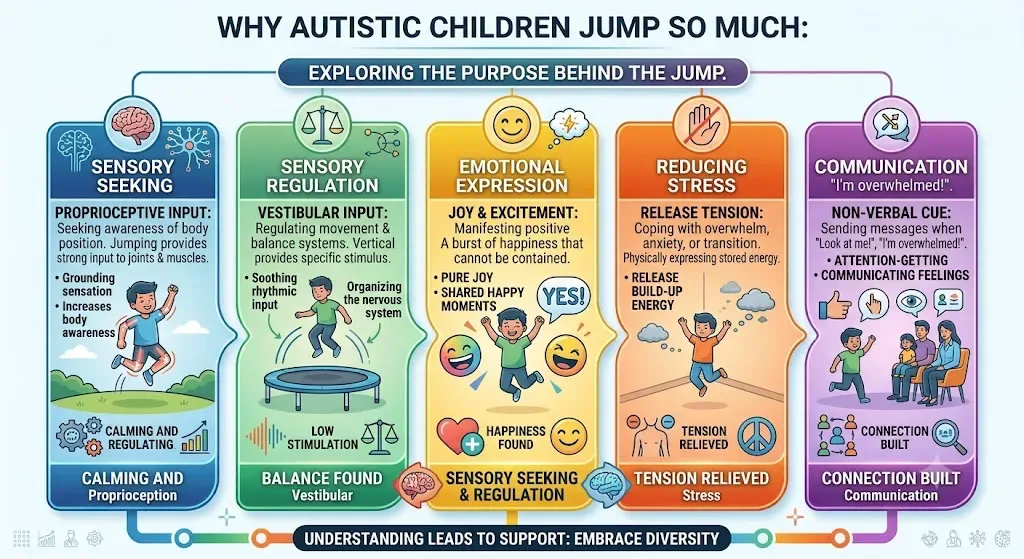
The five reasons behind jumping, at a glance
Jumping activates two sensory systems at once. The vestibular system, based in the inner ear, tracks movement and balance. The proprioceptive system, based in the muscles and joints, tracks where the body is in space. Landing from a jump sends a strong, clear signal through both, which is part of why it feels so satisfying to repeat.
Many autistic children process vestibular and proprioceptive input differently from their peers, sometimes needing much more of it to register the same sense of "enough." A study by Boyd and colleagues, published in the journal Autism Research, found that sensory seeking behaviors, including a strong pull toward vestibular input such as jumping and spinning, were closely linked to the repetitive behaviors seen in children with autism and developmental delays. Researchers describe this as a difference in sensory processing thresholds: some children are hyposensitive to movement input and actively seek out intense experiences like jumping, spinning, or crashing to get the input their body is asking for.
This is not a behavior problem to correct. It is closer to how a fidgety adult might tap a foot through a long meeting; the movement is doing real regulatory work, even if it looks unrelated to what is happening around it.
Is Jumping a Form of Stimming?
Yes. Jumping sits alongside spinning, rocking, and hand-flapping as one of the most common vestibular stims in autism. Stimming in general is a self-regulating behavior, not a symptom that needs eliminating, and jumping specifically is one of the more energy-intensive and visible forms of it.
Our complete guide to stimming in autism covers the full range of these behaviors and when, if ever, a stim is worth gently redirecting rather than simply allowing.
When Jumping Might Mean Something Else
The same movement can carry different meanings depending on what surrounds it. A few patterns worth noticing:
Excitement
Jumping paired with laughing, looking at you, or happening right after good news is usually joy finding an outlet.
Sensory seeking
Jumping that happens at fairly predictable times of day, such as after school or before a task requiring focus, often signals a need for input before settling.
Overwhelm release
Jumping right after a loud, crowded, or overstimulating event is frequently the body discharging built-up sensory load.
Anxiety
Jumping paired with distress, avoidance, or trying to leave a situation is worth watching more closely, and may need a calming activity rather than a movement one.
10 Safe Movement Activities to Try
The goal is not to stop the jumping, it is to give the same vestibular and proprioceptive input a safer, more contained outlet. These proprioceptive activities for autism and vestibular activities for autism work well as substitutes or scheduled outlets:
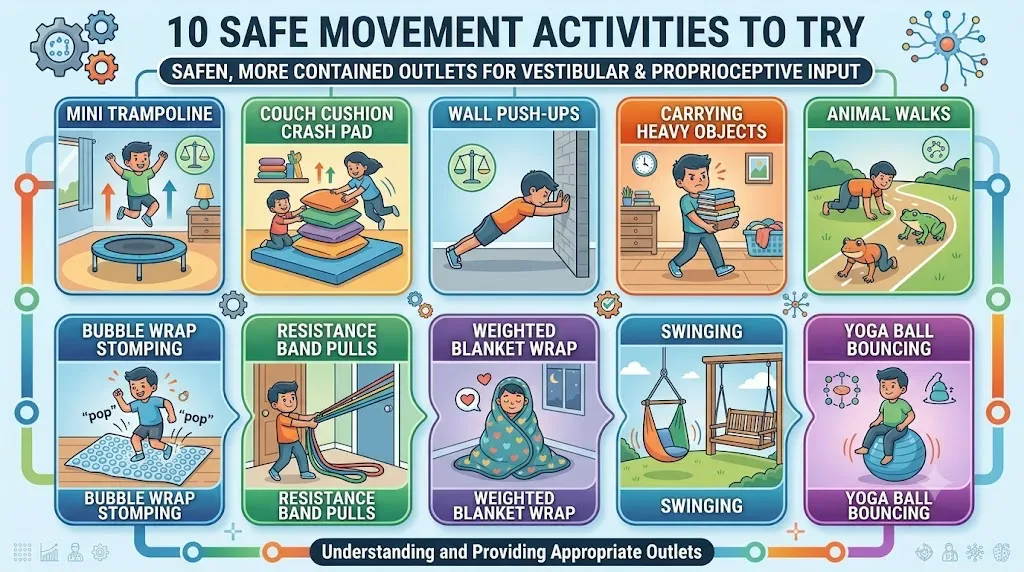
All 10 activities at a glance
- Mini trampoline: the single most direct replacement for jumping, and safe for indoor use.
- Couch cushion crash pad: stack cushions on the floor and allow jumping onto them from a low, safe height.
- Wall push-ups: pushing against a wall provides proprioceptive input without any impact.
- Carrying something heavy: a stack of books or a loaded laundry basket across the room gives deep pressure input.
- Animal walks: bear crawls or frog jumps combine movement with the same landing sensation in a lower-impact form.
- Bubble wrap stomping: a large sheet on the floor gives a satisfying tactile and proprioceptive payoff.
- Resistance band pulls: looped around a doorframe, safe for a quick burst of muscle input.
- Weighted blanket wrap: for calming rather than seeking moments, when the jumping seems to be discharging overwhelm.
- Swinging: a porch swing or indoor sensory swing meets the vestibular need without the jumping impact.
- Yoga ball bouncing: sitting and bouncing on a large stability ball gives rhythmic vestibular input while seated.
These pair naturally with the fuller list in our autism activities at home guide, particularly the gross motor and sensory sections, which cover more options across every skill area, not only movement.
Building a Movement Break Into the Day
Waiting for jumping to start and then reacting is more tiring than planning for it. Most families find it easier to schedule two or three short movement breaks at predictable points, such as after school, before homework, and before bedtime, rather than treating every jump as something to respond to individually.
A visual timer or a simple picture card signaling "jump time" can also help a child move the behavior to the scheduled slot more easily, since the input is still guaranteed to arrive, just on a slightly different schedule.
When to Talk to a Therapist
Most jumping does not need professional intervention. It is worth raising with an occupational therapist if the jumping is increasing sharply, causing injuries, seems to be the only way your child can calm down, or is starting to crowd out other activities they used to enjoy. An OT can also assess whether a broader sensory diet, a planned mix of input across the day, would help balance things out.
Frequently Asked Questions
Why does my autistic child jump so much?
Jumping activates the vestibular system (balance and movement sense) and the proprioceptive system (body position sense) at the same time. Many autistic children process these senses differently and jump to get intense, organizing input their body is asking for, in the same way someone might stretch or crack their knuckles to feel more settled.
Is jumping a type of stimming?
Yes, jumping is one of the most common vestibular stims, alongside spinning, rocking, and swinging. It is generally considered a harmless, self-regulating behavior rather than something that needs to be stopped, unless it is happening in an unsafe location or interfering with something your child needs to do.
Should I try to stop my child from jumping?
Not usually. Stopping a self-regulating behavior without offering an alternative way to meet the same sensory need often increases distress rather than reducing the jumping. A more effective approach is redirecting the same input to a safer time or place, such as a trampoline or a cushioned area, rather than eliminating it.
What does it mean if my child jumps when excited versus when upset?
The same movement can serve different purposes at different moments. Jumping during happy, high-energy moments is usually regulating excitement, while jumping during or after a stressful moment is more often a way of discharging overwhelm. Watching what happens right before the jumping starts usually tells you which one it is.
How much jumping is too much?
There is no fixed number that counts as too much. It becomes worth a closer look if jumping is causing injury, happening in unsafe places like near stairs or roads, or if it is the only way your child can access any sensory input, leaving no time for other activities.
What are proprioceptive activities and how are they different from vestibular ones?
Proprioceptive input comes from muscles and joints and tells the brain where the body is in space, activated by pushing, pulling, squeezing, or carrying something heavy. Vestibular input comes from the inner ear and relates to movement and balance, activated by spinning, swinging, or jumping. Jumping actually provides both at once, which is part of why it feels so satisfying.
Can a trampoline replace other sensory activities?
A trampoline is an excellent single tool for vestibular and proprioceptive input, but it should not be the only sensory activity available. Children benefit from a range of input, including calming activities like heavy work and deep pressure, not only the more intense movement a trampoline provides.
When should I talk to a therapist about my child's jumping?
Bring it up with an occupational therapist if the jumping seems to be increasing, is starting to cause injuries, is the only way your child can calm down, or if you notice it replacing other activities your child used to enjoy. An OT can assess whether a full sensory diet would help balance out the day.
Do non-autistic children jump for the same reasons?
All children seek vestibular input to some degree, which is why playgrounds have swings and trampoline parks are popular with every kind of child. The difference in autism is usually in intensity and frequency; the same need for movement is there, but the drive to meet it can be stronger and more constant.
Not sure whether your child is sensory-seeking or sensory-avoiding?
Our free tool helps you build a sensory profile in a few minutes, useful before picking which activities to try first.
Free Sensory Profile & Support Tool for Parents →Sources: DSM-5, WHO ICD-11, Boyd et al. (2010), Autism Research, 3(2), 78-87, Action for Autism India.