
Blowing Nose Visual Schedule for Autistic Children
A blowing-nose visual schedule shows the 8 steps of this surprisingly complex motor-sequencing skill, which many children benefit from having broken into small taught steps.
At a Glance
- What it is: A free, 8-step printable visual schedule for independently blowing the nose.
- Who it's for: Autistic children who need predictable, picture-based routines.
- Format: One-page PDF, print or laminate.
- Best for ages: Roughly 3+, adjusted to your child's current skill level.
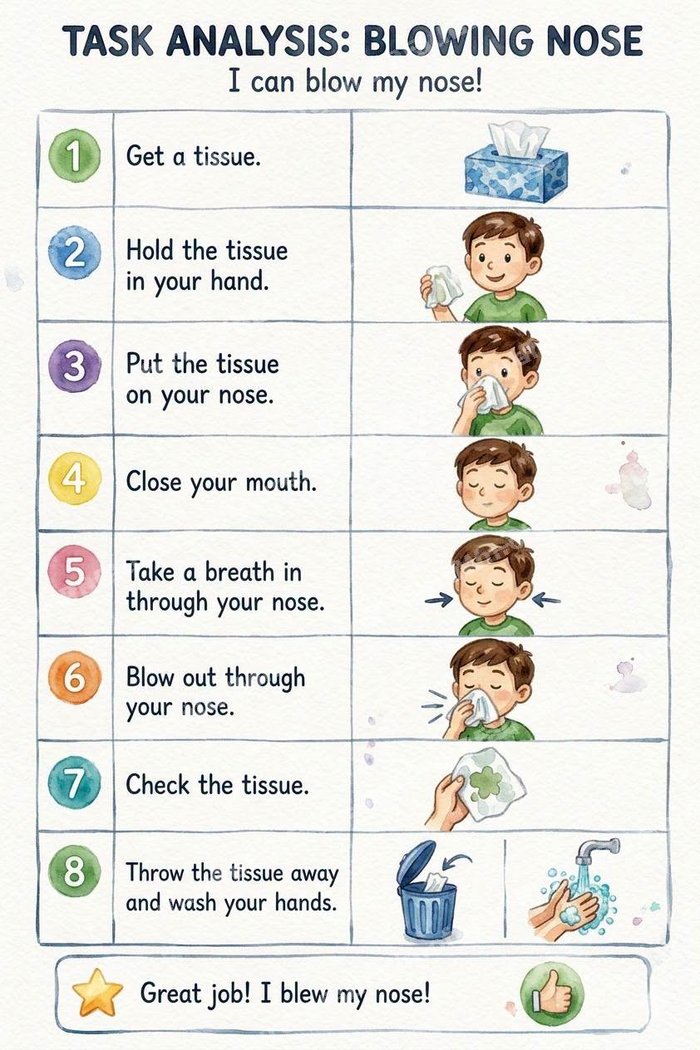
Preview of the printable chart — download the full-resolution, watermark-free PDF below.
What's in this guide
- Why a visual schedule helps
- What you'll get in the free PDF
- How to use it
- If Your Child Can't Blow Through Their Nose Yet
- Frequently asked questions
Why a Visual Schedule Helps
Blowing your nose requires coordinating breath, mouth-closing and nose-blowing all at once — a motor sequence that doesn't come naturally and benefits from being broken into small taught steps, just like any other self-care skill.
What You'll Get in the Free PDF
A single-page, 8-step visual task analysis:
- Get a tissue
- Hold tissue in hand
- Put tissue on nose
- Close your mouth
- Breathe in through nose
- Blow out through nose
- Check the tissue
- Throw away & wash hands
Get the Free Blowing Nose Visual Schedule PDF
Enter your details below and we'll email the printable PDF to you instantly.
How to Use It
Practice steps 5-6 separately first: have your child close their mouth and simply breathe in and out through their nose a few times without a tissue, to build the sensation before adding the blow.
If Your Child Can't Blow Through Their Nose Yet
Some children need an interim step of wiping instead of blowing — that's a reasonable adaptation. Revisit the full blowing sequence again in a few months as motor skills develop.
Frequently Asked Questions
Why is blowing your nose hard to learn?
It requires coordinating breath, mouth-closing and nose-blowing all at once — a motor sequence that doesn't come naturally and benefits from being broken into small taught steps.
My child blows through their mouth instead of their nose — any tips?
Practice step 5-6 separately first: have your child close their mouth and breathe in and out through their nose a few times without a tissue, to build the sensation before adding the blow.
What if my child can't blow at all yet?
Some children need an interim step of wiping instead of blowing — that's a reasonable adaptation; revisit blowing again in a few months.