
Jump to Guide 👉
- Understanding Autism Learning Profiles
- Common Learning Strengths in Autism
- Learning Challenges to Support
- How to Create the Optimal Home Learning Environment
- Evidence-Based Autism Learning Support at Home Strategies
- Homeschooling Autistic Child Tips
- Autism School Readiness Activities
- Pre-Academic Skills Development
- Classroom Behavior Preparation
- Autism Learning Difficulties Solutions: Targeted Interventions
- Best Learning Activities for Autistic Child: Engagement Through Play
- Autism Focus and Attention Activities
- Autism Homework Routine Tips: Reducing Stress and Increasing Success
- Handling Homework Resistance
- Resources for Autism Learning Support at Home
- Building Your Family’s Learning Success Plan
Introduction: Empowering Your Child’s Learning Journey at Home
Providing effective autism learning support at home can transform your child’s educational experience and unlock their full potential. Whether you’re supplementing traditional schooling, exploring homeschooling options, or supporting your child through learning difficulties, understanding evidence-based strategies is essential for every parent and educator.
Approximately 70% of autistic children face learning challenges that require specialized support approaches. However, with the right strategies, structured environment, and consistent implementation, every autistic child can thrive academically and develop essential life skills.
This comprehensive guide provides practical autism learning support at home strategies, homeschooling autistic child tips, school readiness activities, solutions for learning difficulties, focus-building exercises, and homework routine tips that work. You’ll discover actionable activities, proven resources, and expert-backed methods to create a successful learning environment for your child.

Understanding Autism Learning Profiles: Your Child’s Unique Strengths
Autistic children often have distinctive learning profiles with exceptional strengths alongside specific challenges. Understanding this profile is the foundation of effective autism learning support at home.
Common Learning Strengths in Autism:
- Visual Learning Excellence: Many autistic children are strong visual processors who learn best through pictures, diagrams, and written information
- Detail-Oriented Processing: Exceptional ability to notice patterns, details, and systematic approaches
- Deep Interest Learning: Intense focus on special interests can be leveraged for educational motivation
- Concrete Thinking Skills: Strong ability with factual information, rules, and logical sequences
- Memory for Specific Information: Often remarkable recall for details in areas of interest
Learning Challenges to Support:
- Executive Function Difficulties: Challenges with planning, organization, time management, and task initiation
- Flexible Thinking: Difficulty adapting to changes, transitions, or unexpected situations
- Abstract Concepts: Struggles with inferential thinking, reading comprehension beyond literal meaning
- Sensory Processing: Environmental factors (noise, lighting, textures) significantly impact learning capacity
- Social Communication: Group work, verbal instructions, and social classroom demands may be challenging
According to research published in Focus on Autism and Other Developmental Disabilities, implementing evidence-based educational interventions that address these unique profiles significantly improves academic outcomes for autistic learners.
Creating the Optimal Home Learning Environment
The foundation of successful autism learning support at home starts with the physical and sensory environment.
1. Structured Learning Space Design
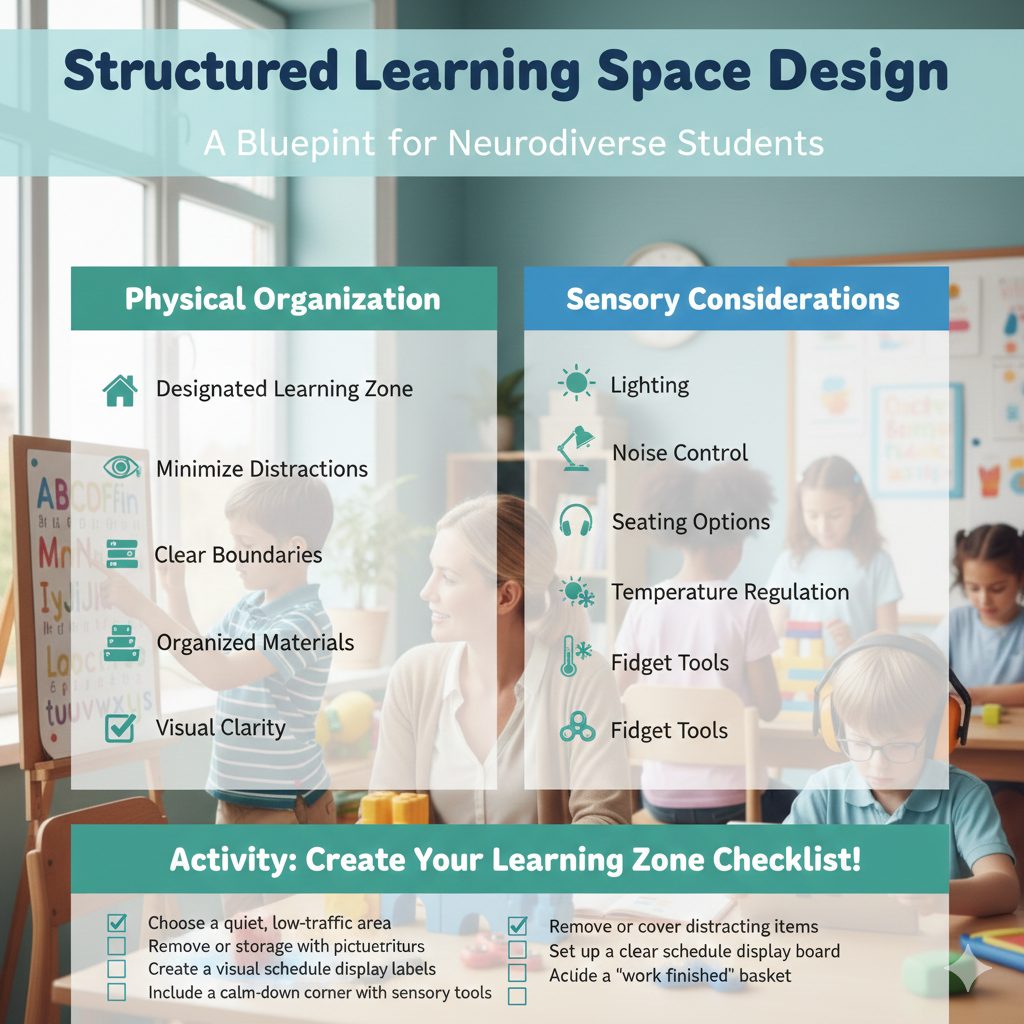
Physical Organization:
- Designated Learning Zone: Create a specific area exclusively for learning activities, separate from play spaces
- Minimize Distractions: Face the workspace toward a wall rather than windows; use neutral wall colors
- Clear Boundaries: Use rugs, tape on the floor, or furniture placement to define the learning area
- Organized Materials: Use labeled bins, shelves, and containers so everything has a designated place
- Visual Clarity: Keep surfaces clutter-free; only present materials needed for the current activity
Sensory Considerations:
- Lighting: Natural lighting is ideal; avoid fluorescent lights which can be overstimulating. Use adjustable lamps.
- Noise Control: Use noise-canceling headphones, white noise machines, or soft background music if helpful
- Seating Options: Provide alternatives like wobble cushions, therapy balls, or standing desks for movement needs
- Temperature Regulation: Ensure comfortable temperature; have blankets or fans available
- Fidget Tools: Keep discrete fidget items accessible (stress balls, fidget spinners, textured objects)
Activity: Create Your Learning Zone Checklist
- Choose a quiet, low-traffic area of your home
- Remove or cover distracting items (toys, electronics, clutter)
- Set up clear storage with picture labels
- Create a visual schedule display board
- Add a “work finished” basket for completed tasks
- Include a calm-down corner with sensory tools
Evidence-Based Autism Learning Support at Home Strategies
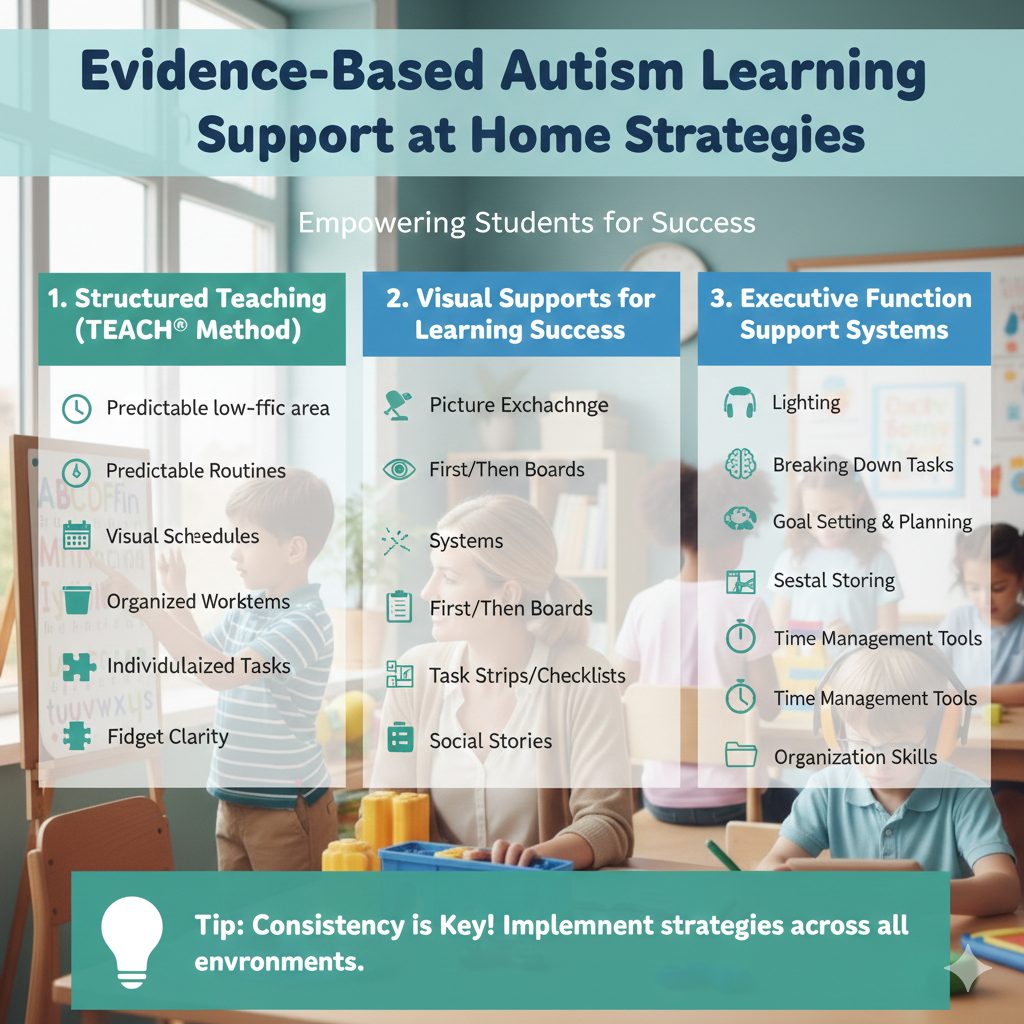
1. Structured Teaching (TEACCH Method)
The TEACCH (Treatment and Education of Autistic and Related Communication-Handicapped Children) approach is one of the most effective autism learning support at home methods, emphasizing visual structure and predictability.
Four Core TEACCH Components:
Physical Structure:
- Clearly defined areas for different activities (work area, break area, play area)
- Visual boundaries help children understand where activities occur
- Reduces confusion and increases independence
Visual Schedules:
- Picture or written schedules showing the sequence of activities
- Helps children understand what’s happening now and what comes next
- Reduces anxiety about transitions and unexpected changes
Work Systems:
- Visual systems answering: What work? How much work? When am I finished? What happens next?
- Can use left-to-right systems, top-to-bottom checklists, or numbered task sequences
- Promotes independence and task completion
Visual Structure of Tasks:
- Clear visual instructions showing what to do
- Materials organized to show what’s needed
- Visual cues indicating how to complete the task
Implementation Example:
Create a simple work system using a three-basket approach:
- Red Basket (left side): Tasks to be completed
- Work Space (center): Where child completes task
- Green Basket (right side): Finished work goes here
Child knows they’re done when the red basket is empty!
2. Visual Supports for Learning Success
Visual supports are among the most powerful best learning activities for autistic child development, providing concrete information that supports comprehension and independence.
Types of Visual Learning Supports:
Daily Learning Schedules:
Use picture or photo schedules showing:
- Morning subjects (math, reading, writing)
- Break times
- Lunch
- Afternoon activities
- Transition to free time
Task Analysis Charts:
Break complex tasks into steps with pictures:
- Getting started (gather materials)
- Step 1, 2, 3 (each with visual)
- Check work
- Put materials away
- Mark “finished”
Visual Instructions:
- Step-by-step picture guides for multi-step problems
- Graphic organizers for writing assignments
- Visual math manipulatives and number lines
- Color-coded systems for different subjects
Choice Boards:
Offer visual choices for:
- Learning activities (math games vs. worksheets)
- Break activities (movement vs. quiet time)
- Reward options after work completion
Activity: Create Subject-Specific Visual Schedules
Math Time Visual:
- Get math notebook and pencil (picture)
- Review today’s concept (picture of teacher/video)
- Complete 5 practice problems (show 5 fingers)
- Check answers with answer key (checkmark picture)
- Earn break time (preferred activity picture)
3. Executive Function Support Systems
Executive function difficulties are common in autism, impacting planning, organization, and task completion. Implementing external support systems is crucial for autism learning support at home.
Planning and Organization Strategies:
Visual Planners:
- Use large wall calendars with color-coding for different subjects
- Weekly planning boards showing assignments due each day
- Monthly overview with tests, projects, and special events marked
Assignment Tracking:
- Assignment notebooks with visual checkboxes
- Color-coded folders for different subjects (Red=Math, Blue=Reading)
- “To Do/Doing/Done” visual tracking boards
Time Management Tools:
- Visual timers showing time remaining (Time Timer or digital countdown)
- Time estimation practice: “This will take 10 minutes” with timer
- Break timers: “5-minute break, then back to work”
Task Breakdown Systems:
Large assignments broken into manageable chunks:
- Book report → Read chapter 1, Read chapter 2, Make notes, Write draft, Edit, Final copy
- Each step becomes a separate task card
- Child completes one card at a time, seeing progress visually
Activity: Weekly Planning Routine
Every Sunday evening:
- Review the week ahead on visual calendar
- Write each assignment on a separate task card
- Estimate time needed for each (use timer next week to check accuracy)
- Place cards in daily slots on planning board
- Build in buffer time for unexpected challenges
- Add preferred activities as rewards for completion
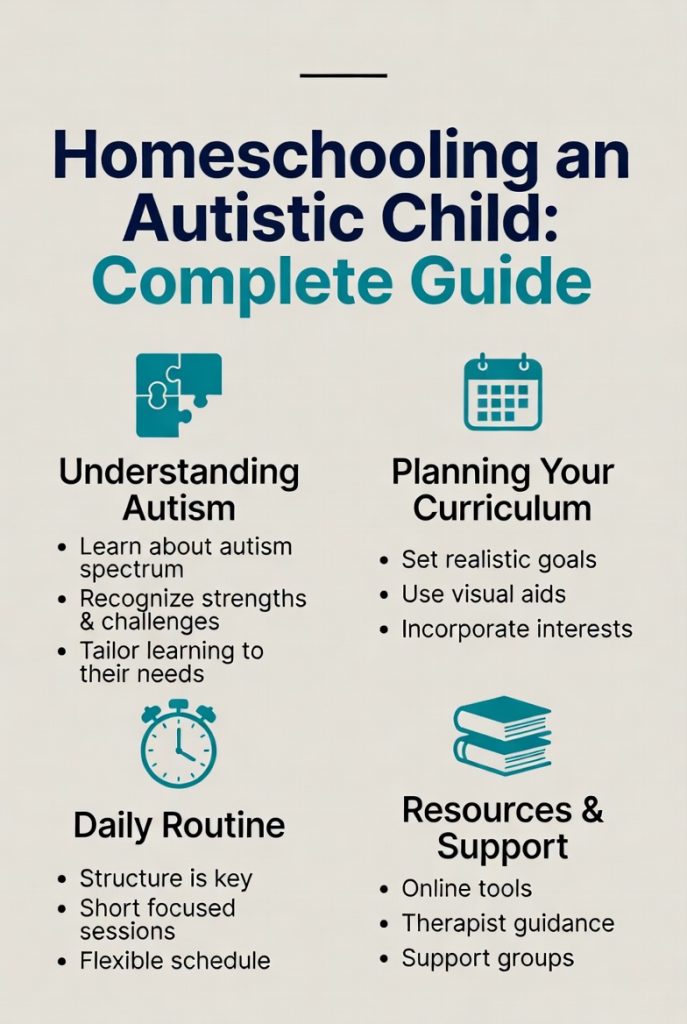
Homeschooling Autistic Child Tips: Complete Guide
Whether full-time homeschooling or supplementing traditional school, these homeschooling autistic child tips create structure, reduce stress, and maximize learning.
1. Establishing Predictable Routines
Routine is the cornerstone of successful homeschooling for autistic children.
Creating Your Homeschool Routine:
Consistent Daily Schedule:
8:00 AM - Morning routine (breakfast, get dressed, prepare workspace)
8:30 AM - Circle time (calendar, weather, schedule review)
9:00 AM - Academic subject 1 (usually most challenging when fresh)
9:45 AM - Movement break
10:00 AM - Academic subject 2
10:45 AM - Snack and sensory break
11:00 AM - Academic subject 3
11:45 AM - Creative/hands-on learning
12:30 PM - Lunch and outdoor time
1:30 PM - Quiet reading/independent work
2:00 PM - Special interest time/enrichment
2:30 PM - Review tomorrow's schedule
3:00 PM - School day ends
Schedule Flexibility:
- Have “backup activities” for difficult days
- Build in choice time where child selects activity order
- Allow for intense special interest exploration (this IS learning!)
- Schedule breaks before frustration builds, not after
2. Curriculum Adaptation Strategies
Modifications for Autistic Learners:
Use Multi-Sensory Approaches:
- Math: Use physical manipulatives (blocks, beads, coins)
- Reading: Incorporate movement with letters, act out stories
- Science: Hands-on experiments rather than just textbook reading
- Writing: Use dictation software, typing, or fill-in-the-blank initially
Incorporate Special Interests:
- Dinosaur enthusiast? Math problems about dinosaurs, reading books about paleontology
- Trains lover? Learn geography through train routes, physics of motion
- Video games? Programming basics, problem-solving through game design
Provide Clear Success Criteria:
- Show examples of completed work
- Rubrics with visual indicators of expectations
- Checklists so child knows exactly what “finished” means
Activity: Interest-Based Learning Week
Choose your child’s passionate interest and create:
- Monday Math: Word problems themed around the interest
- Tuesday Reading: Books, articles, or videos about the topic
- Wednesday Writing: Write facts, create stories, or make lists related to interest
- Thursday Science/Social Studies: Research projects on the interest
- Friday Art/Creativity: Create projects related to the interest
3. Social Skills Integration in Homeschooling
Contrary to concerns, homeschooling can provide excellent social learning opportunities with less overwhelm.
Structured Social Opportunities:
- Co-op Classes: Join homeschool groups for specific subjects or activities
- Special Interest Clubs: Robotics clubs, chess clubs, art classes aligned with interests
- Community Activities: Library programs, museum classes, sports leagues
- Volunteer Work: Animal shelters, food banks (structured, predictable social interaction)
- Online Social Groups: Moderated forums or video calls with shared interests
Social Skills Practice at Home:
- Role-play common social scenarios
- Use social stories before new situations
- Video modeling of expected behaviors
- Practice with siblings or parents in low-pressure situations
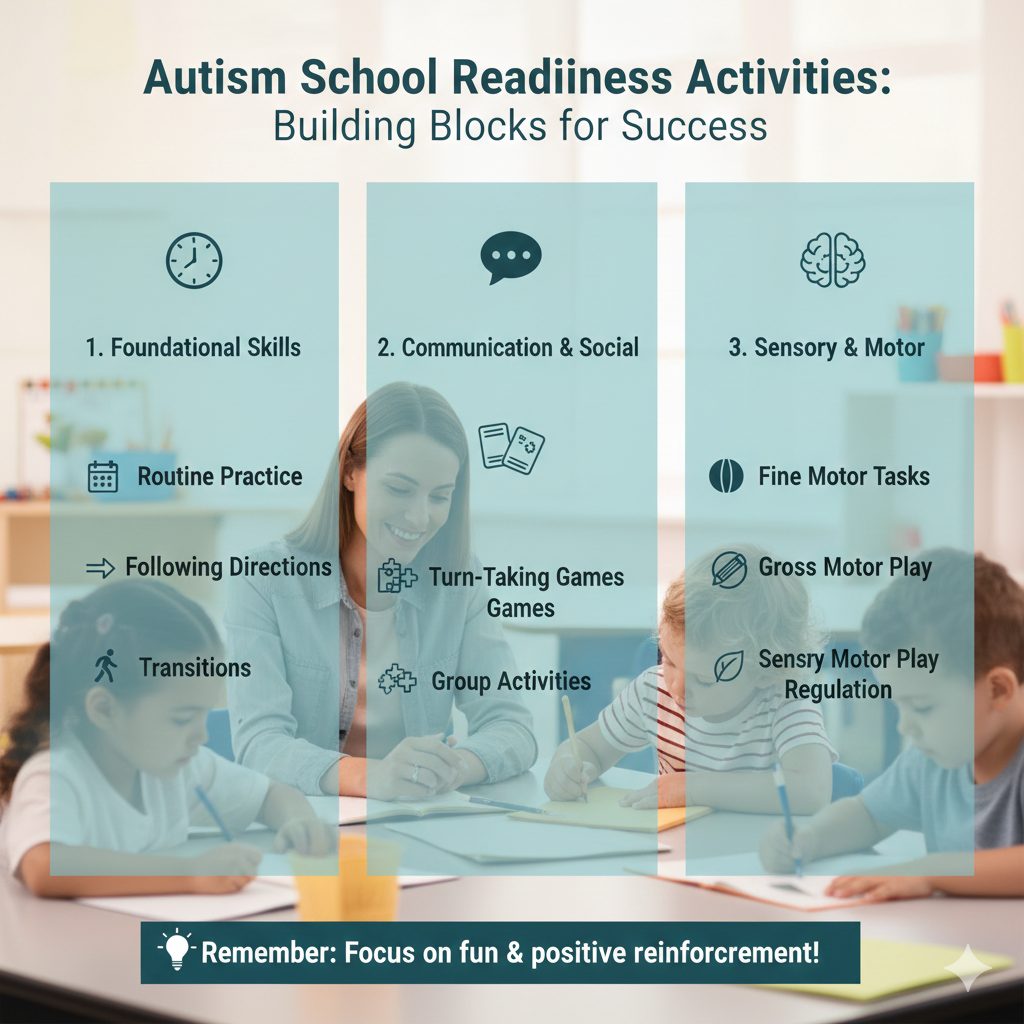
Autism School Readiness Activities: Preparing for Success
Whether transitioning to preschool, kindergarten, or a new school, these autism school readiness activities build essential skills.
Pre-Academic Skills Development
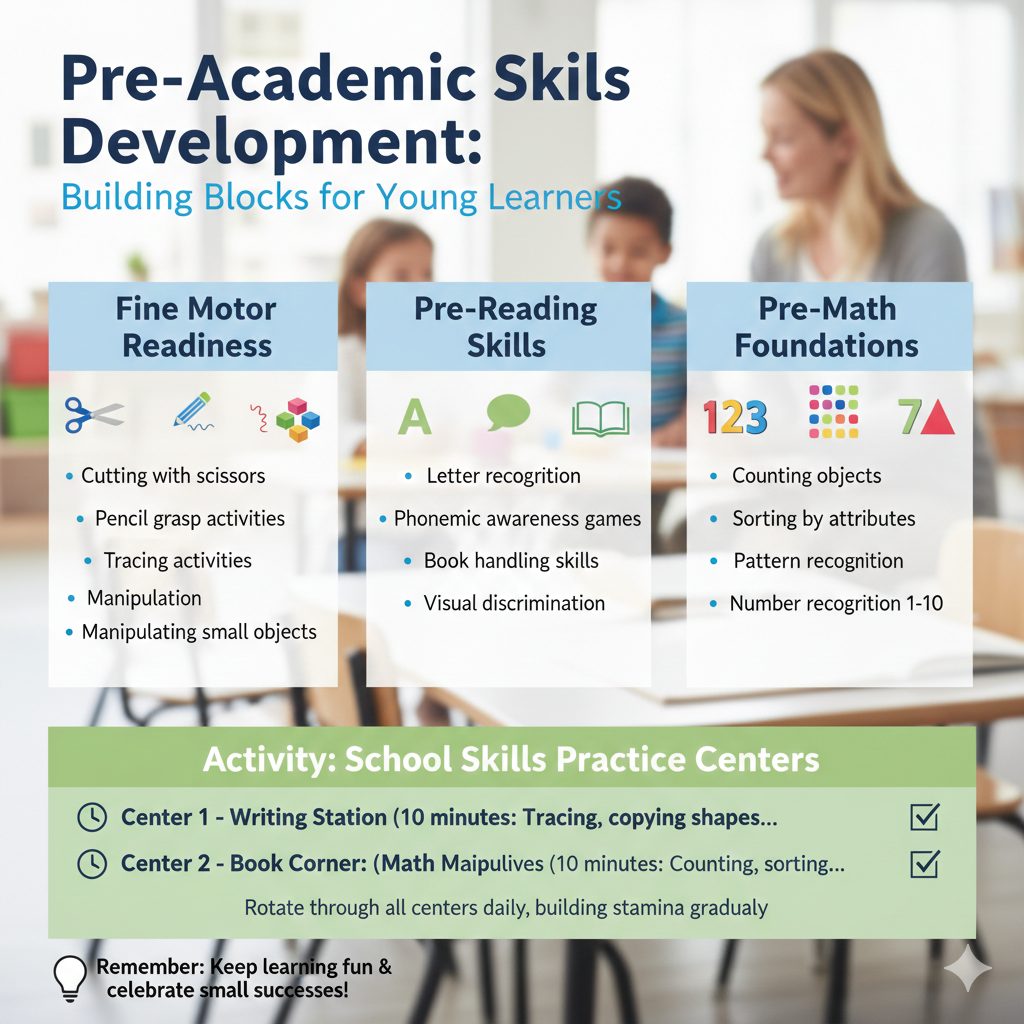
Fine Motor Readiness:
- Cutting with scissors (start with play dough, then paper)
- Pencil grasp activities (tweezers, tongs, clothespins for strength)
- Tracing activities progressing to writing
- Manipulating small objects (beads, buttons, Legos)
Pre-Reading Skills:
- Letter recognition through multi-sensory methods (sandpaper letters, letter building with play dough)
- Phonemic awareness games (rhyming, first sound identification)
- Book handling skills (front to back, left to right, top to bottom)
- Visual discrimination (matching identical pictures/letters)
Pre-Math Foundations:
- Counting objects with one-to-one correspondence
- Sorting by attributes (color, size, shape)
- Pattern recognition and creation
- Number recognition 1-10
Activity: School Skills Practice Centers
Center 1 – Writing Station (10 minutes):
Tracing, copying shapes, pre-writing strokes
Center 2 – Book Corner (10 minutes):
Looking at books, identifying pictures, answering simple questions
Center 3 – Math Manipulatives (10 minutes):
Counting, sorting, creating patterns
Center 4 – Independence Skills (10 minutes):
Zipping, buttoning, opening containers, putting away materials
Rotate through all centers daily, building stamina gradually.
Classroom Behavior Preparation
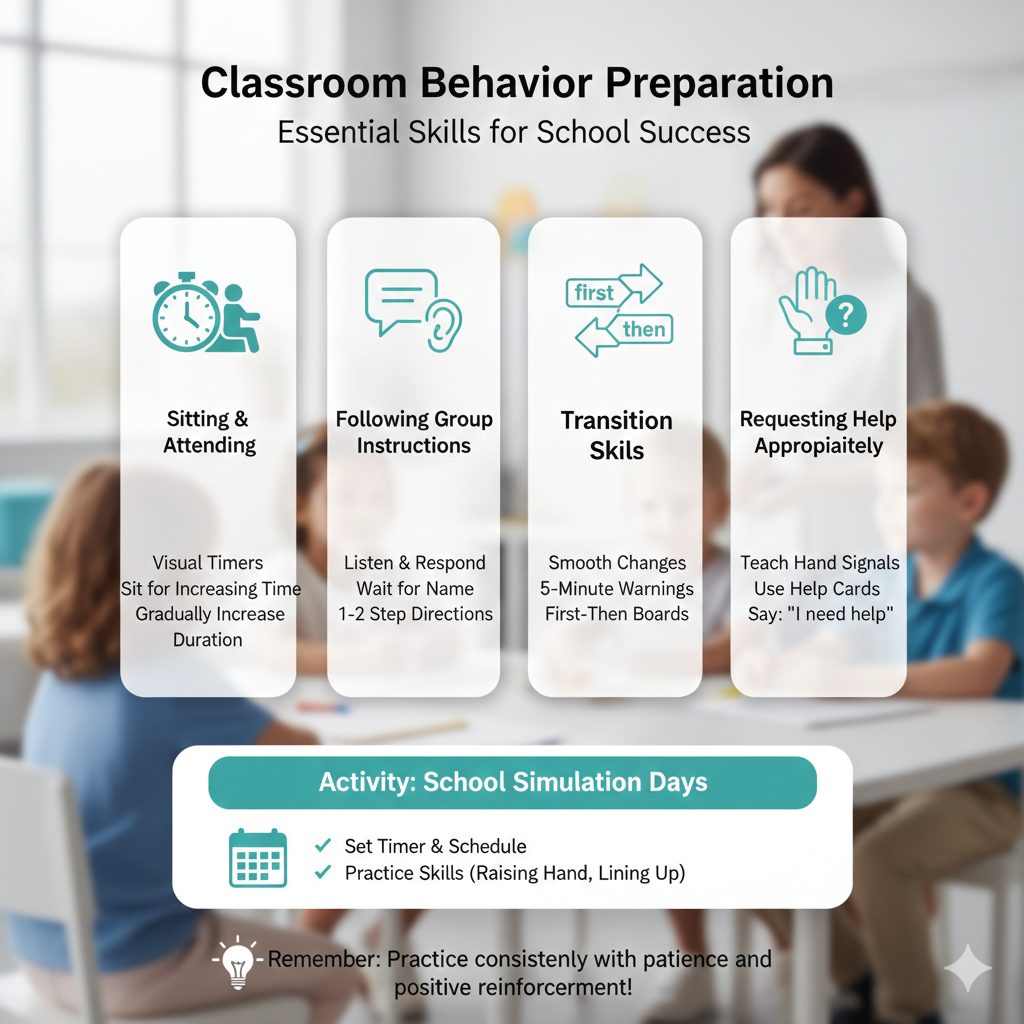
Essential School Behaviors:
Sitting and Attending:
- Practice sitting for increasing durations (start with 5 minutes)
- Use visual timers so child knows when sitting time ends
- Gradually increase to age-appropriate periods (kindergarten: 10-15 minutes)
Following Group Instructions:
- Practice listening when others are present (siblings, family members)
- Wait for name to be called before responding
- Follow 1-2 step directions given to a group
Transition Skills:
- Practice moving between activities with minimal resistance
- Use transition warnings: “5 more minutes, then we clean up”
- First-then boards: “First math, then playground”
Requesting Help Appropriately:
- Teach hand-raising rather than calling out
- Practice: “I need help with ___” or “I don’t understand”
- Use help cards if verbal requests are challenging
Activity: School Simulation Days
Once weekly, simulate school conditions:
- Set timer for “school day” schedule
- Include “classmates” (stuffed animals, family members)
- Practice raising hand for questions
- Have scheduled bathroom breaks (not whenever wanted)
- Use playground/gym time for movement breaks
- Practice lining up, walking in line
- Debrief: What went well? What was hard?
Autism Learning Difficulties Solutions: Targeted Interventions
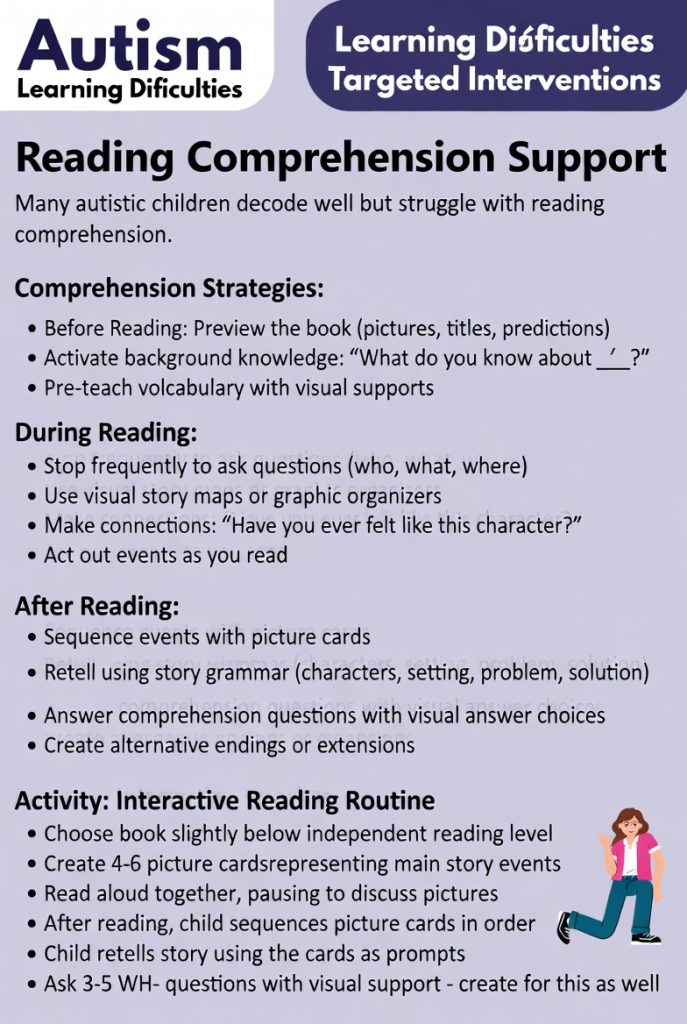
Reading Comprehension Support
Many autistic children decode well but struggle with reading comprehension.
Comprehension Strategies:
Before Reading:
- Preview the book (pictures, titles, predictions)
- Activate background knowledge: “What do you know about ___?”
- Pre-teach vocabulary with visual supports
During Reading:
- Stop frequently to ask questions (who, what, where)
- Use visual story maps or graphic organizers
- Make connections: “Have you ever felt like this character?”
- Act out events as you read
After Reading:
- Sequence events with picture cards
- Retell using story grammar (characters, setting, problem, solution)
- Answer comprehension questions with visual answer choices
- Create alternative endings or extensions
Activity: Interactive Reading Routine
- Choose book slightly below independent reading level
- Create 4-6 picture cards representing main story events
- Read aloud together, pausing to discuss pictures
- After reading, child sequences picture cards in order
- Child retells story using the cards as prompts
- Ask 3-5 WH- questions with visual support
Math Concept Development
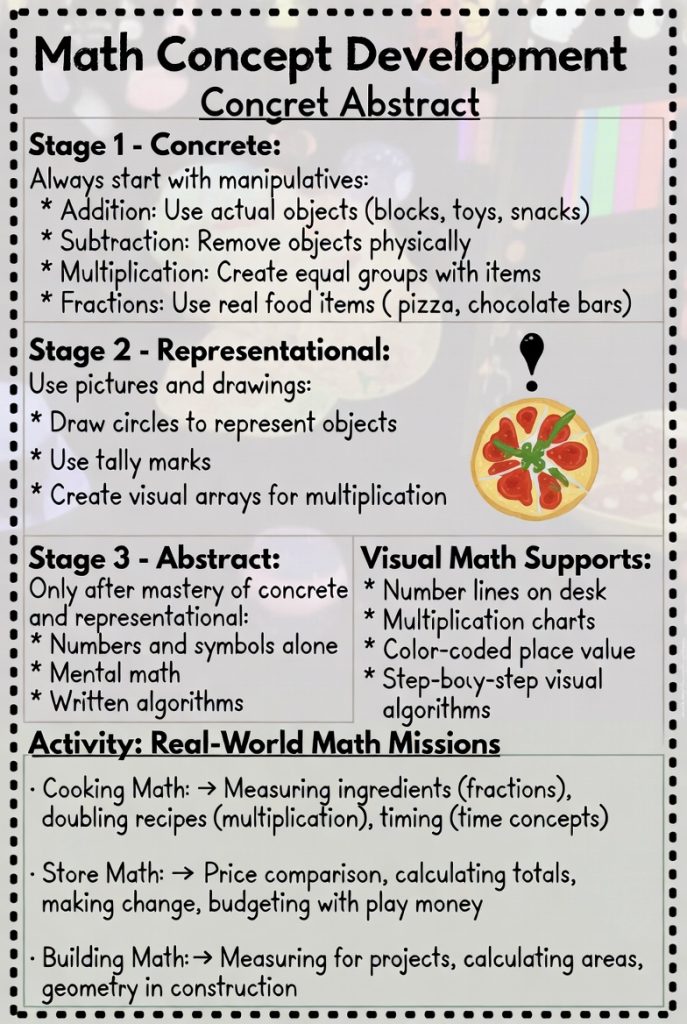
Concrete to Abstract Progression:
Stage 1 – Concrete:
Always start with manipulatives:
- Addition: Use actual objects (blocks, toys, snacks)
- Subtraction: Remove objects physically
- Multiplication: Create equal groups with items
- Fractions: Use real food items (pizza, chocolate bars)
Stage 2 – Representational:
Use pictures and drawings:
- Draw circles to represent objects
- Use tally marks
- Create visual arrays for multiplication
Stage 3 – Abstract:
Only after mastery of concrete and representational:
- Numbers and symbols alone
- Mental math
- Written algorithms
Visual Math Supports:
- Number lines on desk
- Multiplication charts
- Color-coded place value systems
- Step-by-step visual algorithms
Activity: Real-World Math Missions
Cooking Math:
Measuring ingredients (fractions), doubling recipes (multiplication), timing (time concepts)
Store Math:
Price comparison, calculating totals, making change, budgeting with play money
Building Math:
Measuring for projects, calculating areas, geometry in construction
Written Expression Support
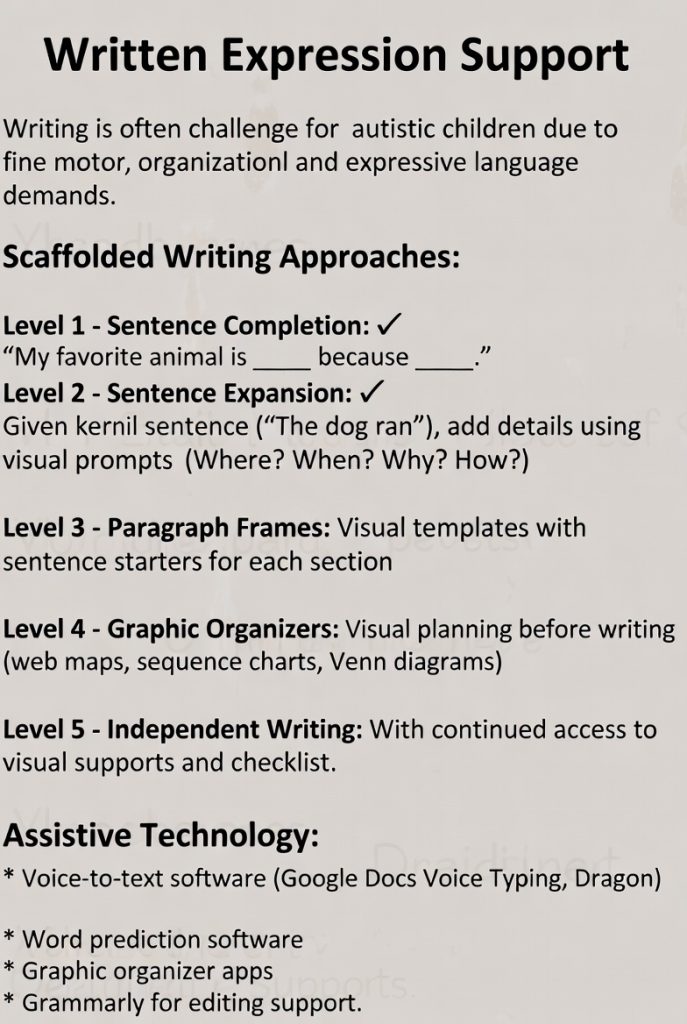
Writing is often challenging for autistic children due to fine motor, organizational, and expressive language demands.
Scaffolded Writing Approaches:
Level 1 – Sentence Completion:
“My favorite animal is ___ because ___.”
Level 2 – Sentence Expansion:
Given kernel sentence (“The dog ran”), add details using visual prompts (Where? When? Why? How?)
Level 3 – Paragraph Frames:
Visual templates with sentence starters for each section
Level 4 – Graphic Organizers:
Visual planning before writing (web maps, sequence charts, Venn diagrams)
Level 5 – Independent Writing:
With continued access to visual supports and checklists
Assistive Technology:
- Voice-to-text software (Google Docs Voice Typing, Dragon)
- Word prediction software
- Graphic organizer apps
- Grammarly for editing support
Best Learning Activities for Autistic Child: Engagement Through Play
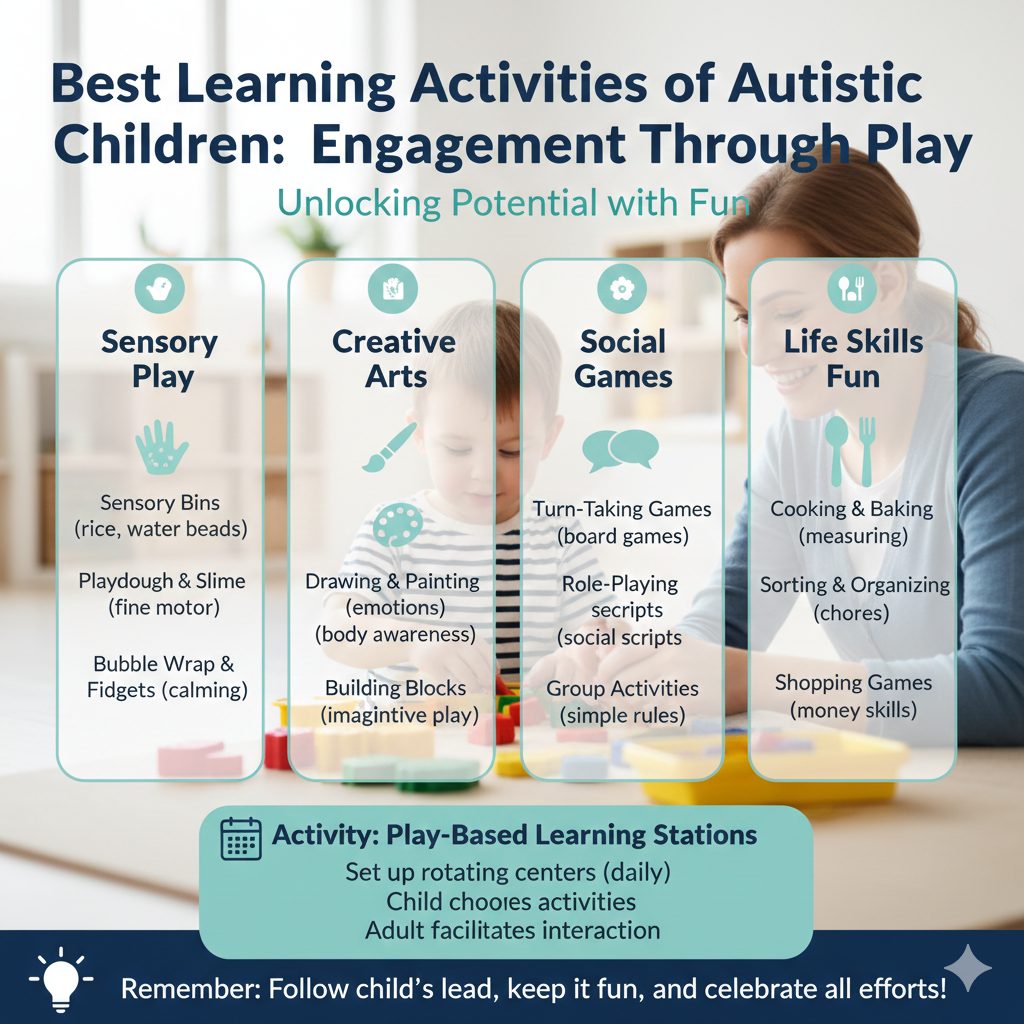
1. Sensory Learning Activities
Sensory Bins for Academic Concepts:
- Letter Learning: Hide magnetic letters in rice; find and name them
- Number Recognition: Bury numbered eggs in sand; put in order when found
- Sight Words: Write words in shaving cream, sandpaper, or gel bags
- Science Exploration: Water tables for sink/float, magnifying glasses with nature items
Movement-Based Learning:
- Gross Motor Letters: Form letters with bodies, jump on letter mats
- Math Hopscotch: Jump to solve addition/subtraction problems
- Reading Relay: Read word, run to retrieve object, return to start
- Simon Says Academic: “Simon says show me something round/red/starts with B”
2. Technology-Based Learning
Educational Apps for Autism:
Reading/Literacy:
- Reading Eggs (subscription): Comprehensive phonics program with engaging games
- Starfall (free/subscription): Multi-sensory letter and word learning
- Epic! (subscription): Digital library with thousands of books
Math:
- Prodigy Math (free/subscription): Game-based math practice
- Splash Learn (subscription): Visual math concepts with immediate feedback
- Math Learning Center Apps (free): Virtual manipulatives
Executive Function:
- Choiceworks ($19.99): Visual schedules, wait timers, emotion tools
- Visual Schedule Planner (free): Customizable daily schedules
- Focus Keeper (free): Pomodoro technique timer for work intervals
Social Learning:
- Social Quest (subscription): Social skills practice in game format
- Model Me Going Places (subscription): Video modeling for community situations
3. Special Interest Integration
Leverage intense interests for educational gains:
If child loves trains:
- Geography: Map train routes across states/countries
- History: Development of railroads, impact on society
- Physics: Motion, speed, energy
- Math: Schedule problems, distance/rate calculations
- Art: Drawing locomotives, creating models
If child loves Pokémon:
- Reading: Pokémon books, game text, character descriptions
- Math: Compare stats, calculate damage, track collections
- Science: Animal classification, habitats, adaptation
- Art: Drawing characters, creating cards
- Social: Discussing favorites, negotiating trades
Autism Focus and Attention Activities: Building Concentration
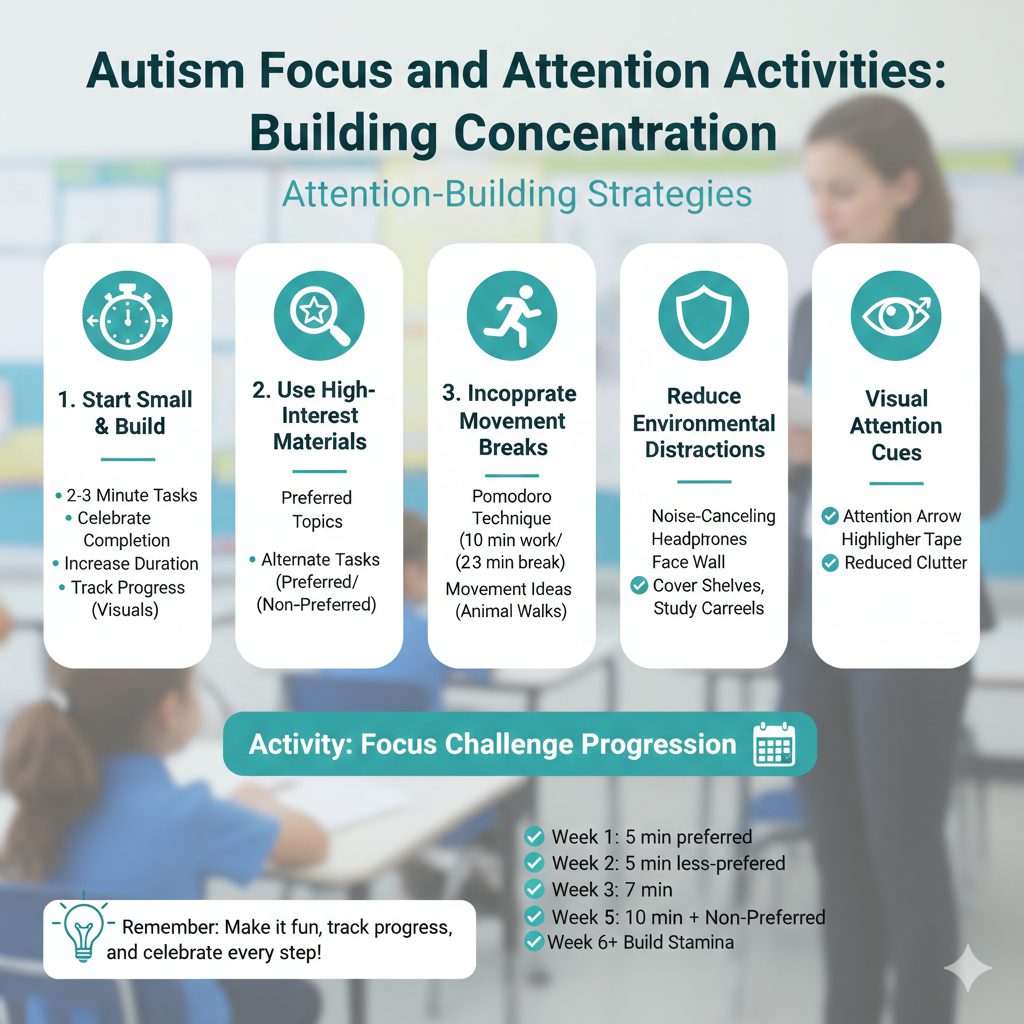
Attention-Building Strategies
1. Start Small and Build Gradually:
- Begin with 2-3 minute tasks child can successfully complete
- Celebrate completion immediately
- Gradually increase duration as success continues
- Track progress visually so child sees improvement
2. Use High-Interest Materials:
- Attention spans are longer for preferred topics
- Start learning sessions with engaging content
- Alternate preferred and non-preferred tasks
3. Incorporate Movement Breaks:
- Use the Pomodoro technique adapted for children:
- 10 minutes work
- 2-3 minutes movement break
- Repeat
- Movement break ideas: jumping jacks, animal walks, dance freeze, stretches
4. Reduce Environmental Distractions:
- Use noise-canceling headphones
- Face wall during work time
- Cover shelves/toys with curtains during learning
- Use study carrels or portable privacy screens
5. Visual Attention Cues:
- Attention arrow pointing to where child should look
- Highlighter tape or wikki stix to show important information
- Reduced visual clutter on worksheets (cover extra problems)
Activity: Focus Challenge Progression
Week 1: Child works for 5 minutes on preferred activity
Week 2: Child works for 5 minutes on less-preferred task (with reinforcement)
Week 3: Increase to 7 minutes
Week 4: Increase to 10 minutes
Week 5: Maintain 10 minutes; add brief non-preferred task before break
Week 6+: Continue building stamina, alternating task difficulty
Attention Games and Activities
Memory and Concentration:
- Matching games: Start with 3-4 pairs, increase difficulty
- Simon Says: Follow increasingly complex directions
- I Spy: Visual scanning and sustained attention
- Freeze Dance: Auditory attention and impulse control
Sequencing Activities:
- Pattern blocks: Copy and extend patterns
- Bead threading: Follow specific color patterns
- Story sequencing: Order picture cards by events
Focus-Building Apps:
- Lumosity (subscription): Cognitive training games
- Focus Games (free): Attention and concentration activities
- Brain Focus Productivity (free): Timer with built-in breaks
Autism Homework Routine Tips: Reducing Stress and Increasing Success
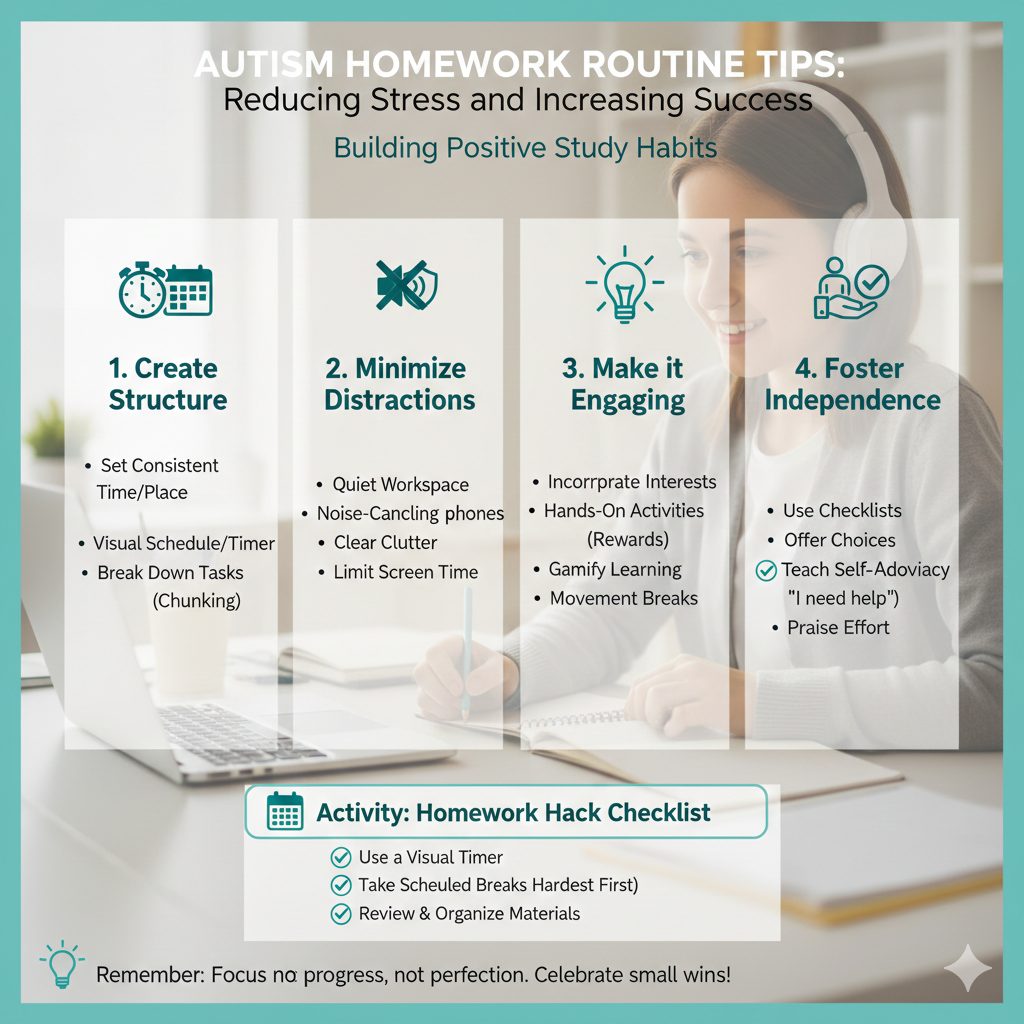
Creating an Effective Homework Routine
1. Consistent Time and Place:
- Same time daily (right after school, after snack, before dinner)
- Same dedicated space with all materials ready
- Reduces decision fatigue and resistance
2. Visual Homework Schedule:
1. [Picture of backpack] Get homework folder
2. [Picture of checklist] Review all assignments
3. [Picture of timer] Set timer for first task
4. [Picture of pencil] Complete assignment
5. [Picture of checkmark] Check work
6. [Picture of folder] Put in "finished" pocket
7. [Picture of preferred activity] Earn break/reward
3. Break Down Assignments:
Never present entire homework load at once:
- Create task cards for each assignment
- Child completes one card at a time
- Move completed cards to “done” pile
- Provides visual progress and sense of achievement
4. Use Timers Strategically:
- Estimate how long assignment should take
- Set timer (add buffer time)
- If timer goes off, take break regardless of completion
- Return to finish after brief break
- This prevents marathon frustration sessions
5. Offer Choices:
- “Which subject first: math or reading?”
- “Do you want to sit at desk or table?”
- “Should we use pencil or type this assignment?”
- Limited choices provide control without overwhelm
Activity: Homework Starter Kit
Assemble a homework caddy containing:
- Sharpened pencils and erasers
- Highlighters for key information
- Scratch paper for working out problems
- Visual timer
- Fidget tool
- Checklist of steps
- “Help” card for requesting assistance
- Small reward tokens
Everything needed is in one portable container!
Handling Homework Resistance
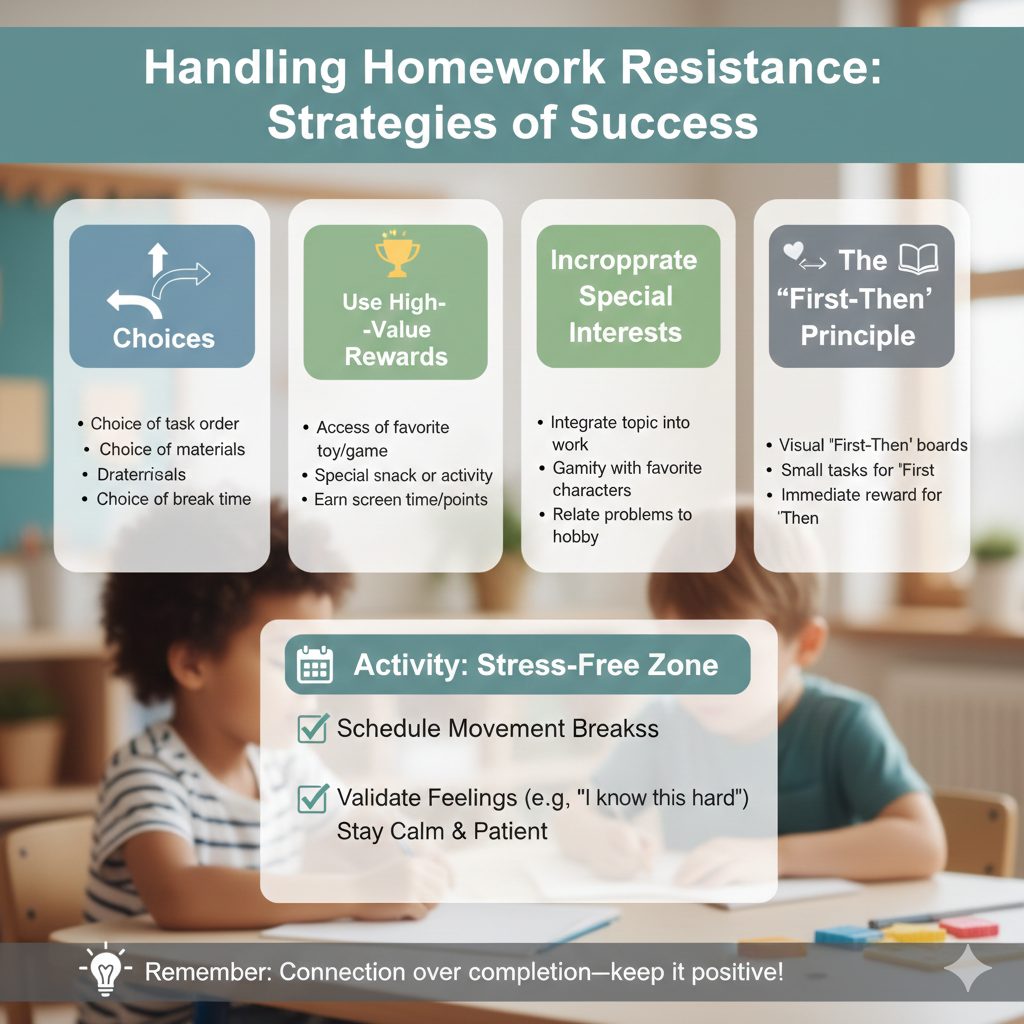
When Your Child Refuses Homework:
Strategy 1 – First/Then Board:
Visual showing: “First 10 minutes homework, Then 5 minutes [preferred activity]”
Strategy 2 – Start Tiny:
“Let’s do just ONE problem, then we’re done for now.”
Often, starting is the hardest part; momentum builds.
Strategy 3 – Work Alongside:
Parent/sibling does their own work nearby, modeling focus
Strategy 4 – Incorporate Movement:
- 5 jumping jacks between math problems
- Read while walking around room
- Use whiteboard on wall instead of paper at desk
Strategy 5 – Communicate with Teacher:
Discuss homework modifications:
- Reduce quantity (every other problem)
- Provide extended time
- Offer alternative format (verbal instead of written)
- Break into smaller chunks with breaks
Resources for Autism Learning Support at Home
Free Online Learning Resources
Autism-Specific Educational Resources:
Autism Little Learners (autismlittlelearners.com)
- Free visual schedules and learning supports
- Task cards and activity ideas
- Evidence-based teaching strategies
AFIRM Modules (afirm.fpg.unc.edu)
- Free online training in evidence-based practices
- Implementation guides and materials
- Videos demonstrating strategies
Autism Internet Modules (autisminternetmodules.org)
- Free training modules on various topics
- Practical implementation strategies
- Assessment tools
STAR Autism Support (starautismsupport.com)
- Structured teaching resources
- Visual supports and schedules
- Implementation guides
Curriculum and Workbook Resources
Adapted Curriculum Options:
Time4Learning (time4learning.com)
- Online curriculum with visual supports
- Self-paced learning
- Progress tracking
Autism Teaching Strategies (autismteachingstrategies.com)
- Communication-focused learning materials
- Social skills resources
- Visual learning tools
- Thousands of printable worksheets
- Organized by grade and subject
- Visual and engaging formats
Apps and Technology Tools
Organization and Executive Function:
- Cozi Family Organizer (free): Shared calendars and checklists
- Trello (free): Visual task management boards
- Forest ($1.99): Gamified focus timer
Learning Support:
- Khan Academy (free): Comprehensive video lessons all subjects
- Duolingo (free): Language learning with visual supports
- Scratch (free): Learn coding through visual programming
Professional Support Services
Finding Specialized Support:
- Educational Therapists: Specialized in learning differences
- Occupational Therapists: Support sensory and fine motor needs affecting learning
- Special Education Advocates: Help navigate IEP/504 plans
- Online Tutoring Services: Autism-trained tutors (Wyzant, Care.com)
Building Your Family’s Learning Success Plan
Step 1: Assess Current Functioning
- What subjects are strengths?
- Where are the challenges?
- What environmental factors help or hinder?
- What time of day is optimal for learning?
Step 2: Set SMART Goals
Instead of: “Improve in math”
Try: “Complete 10 single-digit addition problems with 80% accuracy within 10 minutes, 4 out of 5 days, by end of month”
Step 3: Choose 3-5 Core Strategies
Don’t try to implement everything at once. Start with:
- Visual daily schedule
- Structured learning space
- Work system for task completion
- One executive function support (timer, checklist, etc.)
- Consistent routine
Step 4: Track Progress
Create simple data sheets:
- Date
- Activity/task
- Duration of focus
- Accuracy/completion
- Support needed
- Notes
Review weekly to see patterns and adjust strategies.
Step 5: Celebrate All Progress
Learning differences don’t mean learning disabilities. Every step forward deserves recognition:
- Completed task independently
- Tried something new without resistance
- Stayed focused for personal best time
- Asked for help appropriately
- Showed flexibility with change
Conclusion: Empowering Your Child’s Educational Journey
Effective autism learning support at home is about meeting your child where they are, providing structure and support, and celebrating their unique learning style. Whether implementing homeschooling autistic child tips, using autism school readiness activities, finding autism learning difficulties solutions, or establishing autism homework routine tips, consistency and understanding are your most powerful tools.
Remember: autistic children aren’t broken learners who need fixing. They’re different learners who need different approaches. With visual supports, structured environments, sensory consideration, and leveraging special interests, your child can not only succeed academically but thrive.
Start This Week:
- Create one visual support (schedule or task list)
- Establish a consistent learning time
- Organize a dedicated learning space
- Choose one executive function support to implement
- Celebrate small wins daily
Your child’s learning journey is unique, and you’re the expert on your child. Trust your instincts, implement evidence-based strategies, and know that every accommodation you provide is setting your child up for success.
Next Steps and Additional Resources
Download Free Resources at futureforautism:
- Visual Schedule Templates
- Homework Routine Checklist
- Task Analysis Worksheets
- Executive Function Tracking Sheets
Related Articles:
- Communication & Behavior Support in Autism
- Sensory Processing Strategies for Learning Success
- Building Independent Life Skills in Autism
Join Our Community: Connect with other parents implementing successful autism learning support at homestrategies, share what’s working, and get personalized guidance.