
Public Transport Safety Visual Schedule
Elevators and escalators are two of the most common safety situations a child will face in public places, and each has its own set of steps worth practicing before you need them for real. This free resource covers both in one chart: 6 steps for elevator safety and 6 steps for escalator safety, side by side.
At a Glance
- What it is: A free, two-part printable visual schedule covering elevator safety (6 steps) and escalator safety (6 steps).
- Who it's for: Children learning to navigate elevators and escalators safely in malls, buildings, and transit stations.
- What you get: A full-resolution PDF chart with both sequences plus ABA teaching tips, emailed instantly.
- How to use it: Practice during quiet, low-traffic times before using it in a crowded real-world setting.
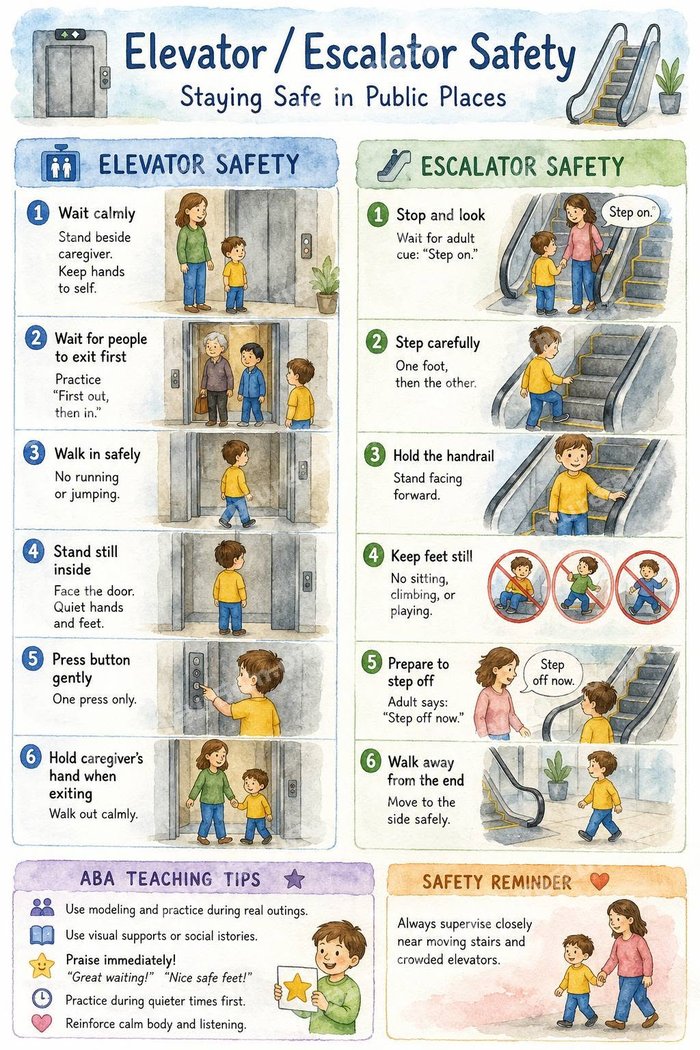
Preview of the printable chart — download the full-resolution, watermark-free PDF below.
What's in this guide
- Why a visual schedule helps
- What you'll get in the free PDF
- How to use it
- What If My Child Wants to Sit, Climb, or Run on an Escalator?
- Frequently asked questions
Why a Visual Schedule Helps
Elevators and escalators both involve moving parts, timing, and close supervision near a hazard — very different demands from most everyday routines. Walking through each sequence as a predictable, practiced script, and rehearsing it during quieter times, builds the calm, careful habits (quiet hands and feet, holding a handrail, waiting for a cue) that matter most in a busy public setting.
What You'll Get in the Free PDF
A single-page, 12-step visual task analysis:
- Elevator: Wait calmly beside caregiver
- Elevator: Wait for people to exit first
- Elevator: Walk in safely, no running
- Elevator: Stand still inside, face the door
- Elevator: Press button gently, one press only
- Elevator: Hold caregiver's hand when exiting
- Escalator: Stop and look, wait for adult cue
- Escalator: Step on carefully, one foot then the other
- Escalator: Hold the handrail, stand facing forward
- Escalator: Keep feet still, no sitting or climbing
- Escalator: Prepare to step off on adult's cue
- Escalator: Walk away from the end
Get the Free Public Transport Safety Visual Schedule PDF
Enter your details below and we'll email the printable PDF to you instantly.
How to Use It
Practice both sequences during quieter times — an early morning mall visit rather than a crowded weekend — so your child can focus on the steps without the added pressure of a busy environment. Use the chart's suggested verbal cues consistently (“step on,” “step off now”) so your child learns to wait for and respond to them, and praise immediately using the chart's own suggestions: “great waiting!” or “nice safe feet!”
What If My Child Wants to Sit, Climb, or Run on an Escalator?
This is exactly what step 4 of the escalator sequence (keep feet still) targets, and it's worth practicing with hand-holding or standing directly in front of your child the first several times rather than expecting independent compliance right away. Always supervise closely near moving stairs and crowded elevators — the chart's teaching tips note that modeling, visual supports or social stories, and immediate praise work best, alongside practicing during quieter, less crowded times first.
Frequently Asked Questions
Is this resource for one skill or two?
It covers two related but distinct public-safety skills — elevator safety and escalator safety — in a single combined chart, since families are usually working on both around the same time.
What age is this appropriate for?
This is aimed at children who are out in public settings like malls and transit stations with a caregiver, rather than tied to a specific age — use your judgment about your own child's readiness.
Does this replace close supervision?
No — the chart itself notes to always supervise closely near moving stairs and crowded elevators. This is a teaching tool to build the habits, not a substitute for hands-on supervision in the moment.