
Identifying Dangerous Objects Visual Schedule
Teaching a child to recognize a dangerous object — and what to do when they see one — is one of the most important safety skills you can build. This free teaching guide breaks it into 6 steps: labeling the object, teaching the safety response, and practicing through role-play.
At a Glance
- What it is: A free, 6-step printable teaching guide for recognizing dangerous household objects and responding safely.
- Who it's for: Children who are curious about household items like knives, cleaning products, or sharp tools.
- What you get: A full-resolution PDF chart, emailed instantly.
- How to use it: Practice with real household items and in different rooms, under supervision.
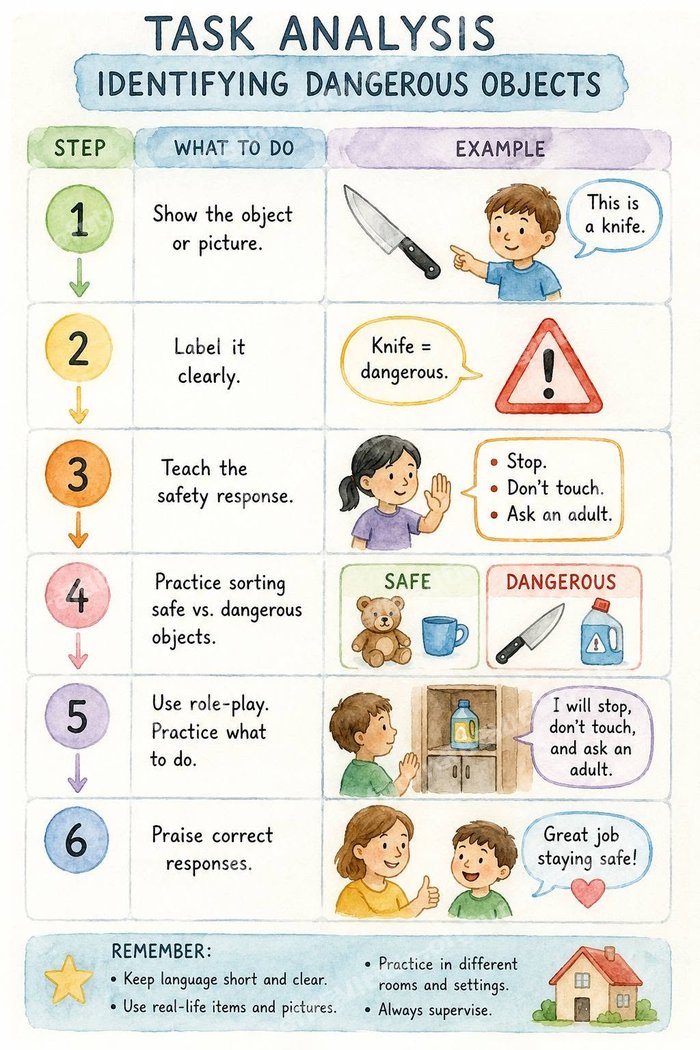
Preview of the printable chart — download the full-resolution, watermark-free PDF below.
What's in this guide
- Why a visual schedule helps
- What you'll get in the free PDF
- How to use it
- What If My Child Touches the Object Anyway During Practice?
- Frequently asked questions
Why a Visual Schedule Helps
Recognizing danger isn't always intuitive — a sharp knife and a safe spoon can look similarly interesting to a curious child. Teaching a simple, consistent safety response (stop, don't touch, ask an adult) as its own practiced skill gives your child a reliable habit to fall back on, rather than relying on them to work out the risk in the moment.
What You'll Get in the Free PDF
A single-page, 6-step visual task analysis:
- Show the object or picture
- Label it clearly
- Teach the safety response
- Practice sorting safe vs. dangerous objects
- Use role-play. Practice what to do
- Praise correct responses
Get the Free Identifying Dangerous Objects Visual Schedule PDF
Enter your details below and we'll email the printable PDF to you instantly.
How to Use It
Use real household items (safely, under your supervision) alongside pictures, and keep the safety response consistent every time: stop, don't touch, ask an adult. Practice sorting safe versus dangerous items as a simple matching game, and role-play scenarios — for example, opening a cabinet and finding a cleaning product — so your child has rehearsed the response before they ever need it for real.
What If My Child Touches the Object Anyway During Practice?
This is a normal part of learning the skill, not a sign it isn't working — calmly restate the safety response (“stop, don't touch, ask an adult”) and continue practicing. Always supervise closely during practice and keep genuinely dangerous items out of reach between sessions, since this is a skill that's built gradually over many repetitions, not learned in one lesson.
Frequently Asked Questions
What objects should I start with?
Start with items your child is most likely to actually encounter at home — kitchen knives, cleaning products, and similar everyday risks — using the chart's example of 'knife = dangerous' as a model.
Should this replace childproofing my home?
No — this teaching guide is a skill-building tool, not a substitute for physically securing dangerous items (locked cabinets, out-of-reach storage). Use both together.
How do I practice this safely?
Always supervise closely, use real items only in a controlled practice setting, and practice in different rooms so the skill generalizes beyond just one location.