
Hair Brushing Visual Schedule for Autistic Children
A hair brushing visual schedule is a 9-step illustrated routine card that breaks combing/brushing hair into small, predictable picture steps — from picking up the brush to saying “all done.” Below is a free, printable chart (boy and girl versions included) you can laminate and use daily.
At a Glance
- What it is: A free, 9-step printable visual schedule for teaching independent hair brushing.
- Who it's for: Autistic children who need predictable, picture-based routines instead of verbal instructions.
- Format: One-page PDF, boy and girl versions, print or laminate.
- Best for ages: Roughly 3+, adjusted to your child's current skill level.
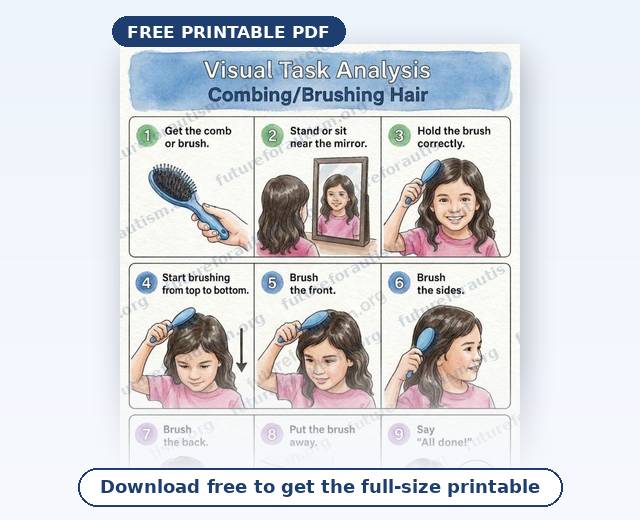
Preview of the printable chart — download the full-resolution, watermark-free PDF below.
What's in this guide
- Why a visual schedule helps
- What you'll get in the free PDF
- How to use it
- If Your Child Resists Hair Brushing
- Frequently asked questions
Why a Visual Schedule Helps
Hair brushing asks a child to tolerate a sensory input (pulling, touch on the scalp) while following a multi-step sequence — a combination that's hard for many autistic children, especially when instructions are only spoken. A picture schedule keeps every step visible and identical each time.
What You'll Get in the Free PDF
A single-page, 9-step visual task analysis:
- Get the comb or brush
- Stand or sit near the mirror
- Hold the brush correctly
- Start brushing from top to bottom
- Brush the front
- Brush the sides
- Brush the back
- Put the brush away
- Say “All done!”
Get the Free Hair Brushing Visual Schedule PDF
Enter your details below and we'll email the printable PDF to you instantly.
How to Use It
Laminate the chart and tape it to the bathroom mirror or wall at your child's eye level. Walk through it together a few times, pointing to each picture as you go, before expecting your child to follow it independently.
If Your Child Resists Hair Brushing
Resistance is usually about the sensory experience, not the routine itself. Try a detangling spray to reduce pulling, let your child hold the brush and try it on a doll first, or start with just 1-2 steps before building up to the full sequence.
Frequently Asked Questions
At what age can I start using this?
Most parents introduce a simple visual schedule like this from age 3-4, adjusting the number of steps shown based on your child's current ability and patience.
My child has sensory sensitivity to brushing — will this still help?
The visual schedule makes the sequence predictable, but sensory resistance usually needs its own approach too — detangling spray and starting with fewer steps can help.
Is there a girl version too?
Yes — the free PDF includes both a boy and a girl illustrated version of the same 9-step routine.
Do I need to use all 9 steps at once?
No — start with whichever 2-3 steps are hardest for your child and build the full sequence gradually.