
Front vs Back of Clothing Visual Schedule
Telling the front of a t-shirt from the back is a small skill that makes a big difference to independent dressing. This free teaching guide walks through 9 steps for showing your child the visual clues — tags, pictures, seams — that mark the back and front of clothing.
At a Glance
- What it is: A free, 9-step printable task analysis for teaching front-vs-back identification on clothing.
- Who it's for: Children working on independent dressing who mix up the front and back of shirts, pants, or jackets.
- What you get: A full-resolution PDF chart, emailed instantly.
- How to use it: Stick it on the closet door, right alongside your Dressing Independently Visual Schedule.
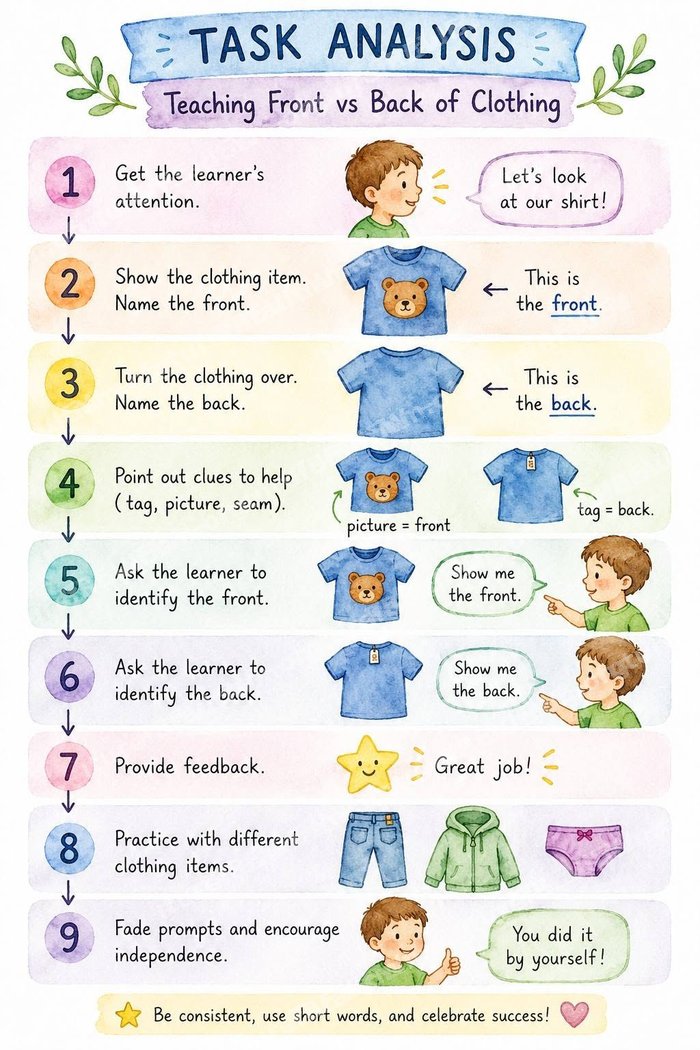
Preview of the printable chart — download the full-resolution, watermark-free PDF below.
What's in this guide
- Why a visual schedule helps
- What you'll get in the free PDF
- How to use it
- What If the Clothing Has No Tag or Picture?
- Frequently asked questions
Why a Visual Schedule Helps
Front-and-back cues (a tag, a picture, a seam) are things most children pick up incidentally, just by watching others dress — but an autistic child may need this pointed out explicitly and practiced as its own skill before it transfers to actual dressing. Teaching it on its own, away from the time pressure of getting dressed in the morning, makes it much easier to learn.
What You'll Get in the Free PDF
A single-page, 9-step visual task analysis:
- Get the learner's attention
- Show the clothing item, name the front
- Turn the clothing over, name the back
- Point out clues to help (tag, picture, seam)
- Ask the learner to identify the front
- Ask the learner to identify the back
- Provide feedback
- Practice with different clothing items
- Fade prompts and encourage independence
Get the Free Front vs Back of Clothing Visual Schedule PDF
Enter your details below and we'll email the printable PDF to you instantly.
How to Use It
Practice away from the morning rush, with a few different clothing items on a table or bed. Show the same tag-equals-back, picture-equals-front cues consistently across shirts, jackets and pants so your child learns the pattern rather than a one-off fact about a single shirt. Once they can reliably point out front and back on request, start fading your prompts and let them check for themselves during real dressing.
What If the Clothing Has No Tag or Picture?
Not every garment has an obvious tag or picture — for plain items, point out the seam lines instead (the back of a t-shirt usually has a smoother, less-seamed neckline). It's fine to only practice this skill on clothing that does have clear clues at first, and introduce plainer items once the concept of “front vs back” itself is solid.
Frequently Asked Questions
What age is this appropriate for?
This is aimed at children who are working on independent dressing and already have some basic tolerance for sitting and attending to a short teaching task — it isn't tied to a specific age.
Does this cover pants and jackets, or just shirts?
The guide's steps are general enough to apply across shirts, jackets, and pants — step 8 specifically has your child practice across different clothing items.
My child gets frustrated during this practice — what should I do?
Keep sessions short, use items your child doesn't mind handling, and end on a step they can succeed at so the session finishes with praise rather than frustration.