
Taking Medicine Appropriately Visual Schedule for Autistic Children
A taking-medicine visual schedule shows the 10 steps of this routine to make it predictable rather than stressful, always following your child's doctor or pharmacist's instructions.
At a Glance
- What it is: A free, 10-step printable visual schedule for a calm medicine-taking routine.
- Who it's for: Autistic children who find medicine time stressful or unpredictable.
- Format: One-page PDF, boy and girl versions, print or laminate.
- Best for ages: Any age; this is a behavioral/routine aid, not medical guidance.
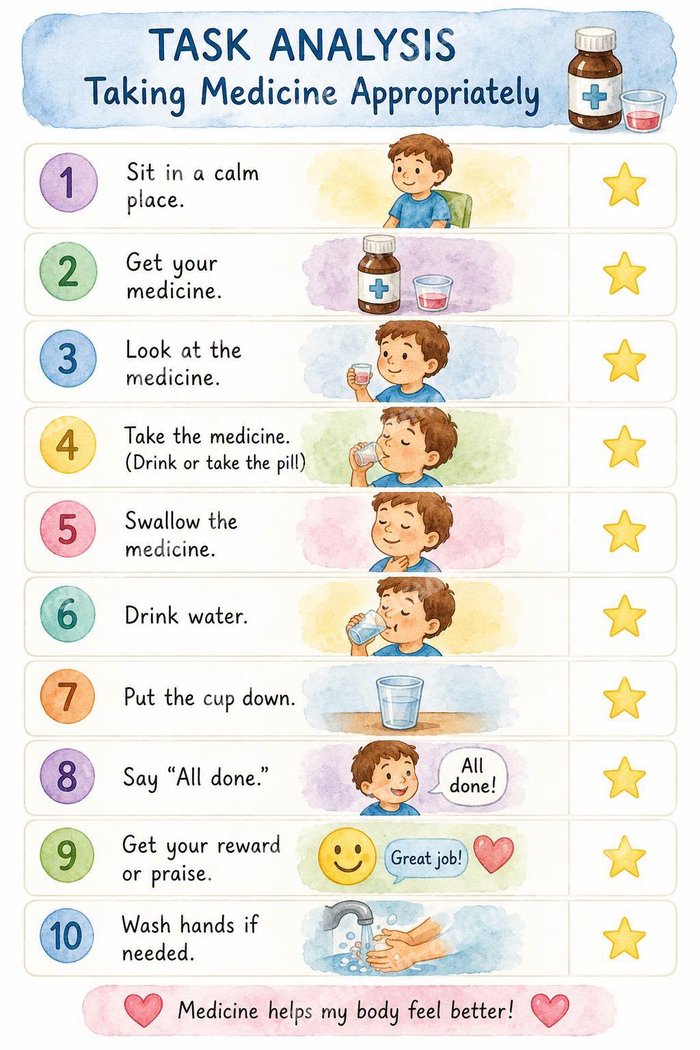
Preview of the printable chart — download the full-resolution, watermark-free PDF below.
What's in this guide
- Why a visual schedule helps
- What you'll get in the free PDF
- How to use it
- Important Note
- Frequently asked questions
Why a Visual Schedule Helps
A predictable, calm sequence often reduces resistance because your child knows exactly what's coming and that it ends with praise or a small reward, rather than an unpredictable, pressured moment.
What You'll Get in the Free PDF
A single-page, 10-step visual task analysis:
- Sit in a calm place
- Get your medicine
- Look at the medicine
- Take the medicine
- Swallow the medicine
- Drink water
- Put the cup down
- Say “All done”
- Get your reward or praise
- Wash hands if needed
Get the Free Taking Medicine Appropriately Visual Schedule PDF
Enter your details below and we'll email the printable PDF to you instantly.
How to Use It
Pair a brief, consistent reward or praise at step 9 to reinforce the routine positively, and keep the reward small and consistent so the pattern stays predictable each time.
Important Note
This card is a behavioral/routine visual aid only, not medical guidance. Always follow your pediatrician's or pharmacist's instructions for what medicine, dose and timing are appropriate for your child.
Frequently Asked Questions
My child resists taking medicine every time — will this help?
A predictable, calm sequence often reduces resistance because your child knows exactly what's coming and that it ends with praise or a small reward; always administer medicine exactly as directed by your child's doctor.
Is it okay to always end with a reward?
Yes — pairing a brief, consistent reward or praise reinforces the routine positively; keep the reward small and consistent so the pattern stays predictable.
This card doesn't cover dosage or medical decisions — where do I get that?
Correct — this is a behavioral/routine visual aid only, not medical guidance; always follow your pediatrician's or pharmacist's instructions.