
Recognizing Sick Feelings Visual Schedule
Many autistic children struggle to notice or name when something in their body feels wrong, which can mean illness or pain goes unreported until it's severe. This free teaching guide walks you through 6 steps for helping your child recognize a sick feeling, point to where it is, and tell you about it.
At a Glance
- What it is: A free, 6-step ABA-style teaching guide for helping a child recognize and communicate sick feelings.
- Who it's for: Parents and caregivers of autistic children who have difficulty noticing or reporting physical discomfort.
- What you get: A full-resolution, step/what-to-do/example PDF chart emailed instantly.
- How to use it: Practice the steps during calm moments, not just when your child is actually unwell.
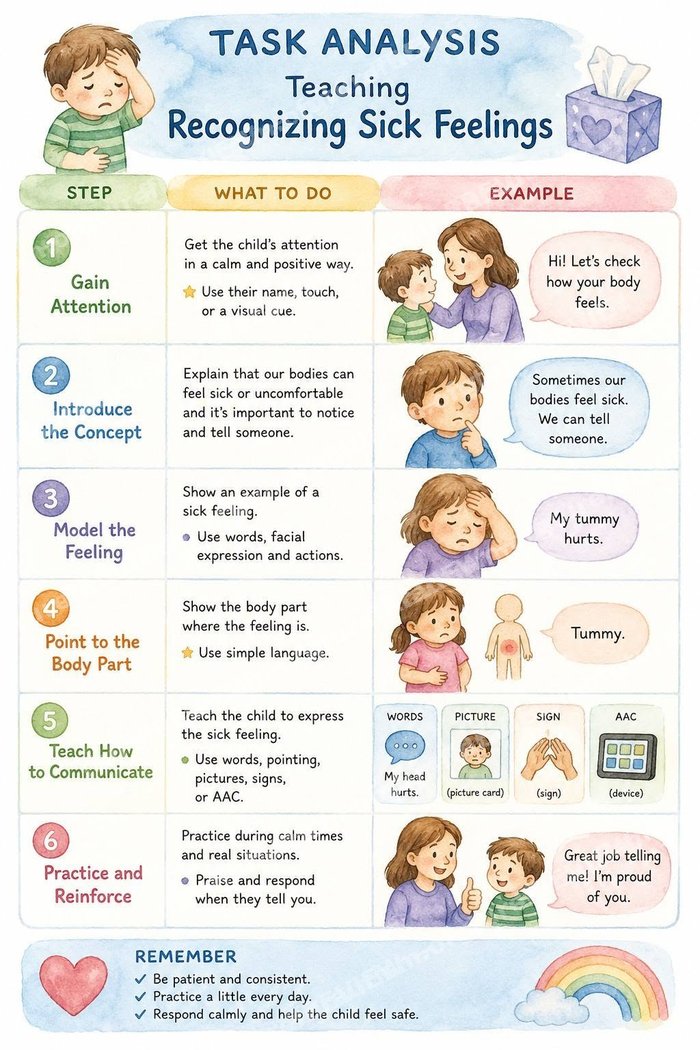
Preview of the printable chart — download the full-resolution, watermark-free PDF below.
What's in this guide
- Why a visual schedule helps
- What you'll get in the free PDF
- How to use it
- What If My Child Can't Point to Where It Hurts?
- Frequently asked questions
Why a Visual Schedule Helps
Interoception — the sense of what's happening inside your own body — can be less reliable for autistic children, which makes it genuinely harder to notice early signs of illness. Teaching this as an explicit skill, the same way you'd teach any other communication skill, gives your child a reliable way to tell you “something's wrong” even before they can describe exactly what.
What You'll Get in the Free PDF
A single-page, 6-step visual task analysis:
- Gain attention
- Introduce the concept
- Model the feeling
- Point to the body part
- Teach how to communicate
- Practice and reinforce
Get the Free Recognizing Sick Feelings Visual Schedule PDF
Enter your details below and we'll email the printable PDF to you instantly.
How to Use It
Start during a calm, ordinary moment — not when your child is actually sick. Get their attention, explain simply that bodies can feel sick sometimes, and model what that looks like (a sad face, a hand on the tummy, the words “my tummy hurts”). Offer several ways to communicate it: words, a picture card, a sign, or an AAC device, whichever fits your child. Practice pointing to the body part and naming the feeling, then praise every attempt, even an imperfect one.
What If My Child Can't Point to Where It Hurts?
Start with a simple body outline or doll and let your child point on that instead of their own body — some children find this easier than pointing to themselves. It's also fine if the first version of “communicating sick” is just a general distress signal rather than a specific body part; you can narrow it down over time as the skill becomes more reliable.
Frequently Asked Questions
What communication methods does this guide cover?
Words, pointing, picture cards, simple signs, and AAC devices — use whichever method your child already relies on, or a combination.
How long does it take to teach this?
Every child is different, but this is a skill to practice in short sessions regularly rather than all at once — consistency over days and weeks matters more than any single session.
Should I use this during an actual illness to teach it?
It's best to build the skill during calm times first, so your child isn't learning a brand-new skill while also feeling unwell.