
Responding to Greetings Visual Schedule
A greeting is often someone's first social interaction with your child, and a reliable response — a wave, a nod, a simple “hi” — can make daily interactions at school, with family, and in public feel much smoother. This free teaching guide breaks the skill into 5 simple steps.
At a Glance
- What it is: A free, 5-step printable teaching guide for responding to greetings.
- Who it's for: Children who are learning to notice and respond when someone says hello.
- What you get: A full-resolution PDF chart, emailed instantly.
- How to use it: Practice in short, low-pressure moments throughout the day.
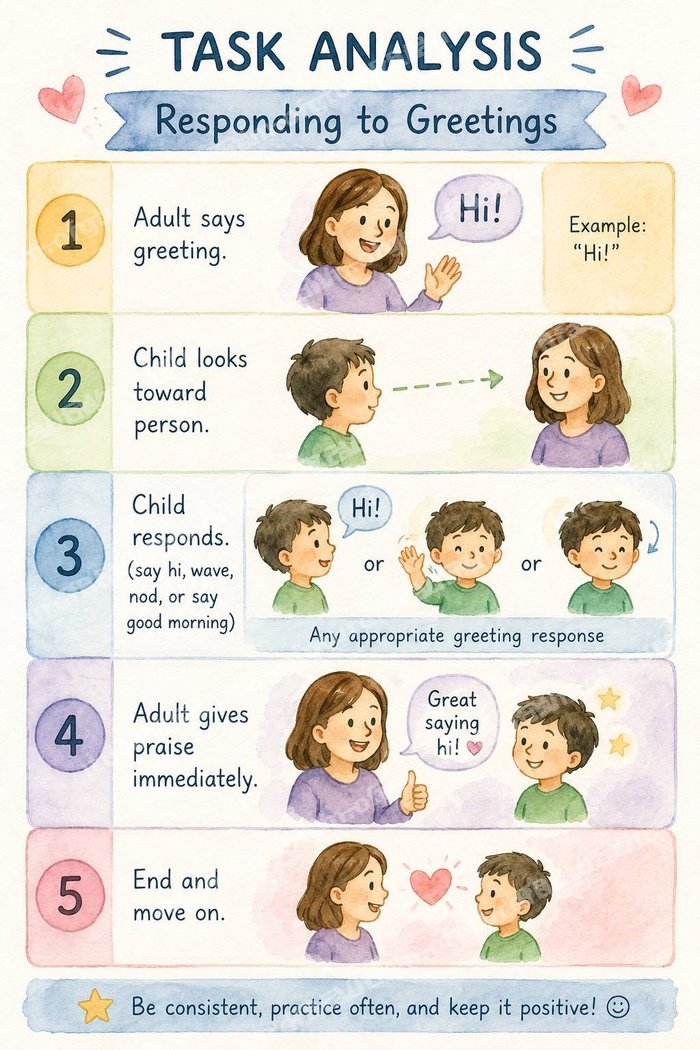
Preview of the printable chart — download the full-resolution, watermark-free PDF below.
What's in this guide
- Why a visual schedule helps
- What you'll get in the free PDF
- How to use it
- What If My Child Doesn't Respond at All?
- Frequently asked questions
Why a Visual Schedule Helps
Responding to a greeting requires noticing that someone is addressing you, then producing a quick social response — two separate skills bundled into one everyday moment. Teaching them as a simple, repeatable sequence (look, respond, get praised) takes the pressure off needing to figure out the right response from scratch every time.
What You'll Get in the Free PDF
A single-page, 5-step visual task analysis:
- Adult says greeting
- Child looks toward person
- Child responds (say hi, wave, nod, or say good morning)
- Adult gives praise immediately
- End and move on
Get the Free Responding to Greetings Visual Schedule PDF
Enter your details below and we'll email the printable PDF to you instantly.
How to Use It
Practice this in brief, everyday moments — at the door, when a family member arrives, during a walk — rather than as a formal sit-down lesson. Accept any appropriate response (a word, a wave, or a nod all count) rather than insisting on one specific form, and praise immediately so the connection between greeting and praise stays clear.
What If My Child Doesn't Respond at All?
If your child doesn't yet look toward the person greeting them, start by gently prompting them to look (a light touch, saying their name) before the greeting, and praise the look itself as a first success, separate from the full response. Build up to the full sequence gradually rather than expecting all 5 steps at once.
Frequently Asked Questions
Does a wave count as a full response, or does my child need to say a word?
Any appropriate response — a word, a wave, or a nod — counts as meeting step 3. There's no requirement to use words specifically.
How often should we practice?
Little and often works best here — real greetings happen throughout the day, so there are natural chances to practice without setting aside separate teaching time.
What if my child says hi but then doesn't move on?
That's step 5, ending and moving on, and it's common for this to take extra practice on its own — you can gently prompt “okay, let's go” as part of the routine.