
Circle Time Visual Schedule
Circle time asks a lot of a young child all at once: sitting still, staying in one spot, listening, and sometimes answering questions in front of the group. This free visual schedule breaks participating in circle time into 7 clear steps.
At a Glance
- What it is: A free, 7-step printable visual schedule for participating in classroom circle time.
- Who it's for: Children who find group sitting, listening, or staying in one spot during circle time difficult.
- What you get: A full-resolution PDF chart, emailed instantly.
- How to use it: Share it with your child's teacher so the same sequence is used at school and at home.
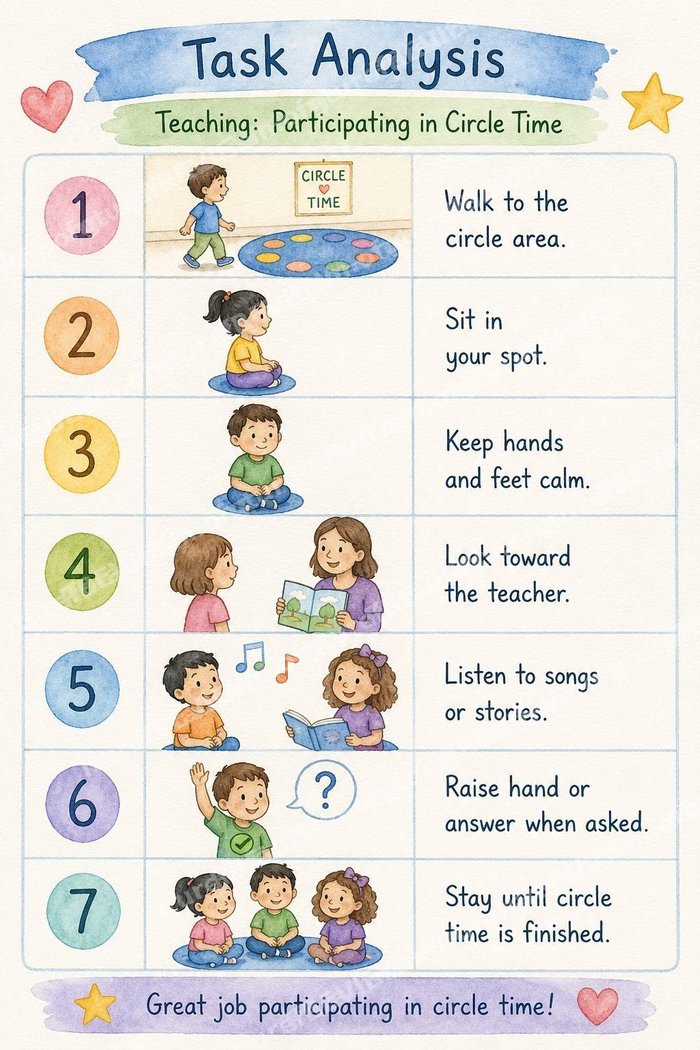
Preview of the printable chart — download the full-resolution, watermark-free PDF below.
What's in this guide
- Why a visual schedule helps
- What you'll get in the free PDF
- How to use it
- What If My Child Can't Sit Still for the Whole Circle Time?
- Frequently asked questions
Why a Visual Schedule Helps
Circle time combines several separate skills — walking to a spot, sitting still, keeping hands and feet calm, listening, and responding on cue — into one continuous group activity. Breaking it into named steps makes each individual expectation clear, rather than leaving your child to infer what “good circle time behavior” means all at once.
What You'll Get in the Free PDF
A single-page, 7-step visual task analysis:
- Walk to the circle area
- Sit in your spot
- Keep hands and feet calm
- Look toward the teacher
- Listen to songs or stories
- Raise hand or answer when asked
- Stay until circle time is finished
Get the Free Circle Time Visual Schedule PDF
Enter your details below and we'll email the printable PDF to you instantly.
How to Use It
Practice the individual pieces separately before expecting the whole sequence — sitting in a spot for a short time, then adding in listening, then adding in responding. Share the chart with your child's teacher or classroom aide so the same steps and language are reinforced consistently at school.
What If My Child Can't Sit Still for the Whole Circle Time?
Start with a shorter version of circle time at home (even just 2–3 minutes) and build up gradually, rather than expecting full classroom-length participation right away. A fidget item held quietly in the lap, or a designated seat near the edge of the circle, can also make staying seated more manageable.
Frequently Asked Questions
Can I use this chart at school, not just at home?
Yes — sharing it with your child's teacher so the same 7 steps and wording are used at school is one of the most effective ways to use this chart.
What if my child answers out of turn instead of raising a hand?
Step 6 specifically targets this — practice the raise-hand cue separately with simple questions at home, and praise any attempt to raise a hand, even if it's not perfectly timed.
How long should circle time practice sessions be?
Start shorter than your child's actual classroom circle time and build up gradually as they succeed at each length.