
Autism Toilet Training: A Practical Guide
Few milestones carry as much daily-life weight as this one, or generate as much conflicting advice. What actually has research behind it is more specific and more encouraging than the general uncertainty around this topic suggests.
Autism toilet training works best with a structured approach combining a scheduled sitting routine, increased fluids to create more learning opportunities, immediate reinforcement for success on the toilet, and caregiver involvement from the very first day. A well-documented outpatient protocol built on this approach produced full or nearly full independent toileting for the majority of children studied, some within as little as two weeks.
Signs of Readiness
Staying dry for stretches
Remaining dry for an hour or two at a time suggests some bladder control is developing.
Awareness of wet or soiled diapers
Noticing or reacting to being wet or dirty is a meaningful early sign.
Tolerating sitting briefly
Being able to sit on a toilet or potty for a short period without significant distress.
What the Research-Backed Protocol Includes
An outpatient toilet-training protocol developed by LeBlanc, Carr, Crossett, Bennett, and Detweiler, a modified version of the classic Azrin and Foxx method adapted specifically for autistic children, combined several elements implemented together by clinic staff and parents. The approach produced fully independent toileting for the majority of children studied, with the training protocol run first by clinic staff and then continued consistently by family and school staff.
Underwear instead of diapers
Removing diapers during training creates immediate, noticeable feedback for accidents.
A scheduled sitting routine
Regular, timed sits on the toilet throughout the day, rather than waiting for self-initiation early on.
Increased fluid intake
More fluids during the training period create more frequent opportunities to succeed on the toilet.
Immediate reinforcement
Praise and a preferred item delivered right after a successful attempt, making the connection clear.
Step-by-Step: Running the Protocol at Home
- Switch to underwear during waking hours. Remove diapers and pull-ups so accidents are immediately noticeable to your child.
- Increase fluid intake for the day. More to drink means more frequent, genuine opportunities to succeed on the toilet.
- Set a sitting schedule. Plan toilet sits at regular intervals, for example every 30 to 45 minutes, rather than waiting for signs of need.
- Sit for a short, consistent duration. A few minutes per sit is usually enough, kept predictable each time.
- Reinforce success immediately. Praise and a preferred item delivered right after a successful attempt, while still sitting or right after standing up.
- Respond calmly to accidents. Change your child promptly, briefly, and without extended discussion, then return to the schedule.
- Introduce a simple request cue. Pair the routine with a consistent word, sign, or picture card for asking to use the toilet.
- Fade the schedule as independence builds. Gradually widen the interval between scheduled sits as self-initiation becomes more reliable.
Alongside the protocol above, a simple, child-facing visual sequence for the physical routine itself, pull down, sit, wipe, pull up, flush, wash hands, gives your child something to follow independently as skills build.
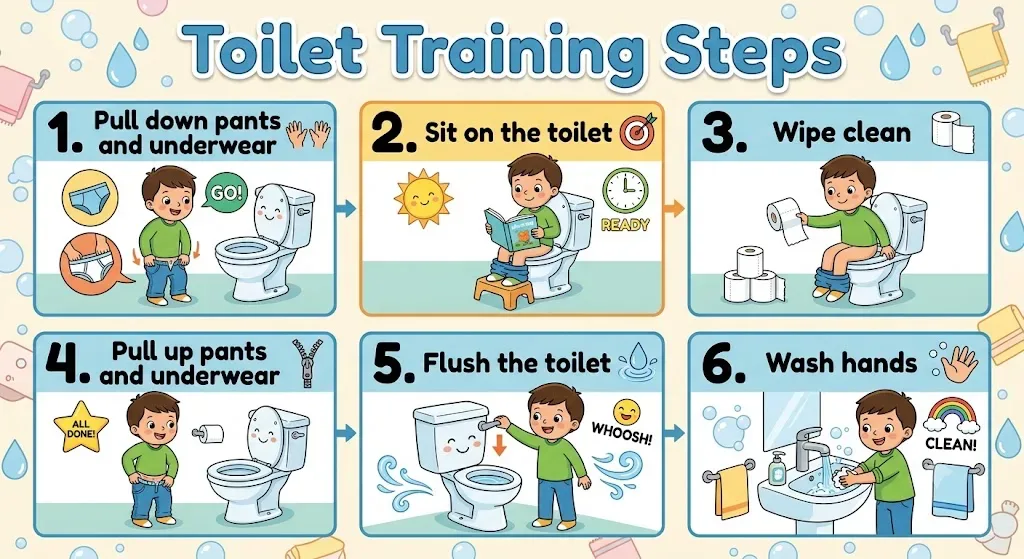
A simple visual sequence for the child's own routine
Handling Accidents
A calm, matter-of-fact response works better than either frustration or an overly dramatic reassurance. Change your child promptly, keep the interaction brief, and return to the scheduled sitting routine right away rather than treating the accident as a major event.
If Your Child Resists Sitting
Build tolerance for sitting on the toilet as its own separate goal before expecting actual toileting success on it.
Fully clothed first
Practice sitting on the closed toilet lid, fully dressed, to build basic comfort with the object itself.
Very short sits
A few seconds at first, paired with something preferred, gradually extended over time.
A consistent, predictable spot
The same toilet, same time of day where possible, reducing unpredictability during an already demanding process.
Frequently Asked Questions
At what age should toilet training start for an autistic child?
There is no single correct age, readiness signs matter more than a specific number. Staying dry for a couple of hours, showing awareness of a wet or soiled diaper, and being able to sit briefly on a toilet are more useful indicators than chronological age alone.
What does research say actually works for autism toilet training?
A well-documented outpatient protocol, based on a modified version of the classic Azrin and Foxx method and evaluated with autistic children, combines a sitting schedule, increased fluids, reinforcement for successful urination, and caregiver involvement from day one. This approach produced full or nearly full independent toileting for the majority of participants studied.
Why does the protocol include increasing fluids?
More fluid intake increases the frequency of urination opportunities during the training period, which means more chances to catch a successful attempt on the toilet and reinforce it, speeding up the learning process.
Should I use a sitting schedule or wait for my child to indicate need?
A scheduled sitting approach, placing your child on the toilet at set intervals, tends to work better in the early stages than waiting for self-initiation, which is a more advanced skill built later once basic toileting success is established.
How do I handle accidents during training?
A calm, matter-of-fact response works better than a strong reaction in either direction. Change the child promptly without extended discussion, and return promptly to the scheduled sitting routine rather than treating the accident as a major setback.
What if my child seems to understand but refuses to sit on the toilet?
Build tolerance for sitting on the toilet, fully clothed at first, as its own separate step before expecting actual toileting success. Short, low-pressure sits paired with a preferred activity or reward can build comfort gradually.
How long does toilet training typically take?
Outcomes vary considerably, but research on intensive outpatient approaches has reported full continence achieved in as little as two weeks for some children, while others require a longer, more gradual process. Consistency matters more than speed.
Should communication training be part of toilet training?
Yes, many effective protocols include teaching a simple, consistent way to request the toilet alongside the physical training, since self-initiated requesting is an important part of full independence.
Not sure if your child is ready for toilet training?
Our free tool helps you build a support profile in a few minutes, a useful starting point before choosing an approach.
Free Sensory Profile & Support Tool for Parents →Sources: DSM-5, WHO ICD-11, LeBlanc, Carr, Crossett, Bennett & Detweiler (2005), Focus on Autism and Other Developmental Disabilities, 20(2), 98-105, Action for Autism India.